Wilson in Ellsworth County, Kansas — The American Midwest (Upper Plains)
World's Largest Czech Egg
Ed & LaVange Shiroky Park
Photographed by James Hulse, June 8, 2022
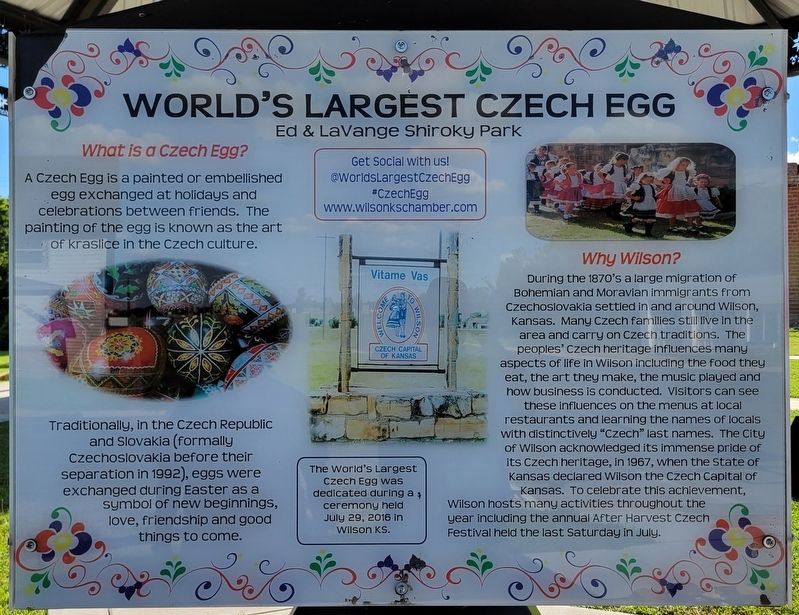
1. World's Largest Czech Egg Marker
Traditionally, in the Czech Republic and Slovakia (formally Czechoslovakia before their separation in 1992), eggs were exchanged during Easter as a symbol of new beginnings, love, friendship and good things to come.
this page online
(2nd Panel)
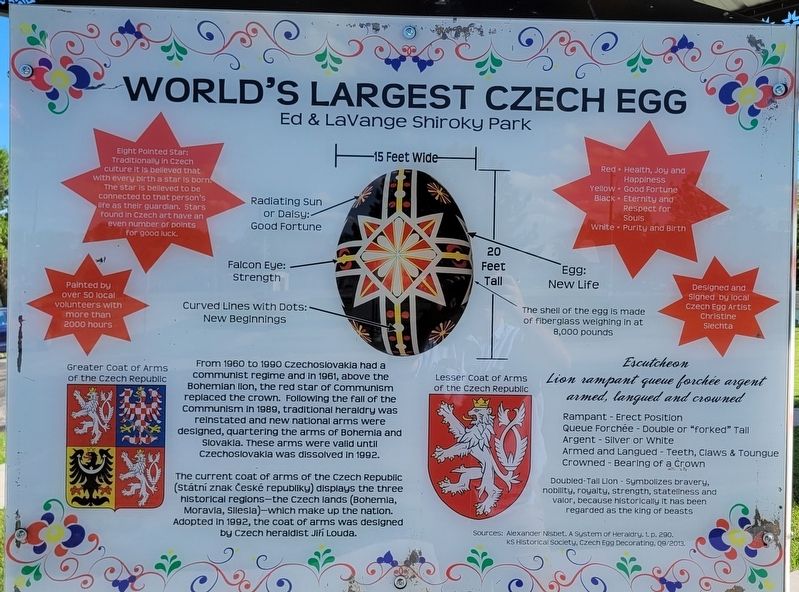
From 1960 to 1990 Czechoslovakia had a communist regime and in 1961, above the Bohemian lion, the red star of Communism replaced the crown. Following the fall of the Communism in 1989, traditional heraldry was reinstated and new national arms were designed, quartering the arms of Bohemia and Slovakia. These arms were valid until Czechoslovakia was dissolved in 1992.
The current coat of arms of the Czech Republic (Státní znak České republiky) displays the three historical regions-the Czech lands (Bohemia, Moravia, Silesia)-which make up the nation. Adopted in 1992, the coat of arms was designed by Czech heraldist Jiří Louda.
Red Star Captions
Upper Left: Eight Pointed Star: Traditionally in Czech culture it is believed that with every birth a star is born. The star is believed to be connected to that person's life as their guardian. Stars found in Czech art have an even number of points for good luck.
Lower Left: Painted by over 50 local volunteers with more than 2000 hours
Upper Right:
Photographed by James Hulse, June 8, 2022
2. 2nd panel - World's Largest Czech Egg Marker
Red = Health, Joy and Happiness
Yellow = Good Fortune
Black = Eternity and Respect for Souls
White = Purity and Birth
Lower Right: Designed and Signed by local Czech Egg Artist Christine Slechta
Lion rampant queue forchée argent
armed, langued and crowned
Queue Forchée - Double or "forked" Tail
Argent - Silver or White
Armed and Langued - Teeth, Claws & Toungue
Crowned - Bearing of a Crown
Doubled-Tail Lion - Symbolizes bravery, nobility, royalty, strength, stateliness and valor, because historically it has been regarded as the king of beasts
Sources: Alexander Nisbet. A System of Heraldry. 1. p. 290. KS Historical Society, Czech Egg Decorating, Q9/2013.
Erected 2016 by Kansas Historical Society.
Topics. This historical marker is listed in these topic lists: Arts, Letters, Music • Immigration • Parks & Recreational Areas. A significant historical year for this entry is 1967.
Location. 38° 49.449′ N, 98° 28.364′ W. Marker is in Wilson, Kansas, in Ellsworth County. It is at the intersection of Avenue D and 27th Street, on the right when traveling south on Avenue D. The
Photographed by James Hulse, June 8, 2022
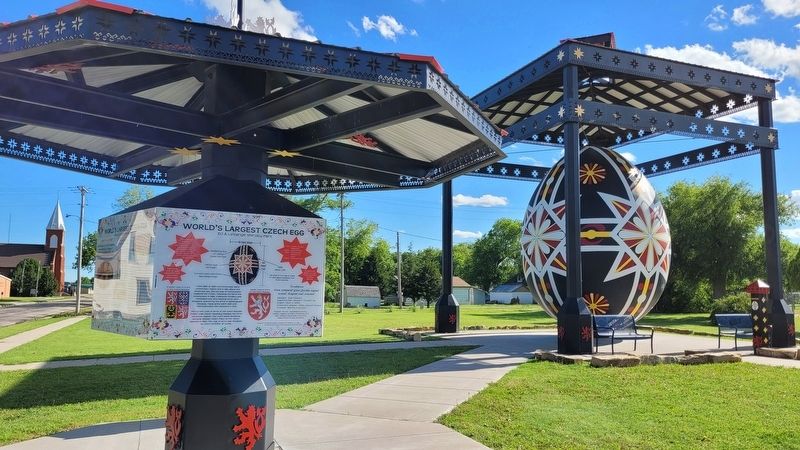
3. The World's Largest Czech Egg and Markers

Regionally, this marker is in Kansas’ Smoky Hills. It is also in the American Midwest, in the Corn Belt, on the prairies, and on the Southern Plains. Globally, it is in North America, the Western Hemisphere, the Western World, and the Anglosphere. Historically, it finds itself in what was once the Louisiana Purchase.
Other nearby markers. At least 8 other markers are within 11 miles of this marker, measured as the crow flies: Czech Capital of Kansas (a few steps from this marker); A Culture Lives On (within shouting distance of this marker); Post Rock Architecture (within shouting distance of this marker); War Memorial (about 500 feet away, measured in a direct line); Geology of Post Rock Country (approx. 1.9 miles away); Building with Limestone (approx. 1.9 miles away); Fenceposts (approx. 1.9 miles away); Post Rock Scenic Byway (approx. 10.1 miles away). Touch for a list and map of all markers in Wilson.
Additional keywords. Czechia
Photographed by James Hulse, June 8, 2022
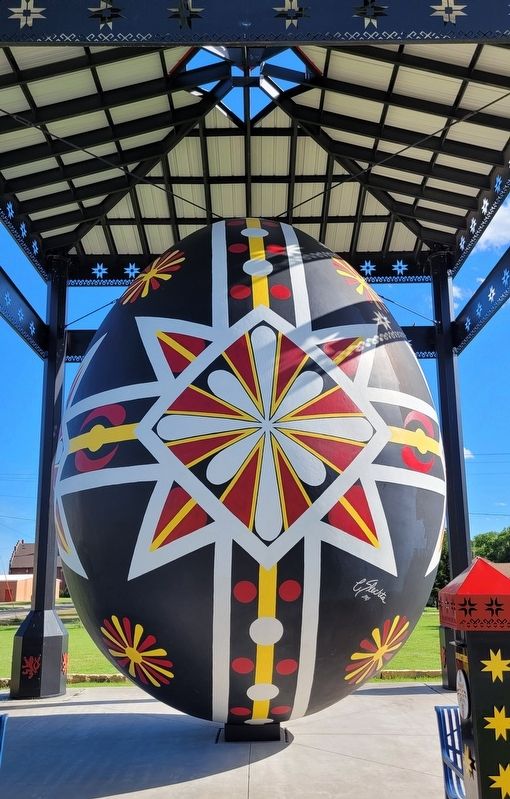
4. Closeup of the World's Largest Czech Egg
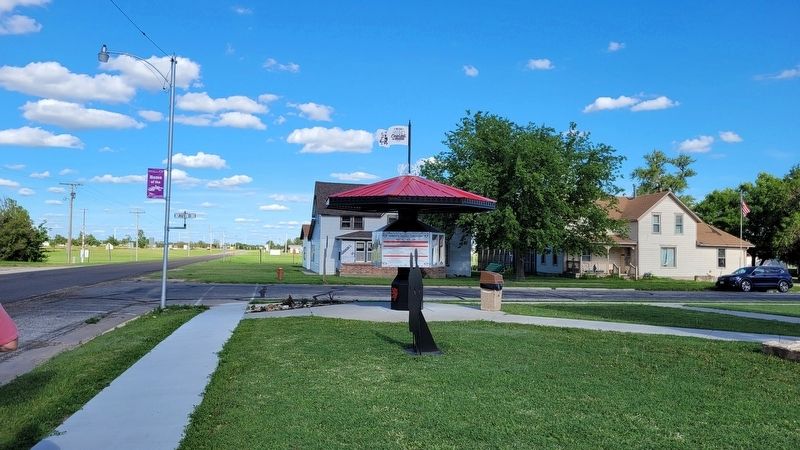
Photographed by James Hulse, June 8, 2022
5. The view of the World's Largest Czech Egg and Markers from the street
Credits. This page was last revised on December 15, 2024. It was originally submitted on June 28, 2022, by James Hulse of Medina, Texas. This page has been viewed 649 times since then and 51 times this year. Photos: 1, 2, 3, 4, 5. submitted on June 28, 2022, by James Hulse of Medina, Texas.
