Pickens in Pickens County, South Carolina — The American South (South Atlantic)
To the Valiant Citizen-Soldiers of Pickens County
Photographed by Brian Scott
1. To the Valiant Citizen-Soldiers of Pickens County Memorial -
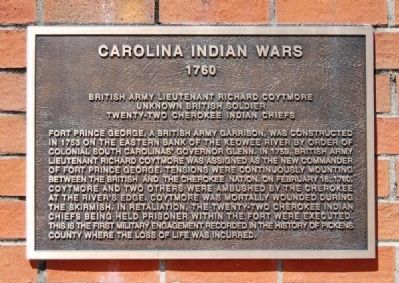
Carolina Indian Wars Plaque
Carolina Indian Wars Plaque
For our future generations, their youth, they gave away, never again to see the land between the Oolenoy River Valley and the Keowee River
Remember always their valor...For they are of us...Pickens...A County That Went to War
1760
British Army Lieutenant Richard Coytmore
Unknown British Soldier
Twenty-two Cherokee Indian Chiefs
this page online
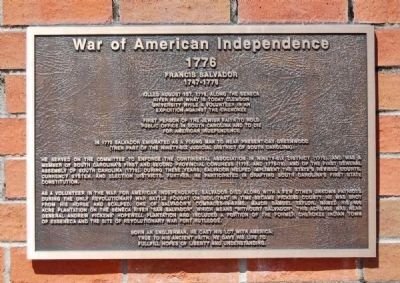
1776
Francis Salvador
1747-1776
Killed August 1st, 1776, along the Seneca
River near what is today Clemson
University while a volunteer in an
expedition against the Cherokee
First person of the Jewish faith to hold
public office in South Carolina and to die
for American independence
In 1773 Salvador emigrated as a young man to near present-day Greenwood
(then part of the Ninety-Six Judicial District of South Carolina)
As a volunteer in the War for American Independence, Salvador died along with a few other unknown patriots during the only Revolutionary War battle fought on soil that in time became
Photographed by Brian Scott, May 29, 2009
2. To the Valiant Citizen-Soldiers of Pickens County Memorial -
War of American Independence Plaque
War of American Independence Plaque
true to his ancient faith, he gave his life to
fulfill hopes of liberty and understanding.
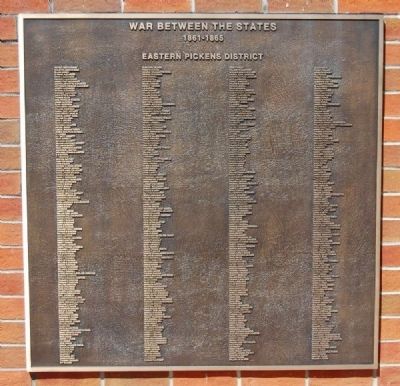
1861-1865
Eastern Pickens District
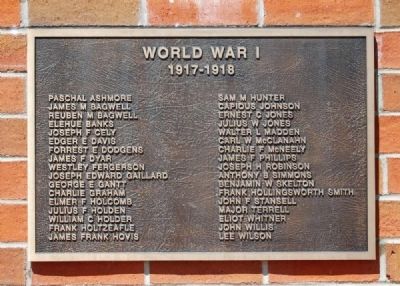
1917-1918
1941-1945
1950-1953
1961-1975
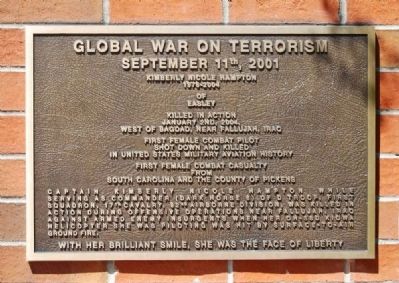
September 11th, 2001
Kimberly Nicole Hampton
1976-2004
of
Easley
Killed in Action
January 2nd, 2004,
west of Baghdad, near Fallujah, Iraq
First female combat pilot
shot down and killed
in United States
Photographed by Brian Scott, May 29, 2009
3. To the Valiant Citizen-Soldiers of Pickens County Memorial -
War Between the States Plaque
War Between the States Plaque
First female combat casualty
from
South Carolina and the County of Pickens
Topics. This memorial is listed in these topic lists: War, 2nd Iraq • War, Korean • War, US Civil • War, Vietnam • War, World I • War, World II • Wars, US Indian.
Location. 34° 52.967′ N, 82° 42.4′ W. Memorial is in Pickens, South Carolina, in Pickens County. It can be reached from Pendleton Street 0.1 miles south of West Main Street. Marker is located near the south entrance of the Pickens County Courthouse. Touch for map. Memorial is in this post office area: Pickens SC 29671, United States of America. Touch for directions.

Regionally, this memorial is in South Carolina’s
Photographed by Brian Scott, May 29, 2009
4. To the Valiant Citizen-Soldiers of Pickens County Memorial -
World War I Plaque
World War I Plaque
Other nearby markers. At least 10 other markers are within walking distance of this marker: General Andrew Pickens Charted the Way (here, next to this marker); Pickens County Buffalo Soldiers (here, next to this marker); Pickens County Congressional Medal of Honor Memorial (here, next to this marker); Major General Andrew Pickens (within shouting distance of this marker); Thomas Joab Mauldin (within shouting distance of this marker); Andrew Pickens (within shouting distance of this marker); John C. Calhoun (within shouting distance of this marker); Gen. Robert E. Lee (within shouting distance of this marker); In Honor of Elinor Knight
Photographed by Brian Scott, May 29, 2009
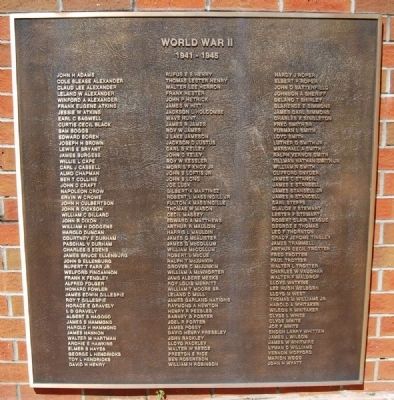
5. To the Valiant Citizen-Soldiers of Pickens County Memorial -
World War II Plaque
World War II Plaque
Also see . . .
1. Trailing Issaqueena. Historians have argued for well over one hundred years about the origin of a local legend in upstate South Carolina, circa 1760, about a young Cherokee woman who made an epic ride from her native village of Keowee to a log fort on the edge of the Carolina frontier, to warn her white lover of an imminent Indian attack. (Submitted on June 20, 2009, by Brian Scott of Anderson, South Carolina.)
2. Fort Prince George (South Carolina). Fort Prince George (not to be confused with Prince's Fort, which was in use in 1777 and also in South Carolina) was constructed in 1753 in northwest South Carolina, on the Cherokee Path. (Submitted on June 20, 2009, by Brian Scott of Anderson, South Carolina.)
3. Francis Salvador. When we think of Jewish heroes of the American Revolution, Haym Salomon, the "financier" of the patriot cause or Isaac Franks, aide-de-camp to General George Washington, are the first names that come to mind. (Submitted on June 20, 2009, by Brian Scott of Anderson, South Carolina.)
4. Francis Salvador.
Photographed by Brian Scott, May 29, 2009
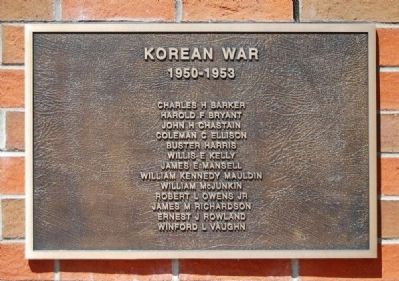
6. To the Valiant Citizen-Soldiers of Pickens County Memorial -
Korean War Plaque
Korean War Plaque
5. Kimberly Hampton. Captain Kimberly Nicole Hampton (August 18, 1976 in Greenville, South Carolina – January 2, 2004 in Fallujah, Iraq) was the first female military pilot to be shot down and killed in United States history. (Submitted on June 20, 2009, by Brian Scott of Anderson, South Carolina.)
Photographed by Brian Scott, May 29, 2009
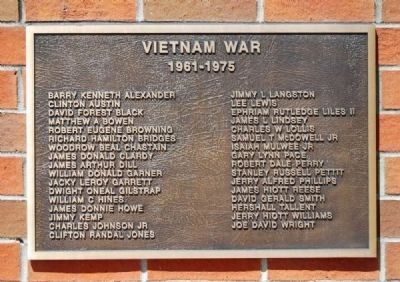
7. To the Valiant Citizen-Soldiers of Pickens County Memorial -
Vietnam War Plaque
Vietnam War Plaque
Photographed by Brian Scott, May 29, 2009
8. To the Valiant Citizen-Soldiers of Pickens County Memorial -
Global War on Terrorism Plaque
Global War on Terrorism Plaque
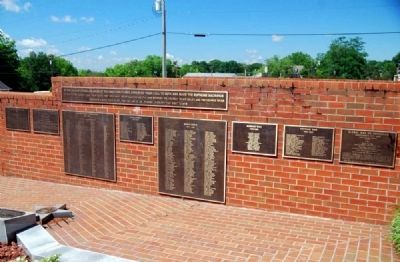
Photographed by Brian Scott, May 29, 2009
9. To the Valiant Citizen-Soldiers of Pickens County Memorial
Credits. This page was last revised on November 23, 2020. It was originally submitted on June 20, 2009, by Brian Scott of Anderson, South Carolina. This page has been viewed 2,368 times since then and 99 times this year. Photos: 1, 2, 3, 4, 5, 6, 7, 8, 9. submitted on June 20, 2009, by Brian Scott of Anderson, South Carolina.
