Avondale in Cincinnati in Hamilton County, Ohio — The American Midwest (Great Lakes)
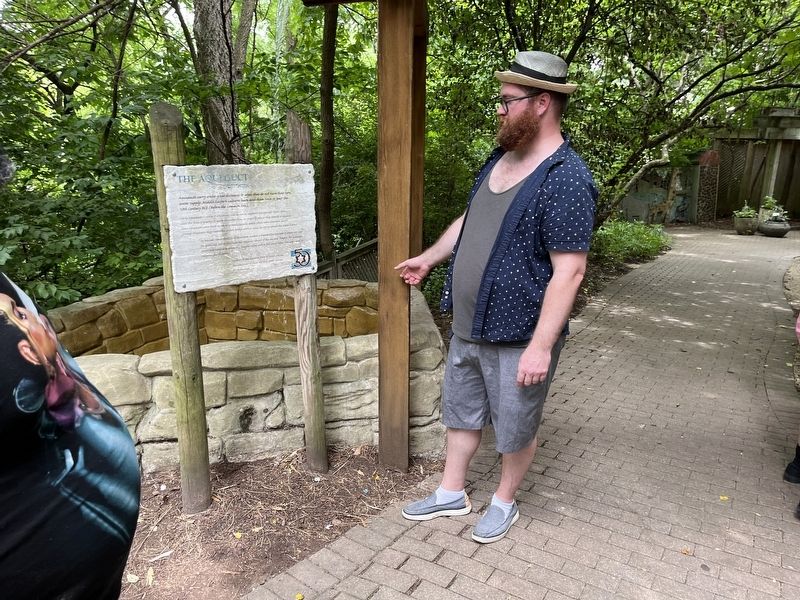
The Aqueduct
אקוודוקט

Aqueducts carry water great distances to areas that do not have their own water supply. Middle Eastern cultures have used them since at least the 10th Century BCE (Before the Common Era).
Early aqueducts — some of which are still in use in southern Europe and North Africa — used the force of gravity to move the water from its source to places that needed irrigation. Some aqueducts were built as underground tunnels, which others were elevated, above-ground structures that resembled a thin bridge with a canal on top in which the water flowed.
In ancient times, the City of Jerusalem needed a tremendous amount of water not only for drinking, but to facilitate the religious rituals of the ancient Temple. For example, water was needed to clean the Temple's altar and to fill ritual baths that were used for religious purification.
Visitors to the modern State of Israel can see the remnants of these ancient water systems for themselves.
Erected by Cincinnati Zoo and Botanical Garden.
Topics. This historical marker is listed in these topic lists: Anthropology & Archaeology • Natural Resources • Religion & Religious Structures
this page online
Location. 39° 8.739′ N, 84° 30.396′ W. Marker is in Cincinnati, Ohio, in Hamilton County. It is in Avondale. It can be reached from Vine Street north of Erkenbrecher Avenue, on the right when traveling north. Touch for map. Marker is at or near this postal address: 3489 Dury Ave, Cincinnati OH 45229, United States of America. Touch for directions.

Regionally, this marker is in the American Midwest and in the Ohio River Valley. Globally, it is in North America, the Western Hemisphere, the Western World, and the Anglosphere. Historically, it finds itself in what was once the Haudenosaunee (Iroquois) Confederacy, the territory of the Mississippian Culture, and the Northwest Territory.
Other nearby markers. At least 8 other markers are within walking distance of this marker: Roman Period (here, next to this marker); Hellenistic Peirod (here, next to this marker); Byzantine Period (here, next to this marker); Persian Period (here, next to this marker); Iron Age (here, next to this marker); Bronze Age (here, next to this marker); Omayyad or Early Arab Period
Credits. This page was last revised on February 4, 2023. It was originally submitted on July 2, 2022, by Devry Becker Jones of Washington, District of Columbia. This page has been viewed 420 times since then and 28 times this year. Photos: 1, 2. submitted on July 2, 2022, by Devry Becker Jones of Washington, District of Columbia.
