Smithsonian National Zoo in Northwest Washington in Washington, District of Columbia — The American Northeast (Mid-Atlantic)
Ostrich
Struthio camelus
| — | Weight 220-350 lb (100-160 kg) | — |
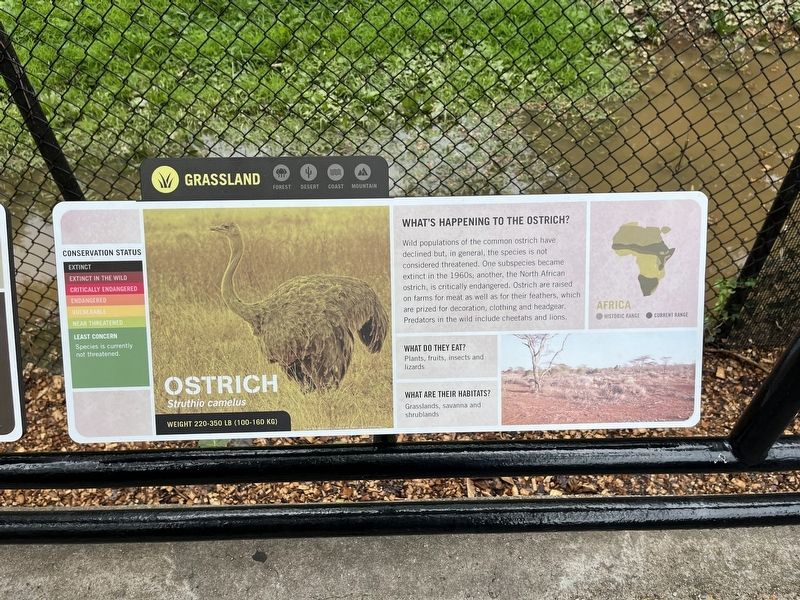
Conservation Status
Least Concern: Species is currently not threatened.
What's Happening to the Ostrich?
Wild populations of the common ostrich have declined but, in general, the species is not considered threatened. One subspecies became extinct in the 1960s; another, the North African ostrich, is critically endangered. Ostrich are raised on farms for meat as well as for their feathers, which are prized for decoration, clothing and headgear. Predators in the wild include cheetahs and lions.
What Do They Eat?
Plants, fruits, insects and lizards
What are their habitats?
Grasslands, savanna and shrublands
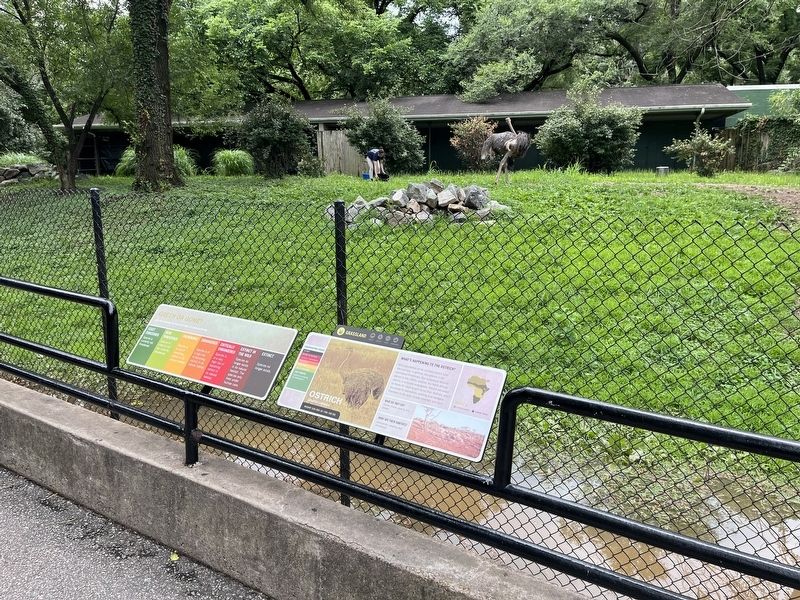
Erected by Smithsonian Institution.
Topics. This historical marker is listed in these topic lists: Agriculture • Animals • Environment • Industry & Commerce.
Location. 38° 55.911′ N, 77° 3.204′ W. Marker is in Northwest Washington in Washington, District of Columbia. It is in Smithsonian National Zoo. It can be reached from Olmsted Walk east of Connecticut Avenue Northwest, on the left when traveling east. Touch for map. Marker is
this page online

Regionally, this marker is in the Washington Metropolitan Area. It is also in the American Northeast, in the Upper South, in the Mid-Atlantic, in the Tidewater, and in the Chesapeake Bay Region. Globally, it is in North America, the Western Hemisphere, the Western World, and the Anglosphere.
Other nearby markers. At least 8 other markers are within walking distance of this marker: The Scoop on Poop (within shouting distance of this marker); From Collecting to Breeding (within shouting distance of this marker); Last Chance (about 300 feet away, measured in a direct line); Bison and the Land (about 300 feet away); And Then There Were (Almost) None (about 300 feet away); Bison and the National Zoo (about 300 feet away); Are They Bison or Buffalo? (about 300 feet away); Meet Our Bison (about 300 feet away). Touch for a list and map of all markers in Northwest Washington.
Credits. This page was last revised on January 30, 2023. It was originally submitted on July 3, 2022, by Devry Becker Jones of Washington, District of Columbia. This page has been viewed 213 times since then and 8 times this year. Photos: 1, 2. submitted on July 3, 2022, by Devry Becker Jones of Washington, District of Columbia.
