Monroe in Monroe County, Michigan — The American Midwest (Great Lakes)
George Armstong Custer
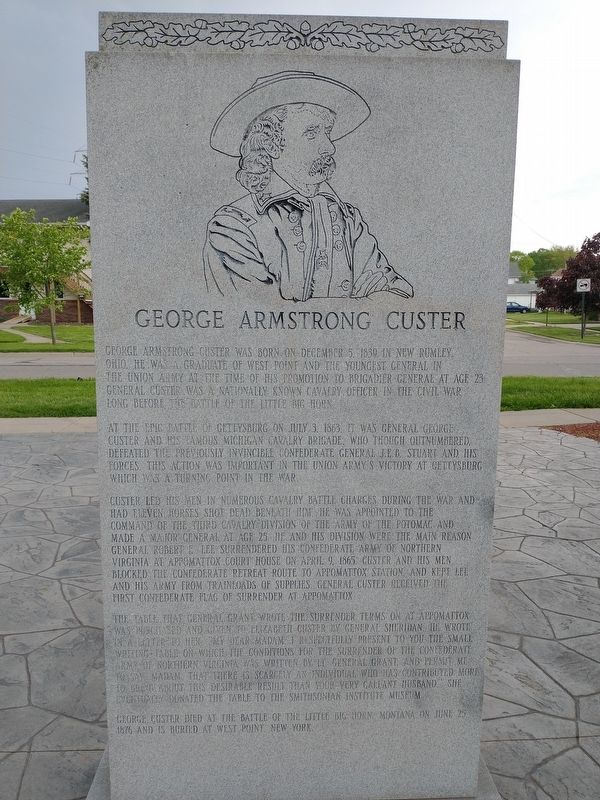
Photographed by Craig Doda, May 21, 2022
1. George Armstong Custer Marker
At the epic Battle of Gettysburg on July 3, 1863, it was General George Custer and his famous Michigan Cavalry Brigade, who though outnumbered, defeated the previously invincible Confederate general J.E.B. Stuart and his forces. This action was important in the Union army's victory at Gettysburg which was a turning point in the war.
Custer led his men in numerous cavalry battle charges during the war and had eleven horses shot dead beneath him. He was appointed to the command of the third cavalry division of the army of the Potomac and made a major general at age 25. He and his division were the main reason General Robert E. Lee surrendered his Confederate army of northern Virginia at Appomattox Court House on April 9, 1865. Custer and his men blocked the Confederate retreat route
this page online
The table that General Grant wrote the surrender terms on at Appomattox was purchased and given to Elizabeth Custer by General Sheridan. He wrote in a letter to her My dear madam, I respectfully present to you the small writing table on which the conditions for the surrender of the Confederate army of northern Virginia was written by Lt. General Grant and permit me to say madam that there is scarcely an individual who has contributed more to bring about this desirable result than your very gallant husband. She eventually donated the table to the Smithsonian Institute Museum.
George Custer died at the Battle of the Little Big Horn, Montana on June 25, 1876 and is buried at West Point, New York.
Topics. This historical marker is listed in this topic list: War, US Civil. A significant day of the year for for this entry is May 31.
Location. 41° 54.866′ N, 83° 23.37′ W. Marker is in Monroe, Michigan, in Monroe County. It is at the intersection of East Front Street and Navarre Street,
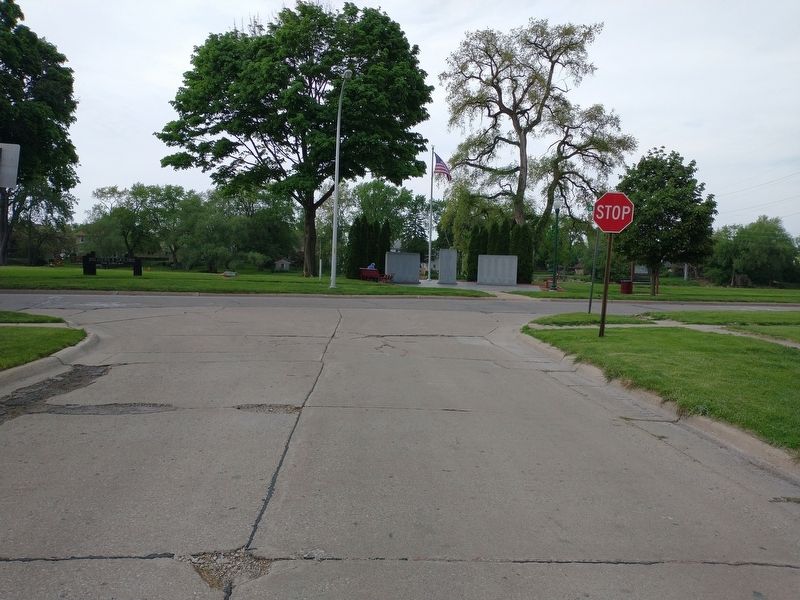
Photographed by Craig Doda, May 21, 2022
2. George Armstong Custer Marker

Regionally, this marker is in Southeast Michigan and in Greater Detroit. It is also in the American Midwest. Globally, it is in North America, on the Great Lakes, in the Western Hemisphere, in the Western World, and in the Anglosphere. Historically, it finds itself in what was once the Northwest Territory.
Other nearby markers. At least 8 other markers are within walking distance of this marker: Monroe County Civil War Memorial (here, next to this marker); Norman Jonathan Hall (here, next to this marker); Monroe County Civil War Fallen Soldiers Memorial (here, next to this marker); Thomas Ward Custer (here, next to this marker); Joyce Kilmer (a few steps from this marker); Monroe County and the Civil War / Grand Army of the Republic (a few steps from this marker); River Raisin Heritage Trail System (a few steps from this marker); Joseph R. Smith Post No. 76 G.A.R. (a few steps from this marker). Touch for a list and map of all markers in Monroe.
Also see . . . George Armstrong Custer.

Photographed by George L. Andrews, circa 1865
3. George Armstong Custer
George Armstrong Custer (December 5, 1839 – June 25, 1876) was a United States Army officer and cavalry commander in the American Civil War and the American Indian Wars.(Submitted on May 8, 2025, by J.T. Lambrou of New Boston, Michigan.)
Custer graduated from the United States Military Academy at West Point, New York, last in his graduating class of 1861, although he finished 34th out of a starting class of 108 candidates. Nonetheless, Custer achieved a higher military rank than any other U.S. Army officer in his class. Following graduation, he worked closely with future Union Army Generals George B. McClellan and Alfred Pleasonton, both of whom recognized his abilities as a cavalry leader. He was promoted in the early American Civil War (1861–1865), to brevet brigadier general of volunteers when only aged 23. Only a few days afterwards, he fought at the pivotal Battle of Gettysburg in Pennsylvania in early July 1863, where he commanded the Michigan Brigade. Despite being outnumbered, the new General Custer defeated Confederate States Army cavalry of General J. E. B. Stuart's attack at East Cavalry Field on the crucial third day of the Gettysburg clash.
Credits. This page was last revised on May 12, 2025. It was originally submitted on July 7, 2022, by Craig Doda of Napoleon, Ohio. This page has been viewed 393 times since then and 41 times this year. Photos: 1, 2. submitted on July 7, 2022, by Craig Doda of Napoleon, Ohio. 3. submitted on May 8, 2025, by J.T. Lambrou of New Boston, Michigan. • J. Makali Bruton was the editor who published this page.
