Ocala in Marion County, Florida — The American South (South Atlantic)
It was a Hard Life at Fort King
Fort King National Historic Landmark
Photographed by Brandon D Cross, July 4, 2022
1. It was a hard life at Fort King Marker
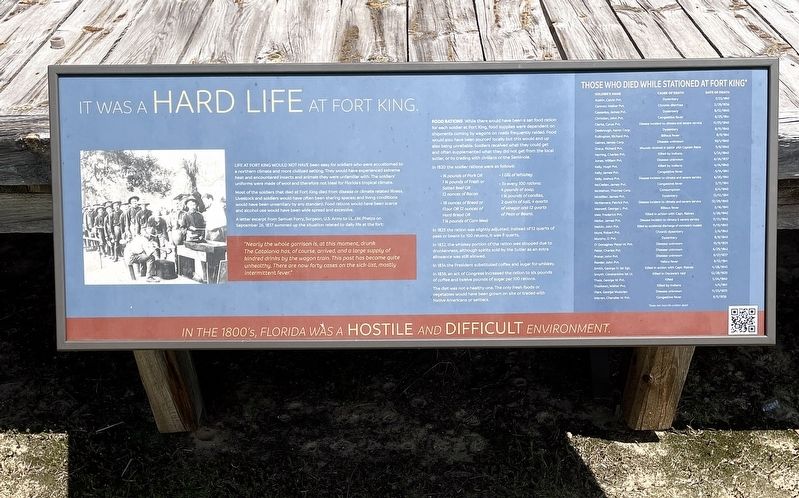
Most of the soldiers that died at Fort King died from disease or climate related illness. Livestock and soldiers would have often been sharing spaces; and living conditions would have been unsanitary by any standard. Food rations would have been scarce and alcohol use would have been wide spread and excessive.
A letter excerpt from Samuel Forry, Surgeon, U.S. Army to LT. J.W. Phillips on September 26, 1837 summed up the situation related to daily life at the fort:
“Nearly the whole garrison is, at this moment, drunk. The Catalonia has, of course, arrived, and a large supply of kindred drinks by the wagon train. This post has become quite unhealthy. There are now forty cases on the sick-list, mostly intermittent fever.”
Food Rations While there would have been a set food ration for each soldier
this page online
In 1820 the soldier rations were as fellows:
• ¾ pounds of pork Or 1 ¼ pounds of Fresh or Salted beef Or 12 ounces of Bacon
• 18 ounces of Bread or Flour Or 12 ounces of hard bread Or 1 ¼ pounds of Corn Meal
• 1 Gill of Whiskey
• To every 100 rations: 4 pounds of soap, 1 ¼ pounds of candles, 2 quarts of salt, 4 quarts of vinegar and 12 quarts of Peas or Beans.
In 1825 the ration was slightly adjusted; instead of 12 quarts of peas or beans to 100 rations, it was 8 quarts.
In 1832, the whiskey portion of the ration was stopped due to drunkenness, although spirits sold by the Sutler as an extra allowance was still allowed.
In 1834, the President substituted coffee and sugar for whiskey.
In 1838, an act of Congress increased the ration to six pounds of coffee and twelve pounds of sugar

Photographed by Brandon D Cross, July 4, 2022
2. It was a hard life at Fort King Marker
The diet was not a healthy one. The only fresh foods or vegetables would have been grown on site or traded with Native Americans or settlers.
Soldiers Name; Cause of Death; Date of Death
Austin, Calvin Pvt.; Dysentery; 7/23/1841 • Cannon, Walter Pvt.; Chronic diarrhea; 2/29/1836 • Cassidy, James Pvt.; Dysentery; 8/12/1840 • Christian, John Pvt.; Congestive fever; 8/9/1841 • Clarke, Cyrus Pvt.; Disease incident to climate and severe service; 11/25/1840 • Desbrough, Aaron Corp.; Dysentery; 8/11/1840 • Fullington, Richard Pvt.; Bilious fever; 8/9/1841 • Gaines, James Corp.; Disease unknown; 10/1/1840 • Grace, Richard Pvt.; Wounds received in battle with Captain Rains; 5/9/1840; • Herring, Charles Pvt.; Killed by Indians; 4/14/1840 • Jones, William Pvt.; Disease unknown; 6/24/1837 • Kelly, Hugh Pvt.; Killed by Indians; 4/14/1840 • Kelly, James Pvt.; Congestive fever; 5/14/1841; • Kelly, Joshua Pvt.; Disease incident to climate and severe service; 6/20/1841 • McCellan, Thomas Corp.; Congestive fever; 2/11/1841 • McMahon, Thomas Corp.; Consumption; 6/4/1840 • McMillen, James Pvt.; Dysentery; 12/12/1841 • McNamara, Patrick Pvt.; Disease incident to climate and severe service; 12/29/1840 • Maxwell, George L. Pvt.; Bilious fever; 2/16/1841 • Meir, Frederick Pvt.; Killed in action with Captain Raines; 4/28/1840 • Mellor, James Pvt.; Disease incident to climate & severe service; 11/21/1840 • Melvin, John Pvt.; Killed by accidental discharge of comrade’s musket; 11/15/1840 • Mure, Robert Pvt.; Chronic dysentery; 2/6/1842 • Murphy, D Pvt.; Dysentery; 8/9/1840 • O’Donaghey, Peter W. Pvt.; Disease unknown; 10/9/1835 • Peter, Charles Pvt.; Disease unknown; 6/29/1842 • Prater, John Pvt.; Disease unknown; 9/27/1837 • Reeder, John Pvt.; Yellow fever; 8/12/1841 • Smith, George H. 1st SGT.; Killed in action with Capt. Raines; 4/28/1840 • Smyth, Constantine 1st Lt.; Killed in Osceola’s raid; 12/28/1835 • Theis, George W. Pvt.; Killed; 3/24/1840 • Thomson, Walter Pvt.; Killed by Indians; 4/4/1841 • Viars, George Musician; Disease unknown; 11/23/1835 • Warren, Chandler M. Pvt.; Congestive fever; 8/5/1838
*Does not include civilian dead
Erected by Florida Department of State/Division of Historical Resources.
Topics. This historical marker is listed in these topic lists: Forts and Castles • Indigenous Peoples and Communities • Settlements & Settlers • Wars, US Indian. A significant historical date for this entry is September 26, 1837.
Location. 29° 11.246′ N, 82° 4.98′ W. Marker is in Ocala, Florida, in Marion County. It can be reached from the intersection of East Fort King Street and SE 39th Avenue, on the left when traveling east. Marker is located on the grounds of the Fort King National Historic Landmark. Touch for map. Marker is at or near this postal address: 3925 E Fort King St, Ocala FL 34470, United States of America. Touch for directions.

Regionally, this marker is in the American South. Globally, it is in the North Atlantic Region, North America, a Gulf of Mexico state, the Western Hemisphere, the Western World, and the Anglosphere. Historically, it finds itself in what was once New Spain, the territory of the Mississippian Culture, one of the Confederate States of America, and the Antebellum South.
Other nearby markers. At least 8 other markers are within walking distance of this marker: Attack on Fort King (a few steps from this marker); The U.S. Army on the frontier (a few steps from this marker); Dade Massacre (a few steps from this marker); Treaty of Payne’s Landing (within shouting distance of this marker); The Treaty of Moultrie Creek (within shouting distance of this marker); The Seminole War (within shouting distance of this marker); Fort King Road (within shouting distance of this marker); The Second Seminole War / The Third Seminole War (within shouting distance of this marker). Touch for a list and map of all markers in Ocala.
Also see . . . Fort King National Historic Landmark. (Submitted on July 11, 2022, by Brandon D Cross of Flagler Beach, Florida.)
Credits. This page was last revised on July 11, 2022. It was originally submitted on July 11, 2022, by Brandon D Cross of Flagler Beach, Florida. This page has been viewed 477 times since then and 32 times this year. Photos: 1, 2. submitted on July 11, 2022, by Brandon D Cross of Flagler Beach, Florida. • Bernard Fisher was the editor who published this page.
