Laredo in Webb County, Texas — The American South (West South Central)
El Primer Congreso Mexicanista
(The First Mexican Congress)
Photographed by James Hulse, July 29, 2022
1. El Primer Congreso Mexicanista Marker
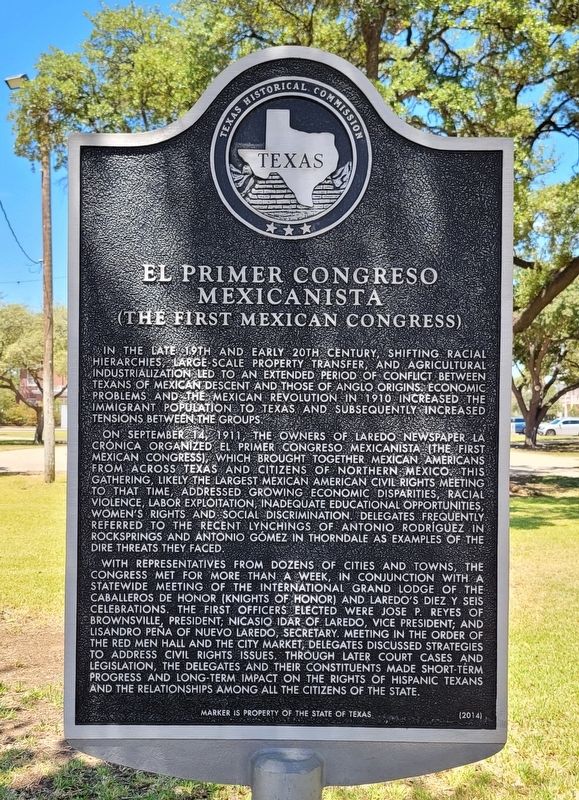
In the late 19th and early 20th century, shifting racial hierarchies, large-scale property transfer, and agricultural industrialization led to an extended period of conflict between Texans of Mexican descent and those of Anglo origins. Economic problems and the Mexican Revolution in 1910 increased the immigrant population to Texas and subsequently increased tensions between the groups.
On September 14 1911, the owners of Laredo newspaper La Crónica organized El Primer Congreso Mexicanista (The First Mexican Congress), which brought together Mexican Americans from across Texas and citizens of northern Mexico. This gathering, likely the largest Mexican American Civil Rights meeting to that time, addressed growing economic disparities, racial violence, labor exploitation, inadequate educational opportunities, women's rights and social discrimination. Delegates frequently referred to the recent lynchings of Antonio Rodríguez in Rocksprings and Antonio Gómez in Thorndale as examples of the dire threats they faced.
With representatives from dozens of cities and towns, the congress met for more than a week, in conjunction
this page online
Erected 2014 by Texas Historical Commission. (Marker Number 18153.)
Topics. This historical marker is listed in these topic lists: Civil Rights • Fraternal or Sororal Organizations • Hispanic Americans • Women. A significant historical date for this entry is September 14, 1911.
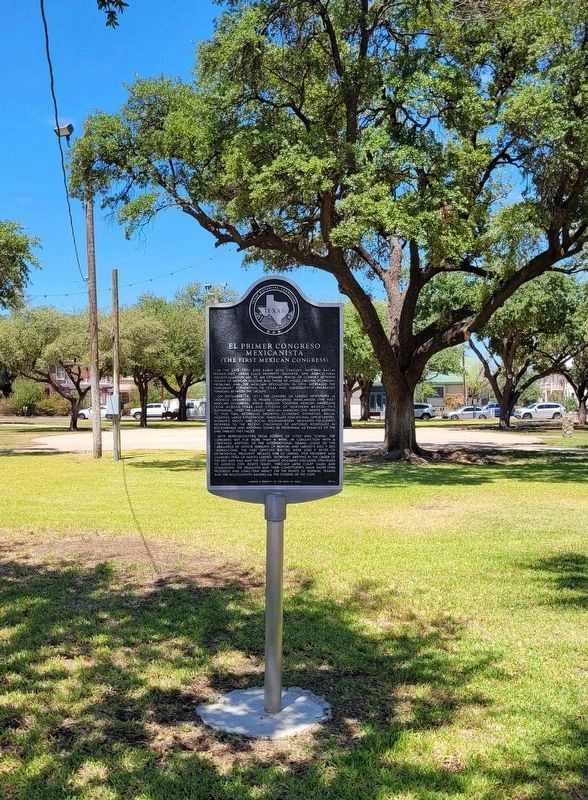
Location. 27° 30.409′ N, 99° 30.691′ W. Marker is in Laredo, Texas, in Webb County. It is at the intersection of Davis Avenue and Houston Street, on the left when traveling north on Davis Avenue. The marker is located at the
Photographed by James Hulse, July 29, 2022
2. El Primer Congreso Mexicanista Marker in Saint Peter’s Plaza

Regionally, this marker is in South Texas. It is also in the American Borderlands. Globally, it is in North America, a Gulf of Mexico state, the Western Hemisphere, the Western World, and the Anglosphere. Historically, it finds itself in what was once New Spain, the Republic of Texas, and one of the Confederate States of America.
Other nearby markers. At least 8 other markers are within walking distance of this marker: Jovita Idar (within shouting distance of this marker); Saint Peter the Apostle Catholic Church (about 300 feet away, measured in a direct line); United States Post Office and Courthouse (approx. 0.2 miles away); Laredo Vietnam War Honor Roll (approx. 0.2 miles away); Laredo World War I Memorial (approx. 0.2 miles away); Holding Institute (Laredo Seminary) (approx. 0.2 miles away); Laredo World War II and Korean Conflict Memorial (approx. 0.2 miles away); Gold Star Mothers & Families (approx. 0.2 miles away). Touch for a list and map of all markers
Photographed by James Hulse, July 29, 2022
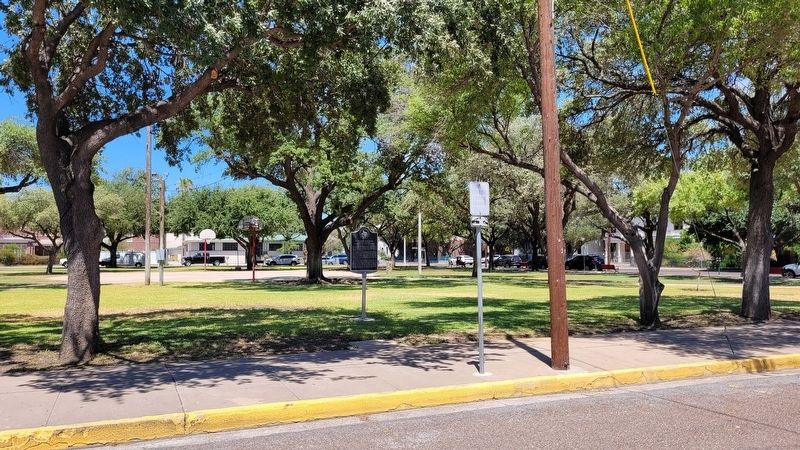
3. The view of the El Primer Congreso Mexicanista Marker from across the street
Also see . . . Congreso Mexicanista. Texas State Historical Association
The Congreso Mexicanista, sometimes referred to as El Primer Congreso Mexicanista, met in Laredo from September 14 to 22, 1911. Clemente Idar, whose family owned and published La Crónica, proposed the meeting to organize the Gran Liga Mexicanista de Beneficencia y Protección (Great Mexican League for Benefit and Protection) to advance education, culture, and civil rights for Mexican Americans. The Idars invited the OCH (Orden Caballeros de Honor), members of lodges and sociedades mutualistas, all Mexican consuls in the state, and Texas-Mexican journalists. They also issued a special invitation to women from the region, including Nuevo Laredo, Tamaulipas.(Submitted on August 1, 2022, by James Hulse of Medina, Texas.)
Credits. This page was last revised on June 4, 2024. It was originally submitted on July 31, 2022, by James Hulse of Medina, Texas. This page has been viewed 1,331 times since then and 155 times this year. Photos: 1, 2, 3. submitted on August 1, 2022, by James Hulse of Medina, Texas.
