Uptown District in Columbus in Franklin County, Ohio — The American Midwest (Great Lakes)
The Ohio Holocaust and Liberators Memorial
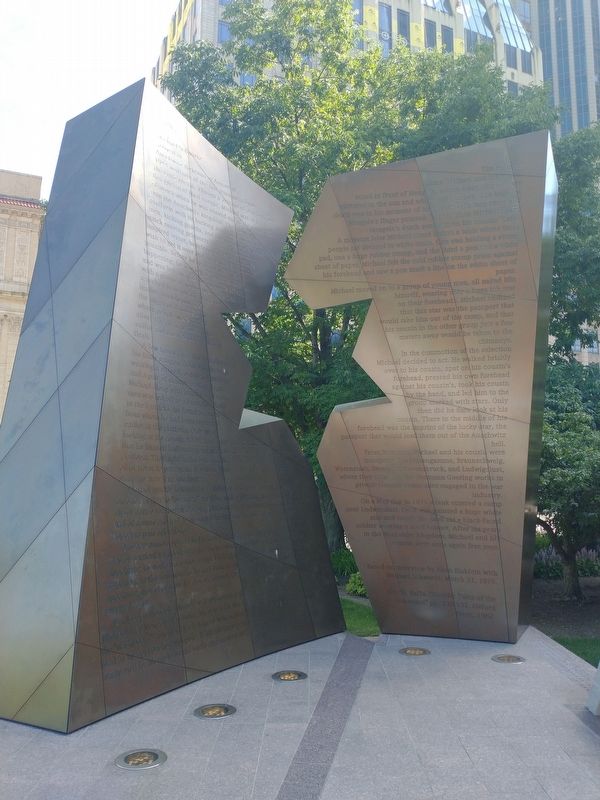
Photographed by Craig Doda, June 24, 2022
1. Star Marker
In remembrance of the six million Jews who perished in the Holocaust and millions more including Prisoners of War, ethnic and religious minorities, free masons, homosexuals, the mentally ill, developmentally disabled, and political dissidents who suffered under Nazi Germany.
Inspired by the Ohio soldiers who were part of the American Liberation and survivors who made Ohio their home
If you save one life, it is as if you saved the world
"Every human being who chooses to remember this chapter of history and to infuse it with meaning is thereby choosing to struggle for the preservation of the bedrock moral values that alone make possible the existence of a well ordered society.
This is a commitment to uphold human rights, above all, freedom and the sanctity of life, and the opportunity for people to live side by side in harmony."
-Avner Shalev
Stars
Michael Schwartz arrived in Auschwitz-Birkenau in August of 1944 with one of the last transports from the Lodz ghetto. Though a veteran of this first and last ghetto of Nazi Europ, Michael was in a state of shock when he was shoved out of the cattle
this page online
A few hours later, his hair shaven, his body stinging from disinfectants, wearing a striped, oversized uniform and a pair of skimpy broken clogs, Michael along with hundreds of young men was led off to a barracks. There in the barracks, he found a cousin from whom he had been separated earlier at the platform. Only after looking at his cousin did Michael realize the transformation that he himself had undergone since his arrival on that accused platform. That night in the barracks the cousins promised each other never to part again.
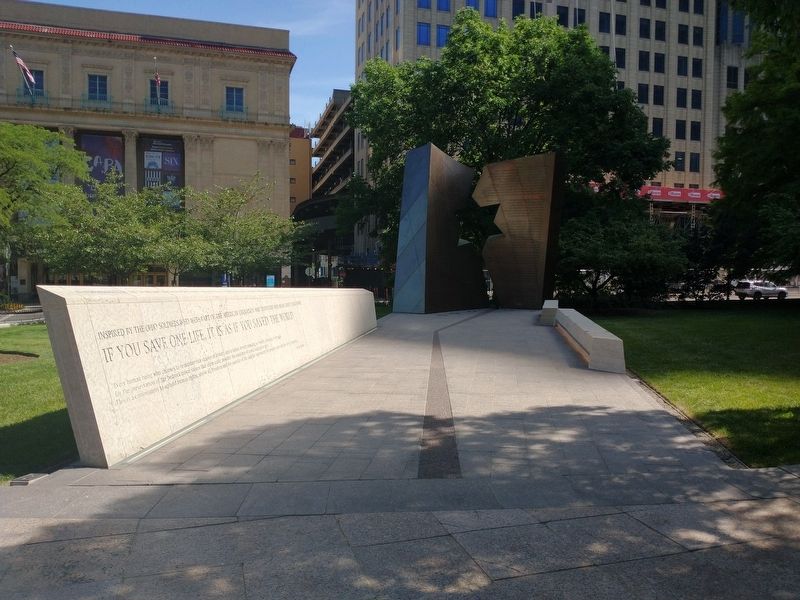
Photographed by Craig Doda, June 24, 2022
2. Star Marker
Michael quickly learned the realities of Auschwitz. Survival depended on one's ability to "organize" anything and everything, from an additional sip of coffee to a better sleeping place on the three-tiered wooden beds and of course one had to present a healthy and useful appearance if one hoped to pass selections.
One day rumors spread in Michael's barracks that the impending selecting was of particular importance, for those selected would be transferred to Auschwitz to work at another camp. Michael was especially anxious to ? selection. In the few months he had been in Auschwitz he had learned that Auschwitz would eventually devour everybody, even those who deciphered us survival code.
Dr. Joseph Mengele himself was supervising the selection. It was apparent to Michael that Mengele was using what was known amung the Auschwitz old miners as the "washboard" criterion. Each inmate was ordered to lift his hands high above his head as he approched Mengele. If his rib cage protruded and each vertebra was clearly visible, Mengele would smile and motion with his snow-white glove to the left.
The moment came, Michael and his cousin stood in front of Mengele, whose clean, shaven face glittered in the sun and whose eyes shown. The angel of death was in his moment of bliss. Michael's turn came and Mengele's finger pointed: "Right!" Then Michael heard Mengele's death sentence on his cousin: "Left!" A moment later Michael stood before a table where three people sat dressed in white coats. One was holding a stamp pad, one a huge rubber stamp, and the third a pen and a white sheet of paper. Michael felt the cold rubber stamp press against his forehead and saw a pen mark a line on the white sheet of paper.
Michael moved on to a group of young men, all marked like himself, wearing only a huge ink star on their foreheads. Michael realized that this star was the passport that would take him out of the camp just as a few meters away would be taken to the chimney.
In the commotion of the selection Michael decided to act. He walked briskly over to his cousin, spat on his cousin's forehead, pressed his own forehead against his cousin's, took his cousin by the hand, and led him to the group marked with stars. Only then did he dare look at his cousin. There in the middle of his forehead was the imprint of the lucky star, the passport that would lead them out of the Auschwitz hell.
From Birkenau, Michael and his cousin were transported to Neuengamme, Braunschweig, Watenstadt, Beendorf, Ravensbruck, and Ludwigslust, where they slaved in the Hermann Goering works in private German companies engaged in the war industry.
On May day in 1945 a tank entered a camp near Ludwigslust. On it was painted a huge white star and inside the tank sat a black-faced soldier wearing a steel helmet. After six years in the Nazi slave kingdom, Michael and his cousin were once again free men.
Based on interview by Ellen Blakfein with Michael Schwartz, March 31, 1979.
Eliach, Yaffa. "Hasidic Tales of the Holocaust" pp. 130-132. Oxford Press, 1982.
Topics and series. This memorial is listed in these topic lists: Civil Rights • Law Enforcement • War, World II. In addition, it is included in the The Holocaust series list. A significant historical date for this entry is March 31, 1979.
Location. 39° 57.63′ N, 82° 59.961′ W. Memorial is in Columbus, Ohio, in Franklin County. It is in the Uptown District. It is on East State Street east of South High Street, on the left when traveling east. Touch for map. Memorial is in this post office area: Columbus OH 43215, United States of America. Touch for directions.

Regionally, this memorial is in the Scioto Valley. It is also in the American Midwest and in the Corn Belt. Globally, it is in North America, the Western Hemisphere, the Western World, and the Anglosphere. Historically, it finds itself in what was once the Haudenosaunee (Iroquois) Confederacy, the territory of the Mississippian Culture, and the Northwest Territory.
Other nearby markers. At least 8 other markers are within walking distance of this marker: Columbus Monument (within shouting distance of this marker); Theodore Roosevelt Memorial Oak (within shouting distance of this marker); Columbus City Hall (within shouting distance of this marker); The Ohio Theatre (within shouting distance of this marker); United Mine Workers of America (within shouting distance of this marker); The Spirit of ’98 (within shouting distance of this marker); The State House (within shouting distance of this marker); Ohio in the Civil War / Defending Ohio (within shouting distance of this marker). Touch for a list and map of all markers in Columbus.
Additional keywords. LGBT, LGBTQ, 🏳️🌈
Credits. This page was last revised on November 22, 2024. It was originally submitted on August 15, 2022, by Craig Doda of Napoleon, Ohio. This page has been viewed 263 times since then and 35 times this year. Photos: 1, 2. submitted on August 15, 2022, by Craig Doda of Napoleon, Ohio. • Devry Becker Jones was the editor who published this page.
