Coshocton in Coshocton County, Ohio — The American Midwest (Great Lakes)
Lynching in America
⎯⎯⎯
The Lynching of Henry Howard
Community Remembrance Project
Photographed by Craig Doda, September 3, 2022
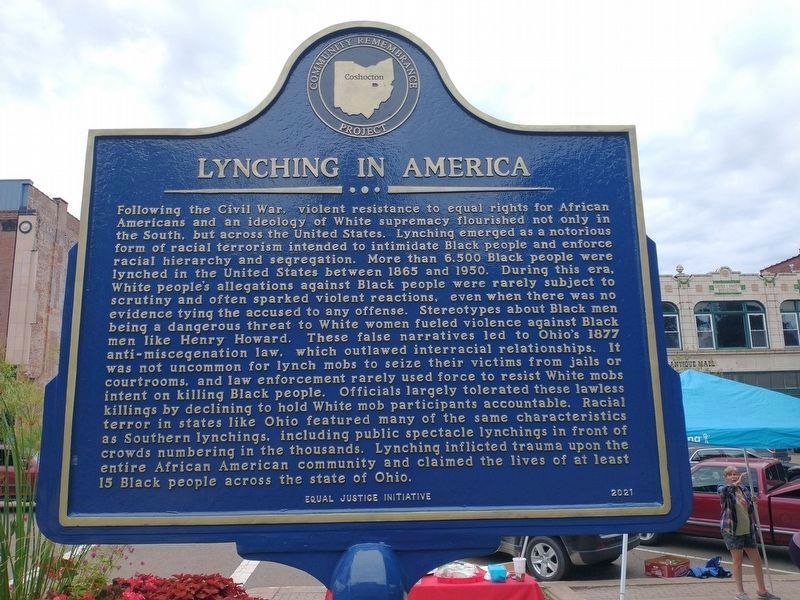
1. Lynching In America marker
Lynching in America. Following the Civil War, violent resistance to equal rights for African Americans and an ideology of White supremacy flourished not only in the South, but across the United States. Lynching emerged as a notorious form of racial terrorism intended to intimidate Black people and enforce racial hierarchy and segregation. More than 6.500 Black people were lynched in the United States between 1865 and 1950. During this era, White people's allegations against Black people were rarely subject to scrutiny and often sparked violent reactions. even when there was no evidence tying the accused to any offense. Stereotypes about Black men being a dangerous threat to White women fueled violence against Black men like Henry Howard. These false narratives led to Ohio's 1877 anti-miscegenation law. which outlawed interracial relationships. It was not uncommon for lynch mobs to seize their victims from jails or courtrooms, and law enforcement rarely used force to resist White mobs intent on killing Black people. Officials largely tolerated these lawless killings by declining to hold White mob participants accountable.
this page online
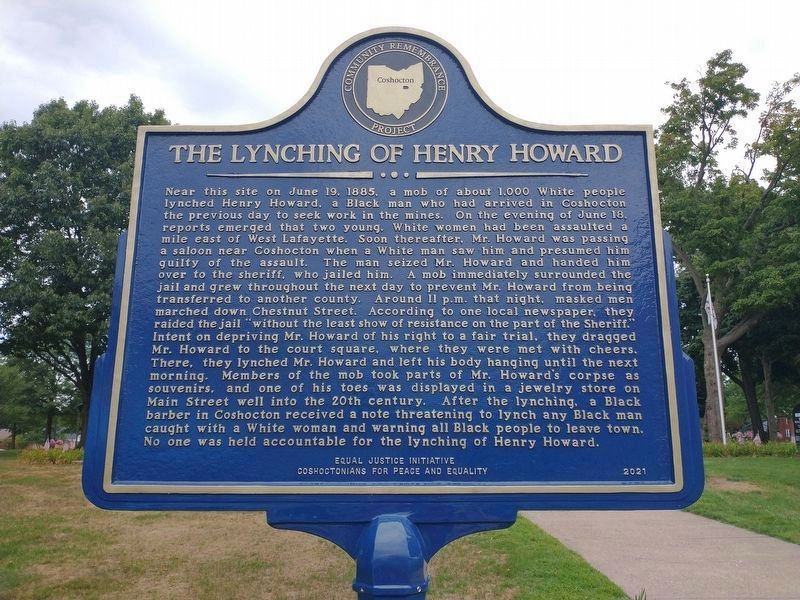
The Lynching of Henry Howard. Near this site on June 19, 1885. a mob of about 1.000 White people lynched Henry Howard, a Black man who had arrived in Coshocton the previous day to seek work in the mines. On the evening of June 18, reports emerged that two young. White women had been assaulted a mile east of West Lafayette. Soon thereafter, Mr. Howard was passing a saloon near Coshocton when a White man saw him and presumed him guilty of the assault. The man seized Mr. Howard and handed him over to the sheriff, who jailed him. A mob immediately surrounded the jail and grew throughout the next day to prevent Mr. Howard from being transferred to another county. Around II p.m. that night, masked men marched down Chestnut Street. According to one local newspaper, they raided the jail "without the least show of resistance
Photographed by Craig Doda, September 3, 2022
2. The Lynching Of Henry Howard marker
Erected 2021 by Equil Justice Initiative / Coshocton For Peace And Equality.
Topics and series. This historical marker is listed in these topic lists: African Americans • Civil Rights • Law Enforcement. In addition, it is included in the Lynching in America series list. A significant historical date for this entry is June 19, 1885.
Location. 40° 16.428′ N, 81° 51.971′ W. Marker is in Coshocton, Ohio, in Coshocton County. It is on Main Street east of North 3rd Street (Ohio Route 541), on the right when

Photographed by Craig Doda, September 3, 2022
3. Coshocton County Courthouse

Regionally, this marker is in Amish Country. It is also in the American Midwest, in Appalachia, and specifically in Northern Appalachia. Globally, it is in North America, the Western Hemisphere, the Western World, and the Anglosphere. Historically, it finds itself in what was once the Haudenosaunee (Iroquois) Confederacy, the territory of the Mississippian Culture, and the Northwest Territory.
Other nearby markers. At least 8 other markers are within walking distance of this marker: Congressional Medal of Honor Recipients (a few steps from this marker); Coshocton County War Memorial (within shouting distance of this marker); Coshocton County Korean War Memorial (within shouting distance of this marker); Coshocton County Vietnam War Memorial (within shouting distance of this marker); The Coshocton County Courthouse (within shouting distance of this marker); William Green (within shouting distance of this marker); Rotary Bicentennial Gazebo (within shouting distance of

Photographed by Brandon D Cross, June 14, 2024
4. The Lynching of Henry Howard Marker
“A Replica marker of one side is located at the Equal Justice Initiatives' National Memorial for Peace and Justice in Montgomery, Alabama. The Equal Justice Initiative supports efforts to locally memorialize documented victims of racial violence and to educate communities about the history of racial injustice.” Mark Hilton
Credits. This page was last revised on October 23, 2024. It was originally submitted on September 9, 2022, by Craig Doda of Napoleon, Ohio. This page has been viewed 1,367 times since then and 111 times this year. Photos: 1, 2, 3. submitted on September 9, 2022, by Craig Doda of Napoleon, Ohio. 4. submitted on October 16, 2024, by Brandon D Cross of Flagler Beach, Florida. • Devry Becker Jones was the editor who published this page.
