
Marquette in Marquette County, Michigan — The American Midwest (Great Lakes)
Jacques Marquette
Photographed by Cosmos Mariner, September 6, 2022
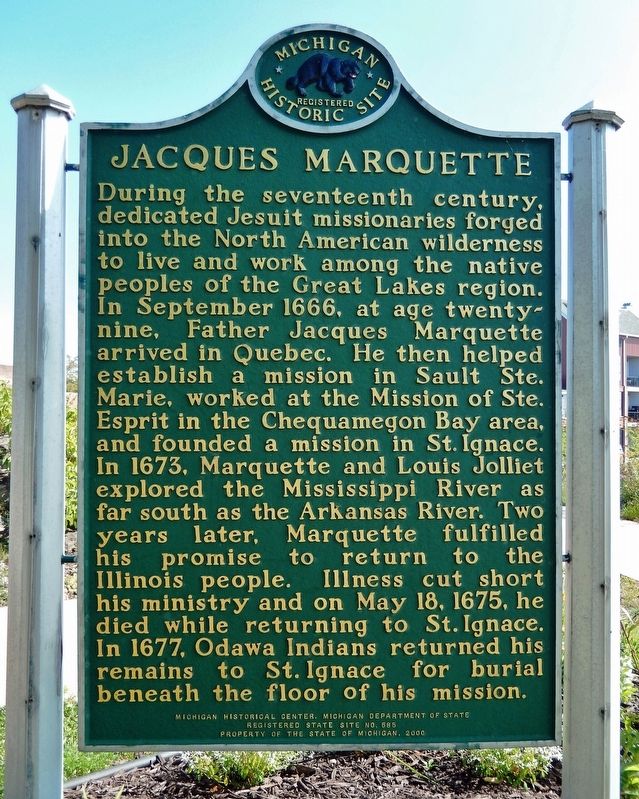
1. Jacques Marquette Marker
During the seventeenth century, dedicated Jesuit missionaries forged into the North American wilderness to live and work among the native peoples of the Great Lakes region. In September 1666, at age twenty-nine, Father Jacques Marquette arrived in Quebec. He then helped establish a mission in Sault Ste. Marie, worked at the Mission of Ste. Esprit in the Chequamegon Bay area, and founded a mission in St. Ignace. In 1673 Marquette and Louis Jolliet explored the Mississippi River as far south as the Arkansas River. Two years later Marquette fulfilled his promise to return to the Illinois people. Illness cut short his ministry and on May 18, 1675, he died while returning to St. Ignace. In 1677 Odawa Indians returned his remains to St. Ignace for burial beneath the floor of his mission.
Erected 2000 by Michigan Historical Center, Michigan Department of State. (Marker Number S585C.)
Topics and series. This historical marker is listed in these topic lists: Colonial Era • Exploration • Indigenous Peoples and Communities • Religion & Religious Structures. In addition, it is included in the Michigan Historical Commission
this page online
Location. 46° 32.397′ N, 87° 23.612′ W. Marker is in Marquette, Michigan, in Marquette County. It can be reached from South Front Street just south of East Baraga Avenue, on the left when traveling south. Marker and Jacques Marquette monument are located at the center of Father Jacques Marquette Park. Touch for map. Marker is at or near this postal address: 501 South Front Street, Marquette MI 49855, United States of America. Touch for directions.

Regionally, this marker is on Michigan’s Upper Peninsula. It is also in the American Midwest and on Lake Superior’s South Shore Region. Globally, it is in North America, in the Great North Woods, on the Great Lakes, in the Western Hemisphere, in the Western World, and in the Anglosphere. Historically, it finds itself in what was once the Viceroyalty of New France and also the Northwest Territory.
Other nearby markers. At least 8 other markers are within walking distance of this marker: Lake Superior Art Association (a few steps from this marker); Lower Harbor Ore Dock (about 700 feet away, measured in a direct line);
Photographed by Cosmos Mariner, September 6, 2022
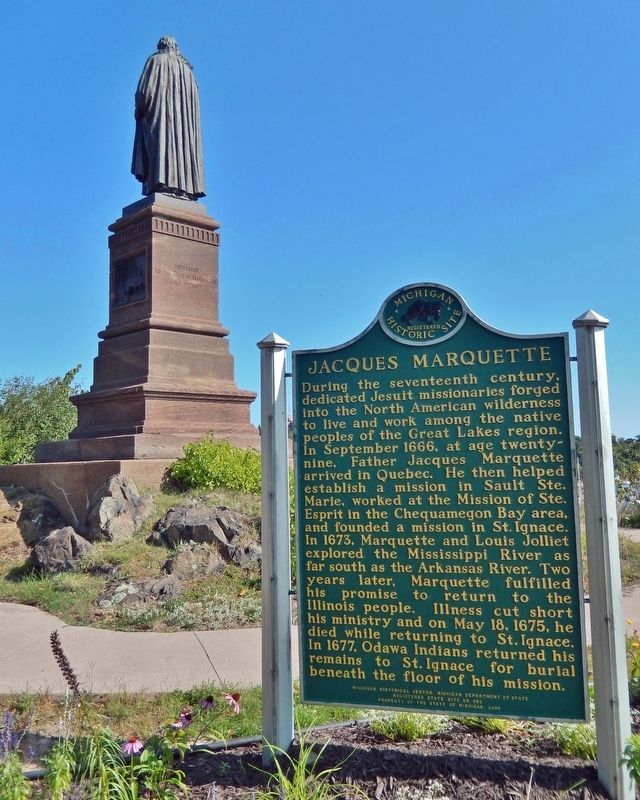
2. Jacques Marquette Marker
More about this marker. Both sides of this marker have the same inscription.
Also see . . .
1. Jacques Marquette – Missionary Explorer.
Jacques Marquette, sometimes known as Père Marquette or James Marquette, was a French Jesuit missionary and explorer who founded Michigan’s first European settlement, Sault Ste. Marie, and later founded St. Ignace, Michigan. In 1673 Father Marquette and Louis Jolliet were the first Europeans to explore and map the northern portion of the Mississippi River.(Submitted on September 14, 2022, by Cosmos Mariner of Cape Canaveral, Florida.)
2. Jacques Marquette – Jesuit explorer.
In mid-May 1673 he left St. Ignace with Jolliet, who had been commissioned by Louis, comte de Frontenac, governor of New France, to find the direction and(Submitted on September 14, 2022, by Cosmos Mariner of Cape Canaveral, Florida.)the mouth of the Mississippi. They travelled westward to Green Bay (now in Wisconsin), ascended the Fox River to a portage that crossed to the Wisconsin River, and entered the Mississippi near Prairie du Chien on June 17. Following it to the mouth of the Arkansas River, they learned that the Mississippi flowed through hostile Spanish domains, and in mid-July they turned homeward by way of the Illinois River.Photographed by Cosmos Mariner, September 6, 20223. Jacques Marquette Marker(looking southwest • South Front Street & Rock Street intersection in background)
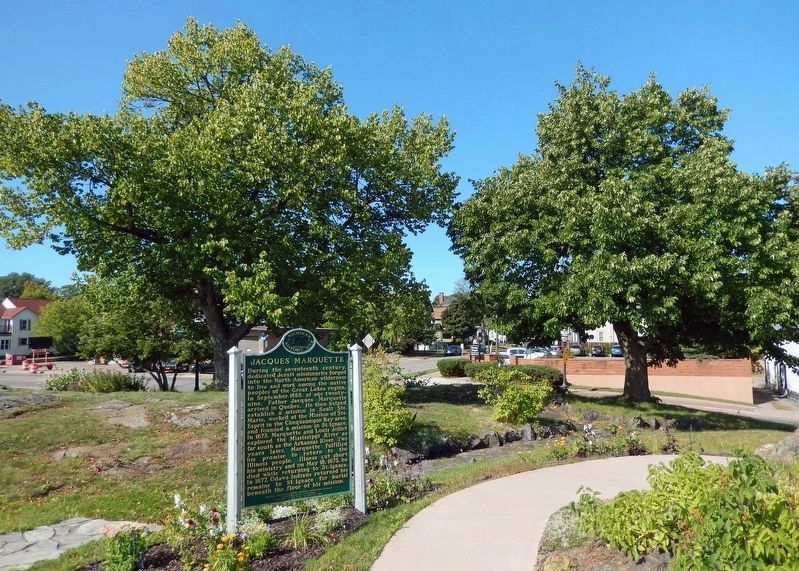
3. Jacques Marquette.
In the spring of 1675, Marquette traveled westward and celebrated a public Mass at the Grand Village of the Illinois near Starved Rock. A bout of dysentery he had contracted during the Mississippi expedition sapped his health. On the return trip to Saint Ignace, he died at 37 years of age near the modern town of Ludington, Michigan. After his death, natives from the Illinois Confederation returned his bones to the chapel at Mission Saint-Ignace.(Submitted on September 14, 2022, by Cosmos Mariner of Cape Canaveral, Florida.)
Photographed by Cosmos Mariner, September 6, 2022
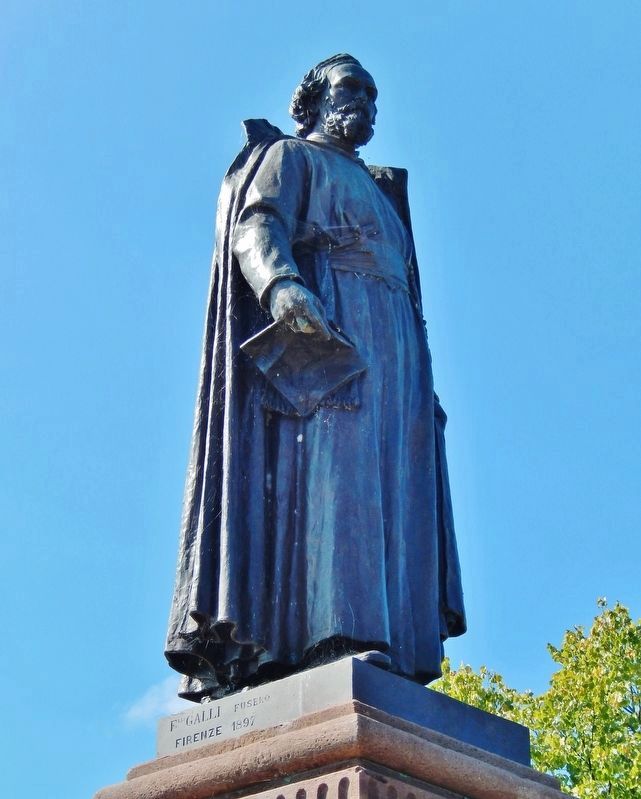
4. Jacques Marquette Statue (adjacent to marker)
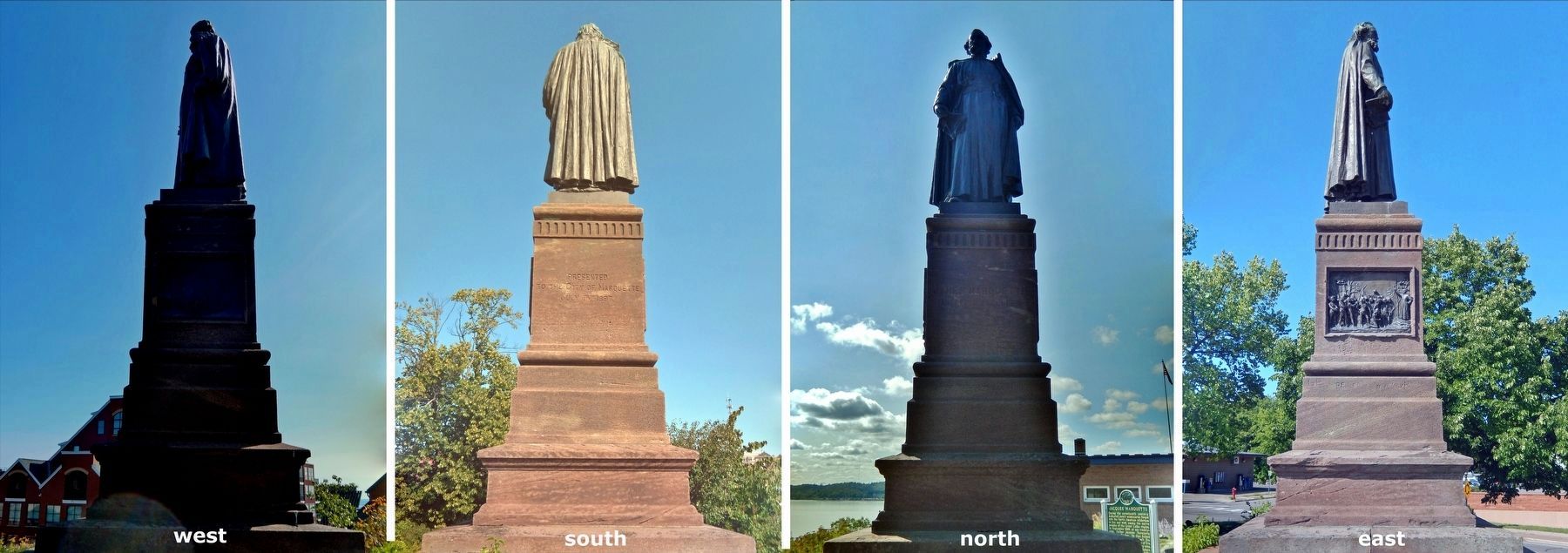
Photographed by Cosmos Mariner, September 6, 2022
5. Jacques Marquette Monument (adjacent to marker)

Photographed by Cosmos Mariner, September 6, 2022
6. Jacques Marquette Monument (detail)
Presented
to the City of Marquette,
July 1897.
[north]
James Marquette,
Intrepid Explorer.
Credits. This page was last revised on September 14, 2022. It was originally submitted on September 14, 2022, by Cosmos Mariner of Cape Canaveral, Florida. This page has been viewed 792 times since then and 75 times this year. Photos: 1, 2, 3, 4, 5, 6. submitted on September 14, 2022, by Cosmos Mariner of Cape Canaveral, Florida.
