Downtown in Tampa in Hillsborough County, Florida — The American South (South Atlantic)
Lynching in America ⎯⎯⎯ The Lynching of Robert Johnson
Community Remembrance Project
Photographed by Tim Fillmon, September 14, 2022
1. Lynching in America marker
Inscription.
Lynching in America
Between 1877 and 1950, thousands of African-Americans were the victims of lynching and racial violence in the United States. Florida had one of the highest per-capita rates of Black victims lynched by white mobs, including five known lynchings in Hillsborough County: Galloway (1892), John Crooms (1893), Lewis Jackson (1903), Samuel Arline (1912) and Robert Johnson (1934). Racial terror lynching was designed to instill fear into the Black community in order to maintain the racial hierarchy of white supremacy. It was not uncommon for law enforcement to hand Black people over to lynchers often without any show of force and indifferent to their legal duty to protect people in their custody. The racial caste system of the era diminished the value of Black life and empowered any white person to act as police, judge, jury, and executioner. This campaign of intimidation was aided by juries and public officials who granted impunity to white lynchers. Government officials frequently condoned or were indifferent to lynch mob violence. Many encouraged it. As a result, racial terror lynching plagued Florida and
Click or scan to see this page online
devastated African-American communities for decades, and many African-American families fled the South to Northern communities as refugees of racial terror. Although the number of documented lynchings is very likely an undercount of the total number of lynchings, at least 319 victims of racial terror lynching were killed in Florida.
The Lynching of Robert Johnson
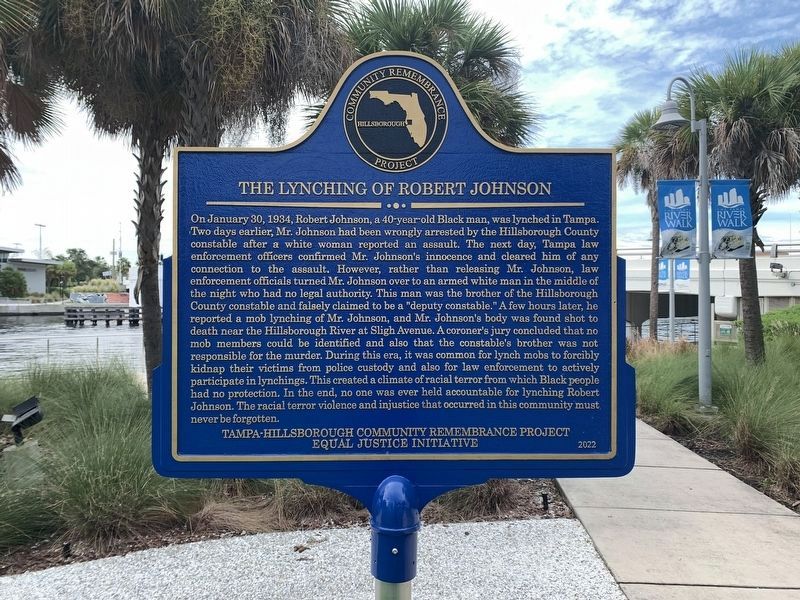
On January 30, 1934, Robert Johnson, a 40-year-old Black man, was lynched in Tampa. Two days earlier, Mr. Johnson had been wrongly arrested by the Hillsborough County constable after a white woman reported an assault. The next day, Tampa law enforcement officers confirmed Mr. Johnson's innocence and cleared him of any connection to the assault. However, rather than releasing Mr. Johnson, law enforcement officials turned Mr. Johnson over to an armed white man in the middle of the night who had no legal authority. This man was the brother of the Hillsborough County constable and falsely claimed to be a "deputy constable." A few hours later, he reported a mob lynching of Mr. Johnson, and Mr. Johnson's body was found shot to death near the Hillsborough River at Sligh Avenue.
Photographed by Tim Fillmon, September 14, 2022
2. The Lynching of Robert Johnson marker
A coroner's jury concluded that no mob members could be identified and also that the constable's brother was not responsible for the murder. During this era, it was common for lynch mobs to forcibly kidnap their victims from police custody and also for law enforcement to actively participate in lynchings. This created a climate of racial terror from which Black people had no protection. In the end, no one was ever held accountable for lynching Robert Johnson. The racial terror violence and injustice that occurred in this community must never be forgotten.
Erected 2022 by Tampa-Hillsborough Community Remembrance Project-Equal Justice Initiative.
Topics and series. This historical marker is listed in these topic lists: African Americans • Civil Rights • Law Enforcement. In addition, it is included in the Lynching in America series list. A significant historical date for this entry is January 30, 1934.
Location. 27° 57.251′ N, 82° 27.853′ W. Marker is in Tampa, Florida, in Hillsborough County. It is in Downtown. It is at the intersection of Doyle Carlton Drive and West Laurel Street, on the right when traveling south on Doyle Carlton
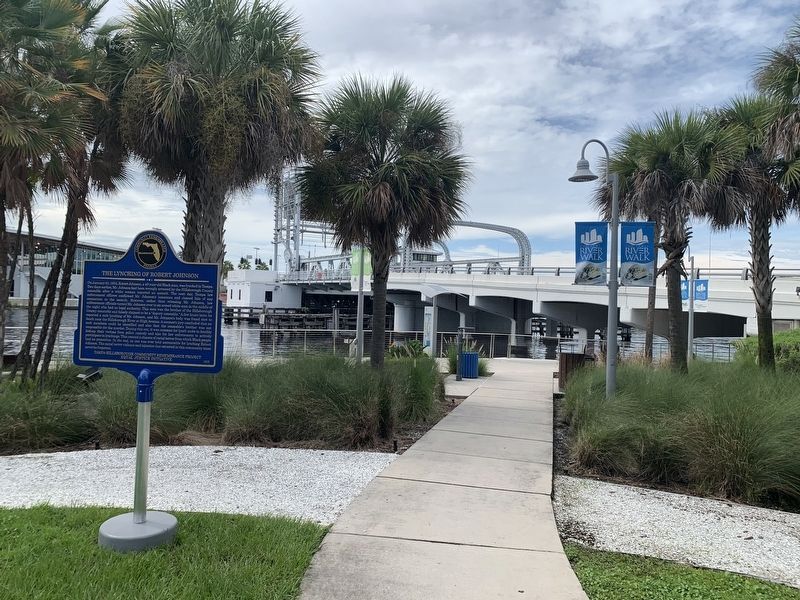
Photographed by Tim Fillmon, September 14, 2022
3. The Lynching of Robert Johnson / Lynching in America Marker
Regionally, this marker is on Florida’s Tampa Bay. It is also in the American South and on the Gulf Coast. Globally, it is in the North Atlantic Region, North America, a Gulf of Mexico state, the Western Hemisphere, the Western World, and the Anglosphere. Historically, it finds itself in what was once New Spain, the territory of the Mississippian Culture, one of the Confederate States of America, and the Antebellum South.
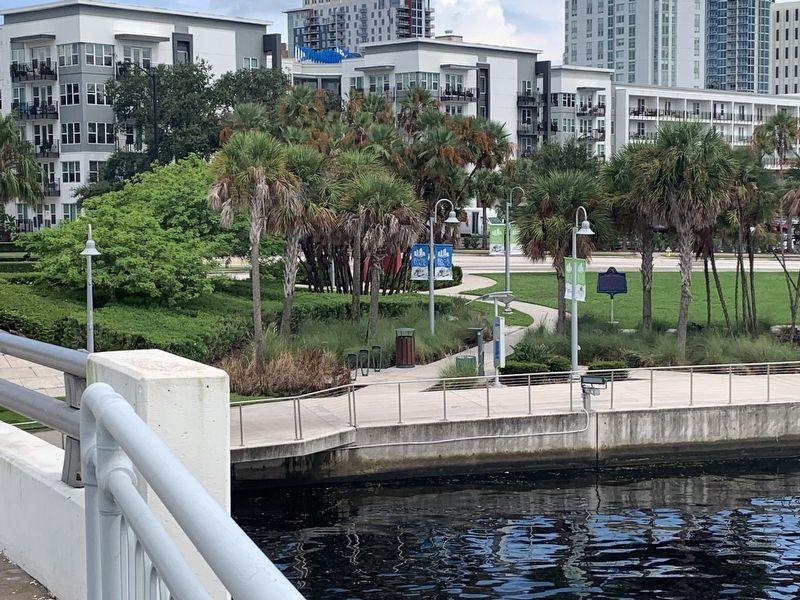
4. The Lynching of Robert Johnson / Lynching in America Marker
Shot from the Madame Fortune Taylor Bridge
(Submitted on September 18, 2022, by Tim Fillmon of Webster, Florida.)
Credits. This page was last revised on July 28, 2024. It was originally submitted on September 18, 2022, by Tim Fillmon of Webster, Florida. This page has been viewed 1,402 times since then and 83 times this year. Photos:1, 2, 3, 4. submitted on September 18, 2022, by Tim Fillmon of Webster, Florida.