Charlestown in Clark County, Indiana — The American Midwest (Great Lakes)
Ohio River: the Human Story
Photographed by Duane and Tracy Marsteller, September 24, 2022
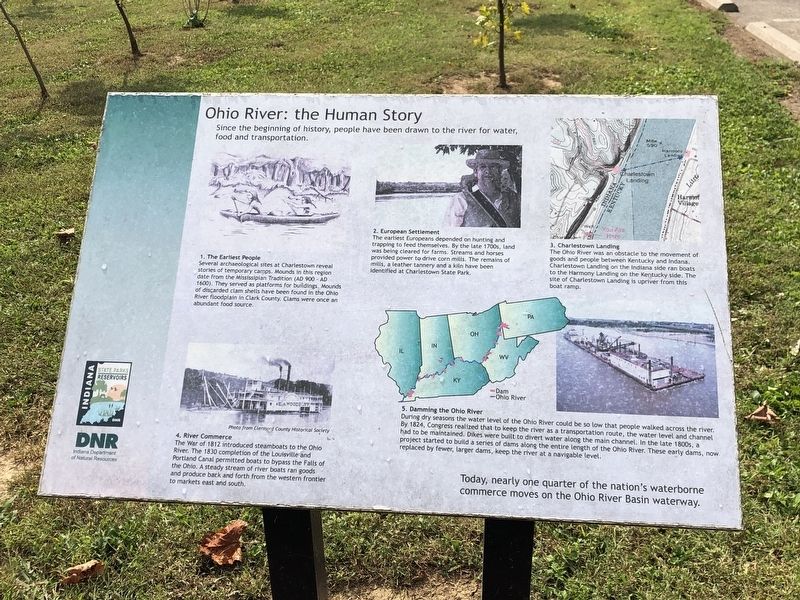
1. Ohio River: the Human Story Marker
1. The Earliest People Several archaeological sites at Charlestown reveal stories of temporary camps. Mounds in this region date from the Mississippian Tradition (AD 900-AD 1600). They served as platforms for buildings. Mounds of discarded clam shells have been found in the Ohio River floodplain in Clark County. Clams were once an abundant food source.
2. European Settlement The earliest Europeans depended on hunting and trapping to feed themselves. By the late 1700s, land was being cleared for farms. Streams and horses provided power to drive corn mills. The remains of mills, a leather tannery and a kiln have been identified at Charlestown State Park.
3. Charlestown Landing The Ohio River was an obstacle to the movement of goods and people between Kentucky and Indiana. Charlestown Landing on the Indiana side ran boats to the Harmony Landing on the Kentucky side. The site of Charlestown Landing is upriver from this boat ramp.
4. River Commerce The War of 1812 introduced steamboats to the Ohio River. The 1830 completion
this page online
5. Damming the Ohio River During dry seasons the water level of the Ohio River could be so low that people walked across the river. By 1824, Congress realized that to keep the river as a transportation route, the water level and channel had to be maintained. Dikes were built to divert water along the main channel. In the late 1800s, a project started to build a series of dams along the entire length of the Ohio River. These early dams, now replaced by fewer, larger dams, keep the river at a navigable level.
Today, nearly one quarter of the nation's waterborne commerce moves on the Ohio River Basin waterway.
Erected by Indiana Department of Natural Resources.
Topics. This historical marker is listed in these topic lists: Indigenous Peoples and Communities • Industry & Commerce • Waterways & Vessels. A significant historical year for this entry is 900 CE.
Location. 38° 23.856′ N, 85° 37.97′ W. Marker is in Charlestown,
Photographed by Duane and Tracy Marsteller, September 24, 2022
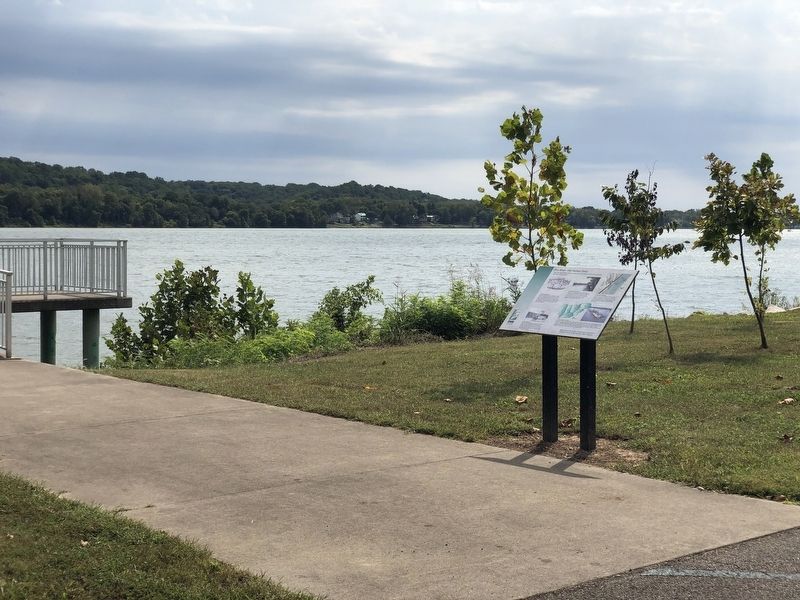
2. Ohio River: the Human Story Marker

Regionally, this marker is in Southern Indiana. It is also in the American Midwest, in the Ohio River Valley, and in the Corn Belt. Globally, it is in North America, the Western Hemisphere, the Western World, and the Anglosphere. Historically, it finds itself in what was once the territory of the Mississippian Culture and also the Northwest Territory.
Other nearby markers. At least 8 other markers are within 2 miles of this marker, measured as the crow flies: Rose Island Dance Hall (approx. 2 miles away); Travel back in time on Rose Island (approx. 2 miles away); Fourteen Mile Creek Boat Landing (approx. 2 miles away); Getting to the Island by Suspension Bridge (approx. 2 miles away); Rose Island (approx. 2.1 miles away); Rose Island Trail (approx. 2.1 miles away); Welcome to Rose Island! (approx. 2.1 miles away); Timeline of Rose Island (approx. 2.1 miles away). Touch for a list and map of all markers in Charlestown.
Credits. This page was last revised on September 28, 2022. It was originally submitted on September 28, 2022, by Duane and Tracy Marsteller of Murfreesboro, Tennessee. This page has been viewed 425 times since then and 57 times this year. Photos: 1, 2. submitted on September 28, 2022, by Duane and Tracy Marsteller of Murfreesboro, Tennessee.
