Temple in Bell County, Texas — The American South (West South Central)
Wilma Carlton
Photographed by James Hulse, September 28, 2022
1. Wilma Carlton Marker
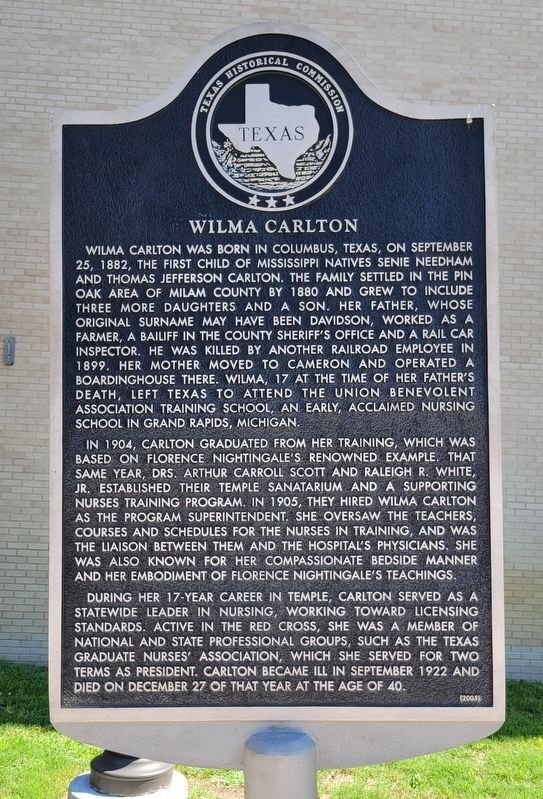
In 1904, Carlton graduated from her training, which was based on Florence Nightingale's renowned example. That same year, Drs. Arthur Carroll Scott and Raleigh R. White, Jr. established their Temple Sanitarium and a supporting nurses training program. In 1905, they hired Wilma Carlton as the program superintendent. She oversaw the teachers, courses and schedules for the nurses in training, and was the liaison between them and the hospital's physicians. She was also known for her compassionate bedside manner and her embodiment of Florence Nightingale's teachings.
During her 17-year career in Temple, Carlton served as a statewide leader in nursing, working toward licensing standards. Active in the Red Cross, she was a member of national and state professional groups, such as the Texas Graduate Nurses' Association, which she served for two terms as president. Carlton became ill in September 1922 and died on December 27 of that year at the age of 40.
Erected 2005 by Texas Historical Commission. (Marker Number 13010.)
Topics. This historical marker is listed in these topic lists: Science & Medicine •
this page online
Location. 31° 4.718′ N, 97° 21.846′ W. Marker is in Temple, Texas, in Bell County. It is at the intersection of South 31st Street and Scott Blvd, on the right when traveling north on South 31st Street. The marker is located at the front entrance to the Baylor Scott and White Medical Center with several other THC historical markers. Touch for map. Marker is at or near this postal address: 2401 South 31st Street, Temple TX 76504, United States of America. Touch for directions.

Regionally, this marker is in Central Texas. It is also in the American South. Globally, it is in North America, a Gulf of Mexico state, the Western Hemisphere, the Western World, and the Anglosphere. Historically, it finds itself in what was once New Spain, the Republic of Texas, and one of the Confederate States of America.
Other nearby markers. At least 8 other markers are within walking distance of this marker: Former Site of Scott & White School of Nursing (here, next to this marker); Claudia Potter, M.D. (here, next to this marker); Scott & White Hospital (here, next to this marker); Arthur Carroll Scott, Sr., M.D.
Photographed by James Hulse, September 28, 2022
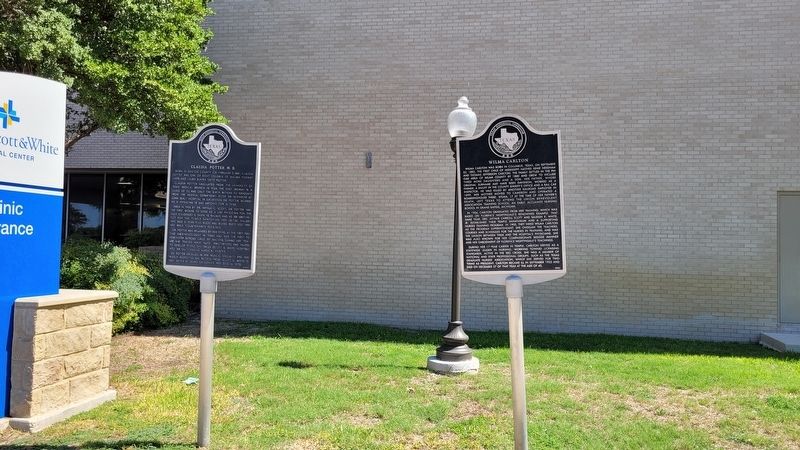
2. The Wilma Carlton Marker is the marker on the right of the two markers
Also see . . .
1. Florence Nightingale. Wikipedia
Nightingale came to prominence while serving as a manager and trainer of nurses during the Crimean War, in which she organised care for wounded soldiers at Constantinople. She significantly reduced death rates by improving hygiene and living standards. Nightingale gave nursing a favourable reputation and became an icon of Victorian culture, especially in the persona of "The Lady with the Lamp" making rounds of wounded soldiers at night.(Submitted on October 6, 2022, by James Hulse of Medina, Texas.)
2. Nursing. Texas State Historical Association
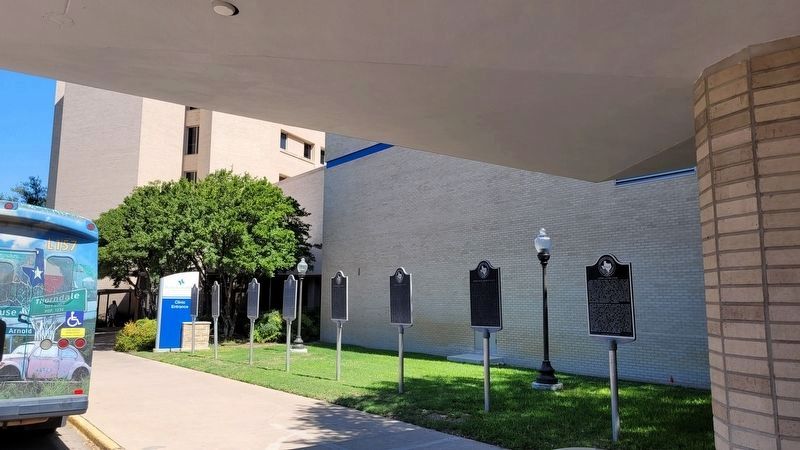
Nursing has been practiced in Texas in a variety of forms, from the work of early lay nurses and midwives who performed their services in patients' homes to that of modern nurses with graduate degrees(Submitted on October 6, 2022, by James Hulse of Medina, Texas.)who work in a large variety of settings. In Texas, as elsewhere before the advent of formal nursing education, caring for the sick, injured, and women in childbirth was considered to be an integral part of the feminine role. By the very nature of the settlement of Texas and the scarcity of physicians, ill people were cared for by women in the household.Photographed by James Hulse, September 28, 20223. The view of all the THC markers in front of the hospitalThe Wilma Carlton marker is the 2nd marker from the left of the 8 THC markers.
Credits. This page was last revised on October 6, 2022. It was originally submitted on October 6, 2022, by James Hulse of Medina, Texas. This page has been viewed 182 times since then and 21 times this year. Photos: 1, 2, 3. submitted on October 6, 2022, by James Hulse of Medina, Texas.
