Whittier in Los Angeles County, California — The American West (Pacific Coastal)
Fred C. Nelles
Photographed by Sonia Eskandarian
1. Fred C. Nelles Marker
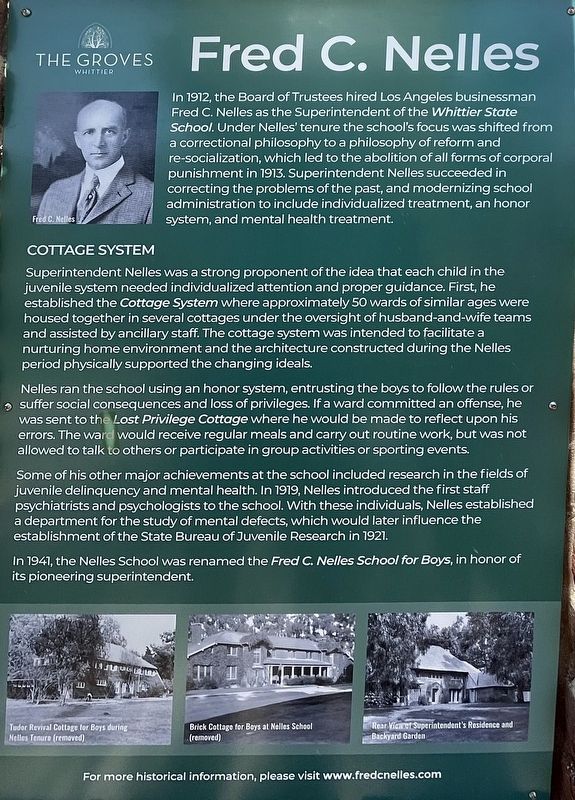
In 1912, the Board of Trustees hired Los Angeles businessman Fred C. Nelles as the Superintendent of the Whittier State School. Under Nelles' tenure the school's focus was shifted from a correctional philosophy to a philosophy of reform and re-socialization, which led to the abolition of all forms of corporal punishment in 1913. Superintendent Nelles succeeded in correcting the problems of the past, and modernizing school administration to include individualized treatment, an honor system, and mental health treatment.
Cottage System
Superintendent Nelles was a strong proponent of the idea that each child in the juvenile system needed individualized attention and proper guidance. First, he established the Cottage System where approximately 50 wards of similar ages were housed together in several cottages under the oversight of husband-and-wife teams and assisted by ancillary staff. The cottage system was intended to facilitate a nurturing home environment and the architecture constructed during the Nelles period physically supported the changing ideals.
Nelles ran the school using an honor
this page online
Some of his other major achievements at the school included research in the fields of juvenile delinquency and mental health. In 1919, Nelles introduced the first staff psychiatrists and psychologists to the school. With these individuals, Nelles established a department for the study of mental defects, which would later influence the establishment of the State Bureau of Juvenile Research in 1921.
In 1941, the Nelles School was renamed the Fred C. Nelles School for Boys, in honor of its pioneering superintendent.
For more historical information, please visit www.fredcnelles.com
Erected by The Groves in Whittier.
Topics. This historical marker is listed in these topic lists: Education • Law Enforcement • Science & Medicine. A significant historical year for this entry is 1912.
Location. 33° 58.544′ N,
Photographed by Craig Baker, August 14, 2022
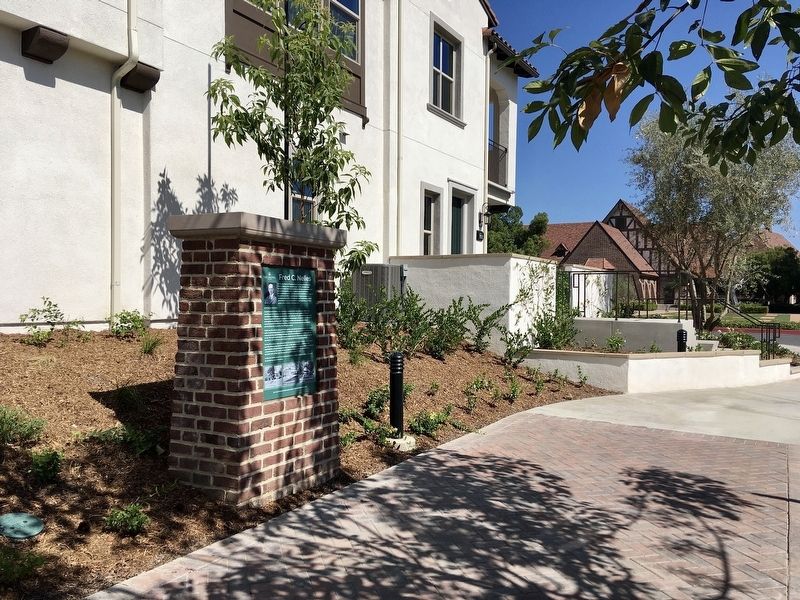
2. Fred C. Nelles Marker

Regionally, this marker is in Greater Los Angeles and in the Transverse Ranges. It is also on the American Pacific Coast. Globally, it is in North America, on the Ring of Fire, in the Pacific Rim, in the Western Hemisphere, in the Western World, and in the Anglosphere. Historically, it finds itself in what was once New Spain and also Mexico’s Alta California.
Other nearby markers. At least 8 other markers are within 2 miles of this marker, measured as the crow flies: Architecture and Reform (about 300 feet away, measured in a direct line); Learning A Trade (about 300 feet away); Reform School for Juvenile Offenders (about 800 feet away); Paradox Hybrid Walnut Tree (approx. 0.3 miles away); Whittier Citrus Association - Big and Busy (approx. 0.3 miles away); Greek George (approx. 0.8 miles away); President Nixon Law Office (approx. 0.8 miles away); Jonathan Bailey House (approx. 1.3 miles away). Touch for a list and map of all markers in Whittier.
Another marker is no longer nearby. Reform School for Juvenile Offenders (was approx. ¼ mile away but has been confirmed missing).
Credits. This page was last revised on January 30, 2023. It was originally submitted on October 13, 2022, by Craig Baker of Sylmar, California. This page has been viewed 427 times since then and 55 times this year. Photos: 1, 2. submitted on October 13, 2022, by Craig Baker of Sylmar, California.
