Near Phelan in San Bernardino County, California — The American West (Pacific Coastal)
Camp Cajon
Photographed by Adam Margolis, February 3, 2024
1. Welcome to Camp Cajon
Welcome to Camp Cajon
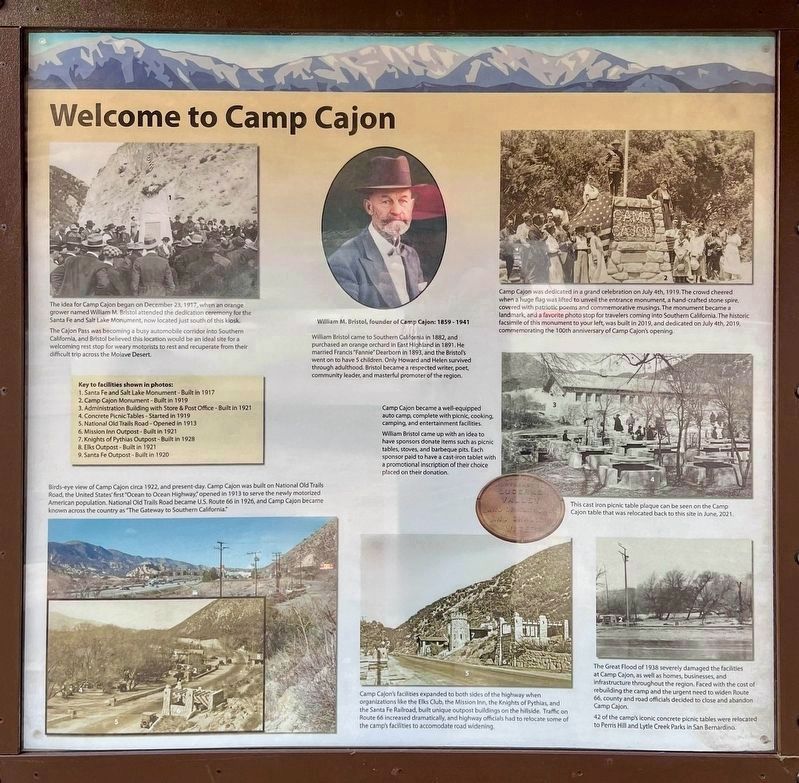
William M. Bristol, founder of Camp Cajon: 1859-1941.
William Bristol came to Southern California in 1882, and purchased an orange orchard in East Highland in 1891. He married Francis "Fannie" Dearborn in 1893, and the Bristol's went on to have 5 children. Only Howard and Helen survived through adulthood. Bristol became a respected writer, poet, community leader, and masterful promoter of the region.
photo captions:
· The idea for Camp Cajon began on December 23, 1917, when an orange grower named William M. Bristol attended the dedication ceremony for the Santa Fe and Salt Lake Monument, now located just south of here.
The Cajon Pass was becoming a busy automobile corridor into Southern California, and Bristol believed this location would be an ideal site for a welcoming rest stop for weary motorists to rest and recuperate from their difficult trip across the Mojave Desert.
· Birds-eye view of Camp Cajon circa 1922, and present-day. Camp Cajon was built on National Old Trails Road, the United States' first "Ocean to Ocean Highway," opened in 1913 to serve the newly motorized
this page online
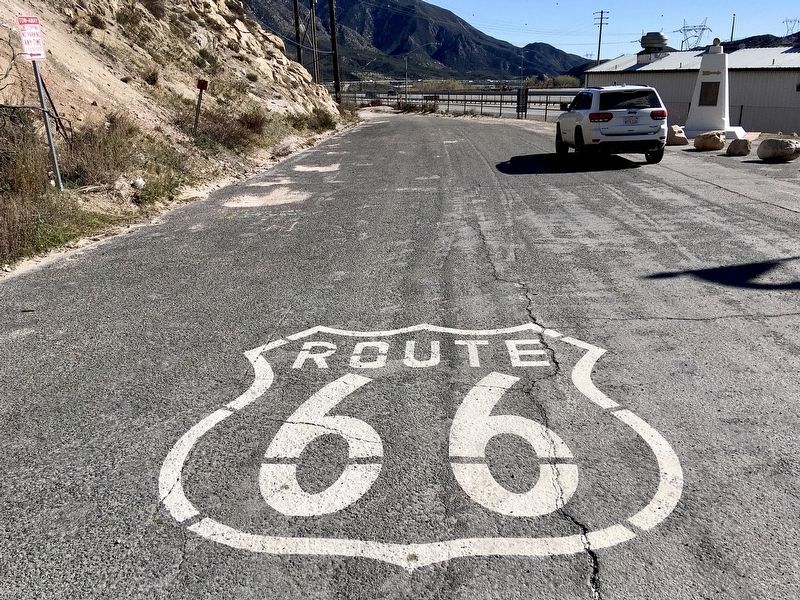
· Camp Cajon's facilities expanded to both sides of the highway when organizations like the Elks Club, the Mission Inn, the Knights of Pythias, and the Santa Fe Railroad, built unique outposts buildings on the hillside. Traffic on Route 66 increased dramatically, and highway officials had to relocate some of the camp's facilities to accommodate road widening.
· The Great Flood of 1938 severely damaged the facilities at Camp Cajon, as well as homes, businesses, and infrastructure throughout the region. Faced with the cost of rebuilding the camp and the urgent need to widen Route 66, county and road officials decided to close and abandon Camp Cajon.
42 of the camp's iconic concrete picnic tables were relocated to Perris Hill Lytle Creek Parks in San Bernardino.
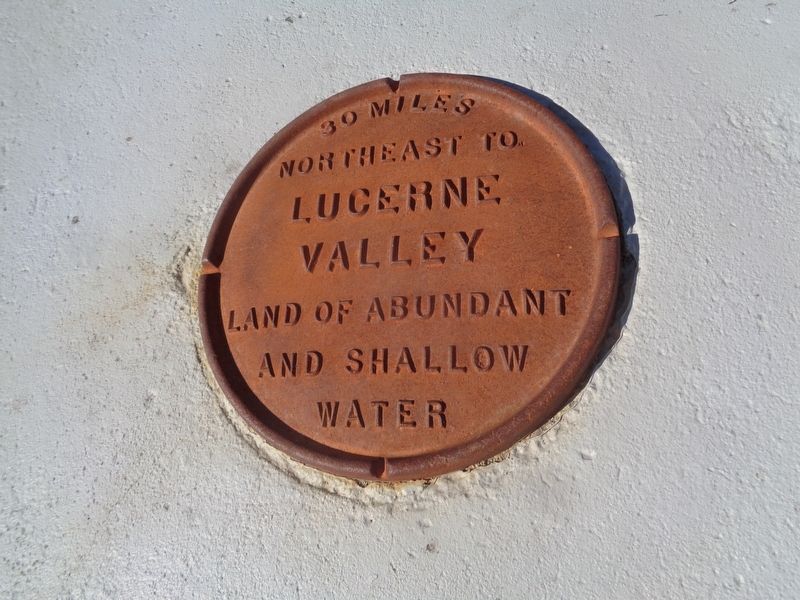
· This cast iron picnic table plaque can be seen on the Camp Cajon table that was relocated back to this site in June, 2021.
· Camp Cajon became a well-equipped auto camp, complete with picnic, cooking,
Photographed by Adam Margolis, February 3, 2024
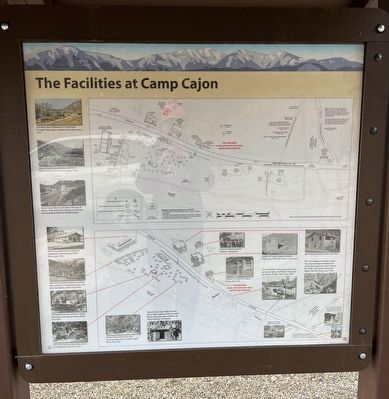
2. The Facilities at Camp Cajon
William Bristol came up with an idea to have sponsors donate items such as picnic tables, stoves, and barbeque pits. Each sponsor paid to have a cast-iron tablet with a promotional inscription of their choice placed on their donation.
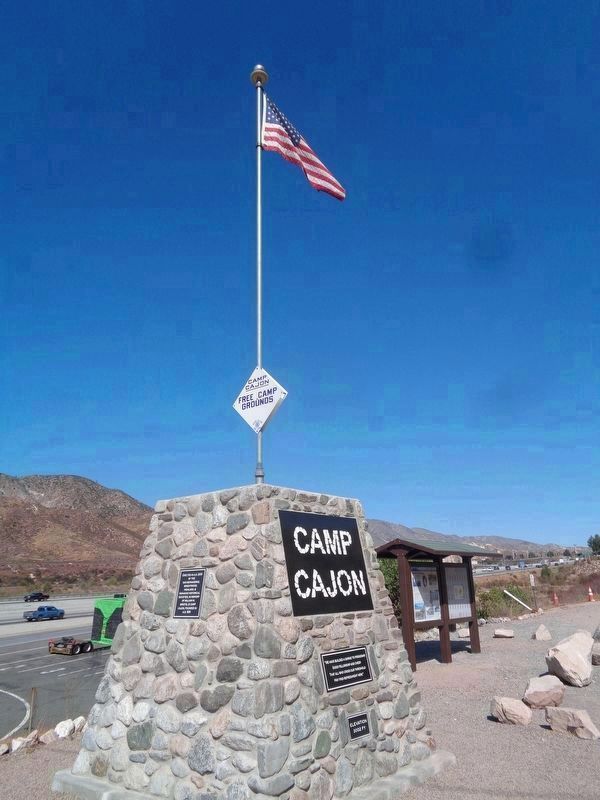
· Camp Cajon was dedicated in a grand celebration on July 4th, 1919. The crowd cheered when a huge flag was lifted to unveil the entrance monument, a hand-crafted stone spire, covered with patriotic poems and commemorative musings. The monument became a landmark, and a favorite photo stop for travelers coming into Southern California. The historic facsimile of this monument to your left, was built in 2019, and dedicated on July 4th, 2019, commemorating the 100th anniversary of Camp Cajon's opening.
Camp Cajon Today
· The Santa Fe and Salt Lake Trail Monument was built in 1917 to honor the early pioneers who blazed the trails through the Cajon Pass and into Southern California. The pioneers who built the monument were also trailblazers, and their names are memorialized on a granite plaque set into the structure.
Footpaths and trails through the

courtesy Camp Cajon, March 16, 2025
3. Camp Cajon Today
The monument was originally located at the mouth of Crowder Canyon, about four hundred feet southeast of here. It was built next to the new National Old Trails Road, which opened in 1914 and followed the route of historic trails across the Southwest.
Pioneers: 1. Richard Weir 2. Silas C. Cox 3. Sheldon Stoddard 4. John Brown Jr. S. Jasper N. Corbett 6. George Miller 7. George M. Cooley 8. Not shown: Sidney P. Waite
· This monument was dedicated on December 23, 1917.
Camp Cajon's founder, William Bristol, of Highland attended the dedication ceremony, and he began formulating his plan for the new camp at the event. This monument has been moved several times due to road realignments, and it was placed here around 1969 to accommodate the construction of the I-15 freeway. It is now listed as California Historic Landmark No. 576.
· The Camp Cajon Picnic Table located between the two monuments was one of the original
Photographed by Jason Voigt, August 14, 2022
4. Camp Cajon Marker - 2022
More historical information will come in the future.
Camp Cajon's famous picnic tables were the brainchild of the camp's founder, William M. Bristol, of Highland.
Bristol came up with the idea to solicit donations to build sturdy, over-sized concrete tables that would withstand time and the elements.
Donors could fund the addition of a table to the camp by paying $50. The donation entitled them to have a cast iron plaque inscribed with some brief text of their choosing, permanently inlaid on one of the concrete tables. The design became known as a "Camp Cajon-style table" and it was copied for other parks in Southern California, Michigan, and Texas.
Camp Cajon was severely damaged by the Great Flood of March, 1938. Faced with the cost of rebuilding the facility and the urgent need to widen Route 66, county and road officials decided to close and abandon the camp.
Some of Bristol's sturdy picnic tables survived the flood, and 43 of them were relocated to parks in San Bernardino. Lytle Creek Park received 20 tables, and 23 tables were placed at Perris Hill Park. The Perris Hill Park tables were removed and demolished in 2023.
Photographed by Adam Margolis, February 3, 2024
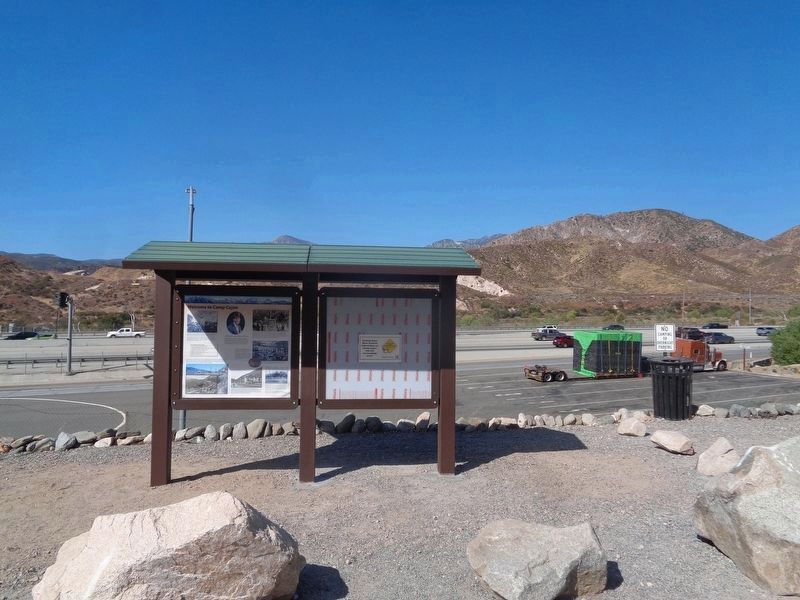
5. Camp Cajon Marker
· The Camp Cajon table was moved from Lytle Creek Park back to the current site on June 23, 2021.
· Dedication day, July 4, 1919. This monument stood at a main entrance to Camp Cajon.
· The Rebuilt Camp Cajon Monument was completed in July 2019, and dedicated on July 4th, of that year; 100 years to the day from the original celebration!
The wording on the black granite plaques is identical to the text on the original monument, with the exception of the small plaque on the monument's south side. That text honors William Bristol, founder of Camp Cajon, and the four historical societies that built the new monument.
· Dedication day, July 4, 2019.
· The new Camp Cajon Monument is a historic facsimile of the original monument which was located about 150 feet to the northwest. The Automobile Club sign on the flag pole is a replica of the sign on the original monument.
· The monument was designed and built by volunteers and skilled stone masons using local rock.
· The Route 66 Signpost is a reproduction showing the mileage from Camp Cajon to several major cities along the famous route. Also shown

courtesy Camp Cajon, March 16, 2025
6. Camp Cajon Marker
· The Concrete Boundary Monument was used by the State of California beginning in 1914, to mark boundaries on state highways at various survey points.
Concrete monuments like this were used on Route 66, National Old Trails Road, and other state and federal highways across the U.S. Markers with an embossed "C" were used in California. These markers were phased out in the 1950s.
The fence post and V-brace were typical of installations in the Cajon Pass area.
Topics and series. This historical marker is listed in these topic lists: Industry & Commerce • Parks & Recreational Areas • Roads & Vehicles • Settlements & Settlers. In addition, it is included in the U.S. Route 66 series list. A significant historical month for this entry is June 2021.
Location. 34° 18.379′ N, 117° 28.009′ W. Marker is near Phelan, California, in San Bernardino County. It is on Wagon Train Road (Old U.S. 66) half a mile south of California Route 138, on the right when traveling south. Touch for map. Marker is at or near this postal address: 3355 Wagon Train Rd, Phelan CA 92371,
Photographed by Jason Voigt, August 14, 2022
7. Camp Cajon Monument

Regionally, this marker is in Greater Los Angeles, in the Peninsular Ranges, and specifically in the Transverse Ranges. It is also in the American Southwest. Globally, it is in North America, on the Ring of Fire, on the Pacific Rim, in the Western Hemisphere, in the Western World, and in the Anglosphere. Historically, it finds itself in what was once New Spain and also Mexico’s Alta California.
Other nearby markers. At least 8 other markers are within 3 miles of this marker, measured as the crow flies: Santa Fe and Salt Lake Trail (a few steps from this marker); Camp Cajon Monument (within shouting distance of this marker); Stoddard-Waite Monument (approx. 0.2 miles away); Mormon Pioneer Trail (approx. ¼ mile away); Hill 582 (approx. 2 miles away); Blue Cut (approx. 2.8 miles away); Summit Train Station (approx. 2.9 miles away); Elliot Ranch (approx. 2.9 miles away). Touch for a list and map of all markers in Phelan.
Regarding Camp Cajon. This site is located on the Pacific Crest Trail.
Also see . . . Traveling an 1860s Wagon Road: The Historic John Brown Toll Road Through Cajon Pass (YT video).
Photographed by Jason Voigt, August 14, 2022
8. Lucerne Valley sponsored plaque
An actual plaque from Camp Cajon's early days was placed back on a picnic table in 2021.
Photographed by Craig Baker, February 12, 2022
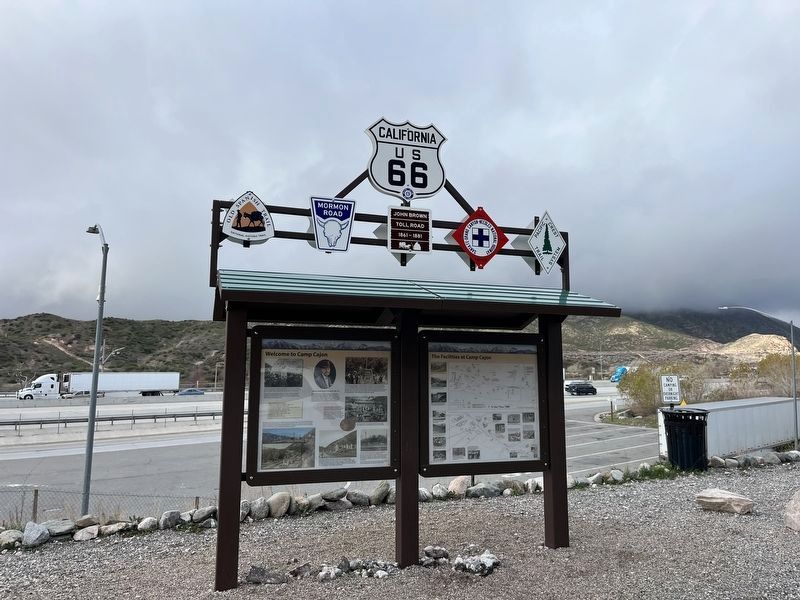
9. Route 66
Credits. This page was last revised on April 23, 2025. It was originally submitted on October 17, 2022, by Jason Voigt of Glen Carbon, Illinois. This page has been viewed 2,280 times since then and 335 times this year. Photos: 1, 2. submitted on February 8, 2024, by Adam Margolis of Mission Viejo, California. 3. submitted on March 17, 2025, by Craig Baker of Sylmar, California. 4. submitted on October 17, 2022, by Jason Voigt of Glen Carbon, Illinois. 5. submitted on February 8, 2024, by Adam Margolis of Mission Viejo, California. 6. submitted on March 17, 2025, by Craig Baker of Sylmar, California. 7, 8. submitted on October 17, 2022, by Jason Voigt of Glen Carbon, Illinois. 9. submitted on January 19, 2023, by Craig Baker of Sylmar, California.
