Greenville in Wayne County, Missouri — The American Midwest (Upper Plains)
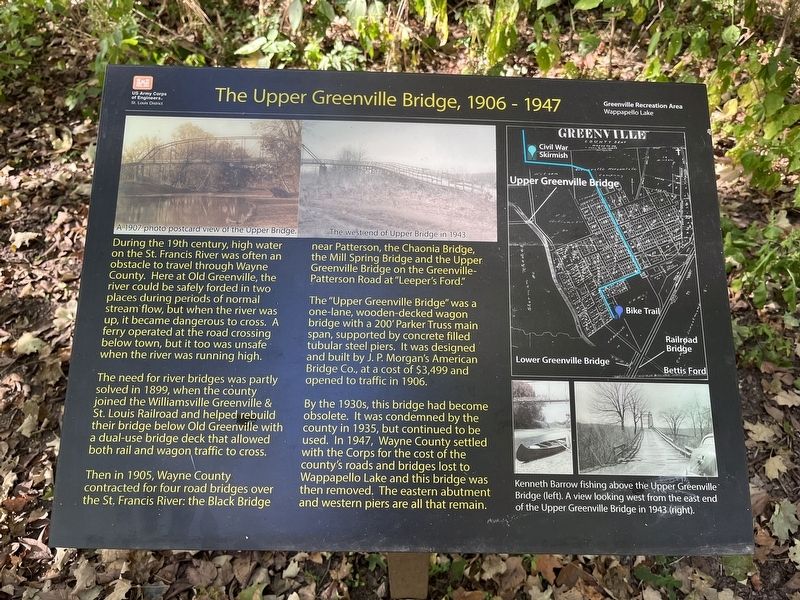
The Upper Greenville Bridge, 1906-1947
Greenville Recreation Area
| — | Wappapello Lake | — |
Photographed by Craig Swain, September 28, 2022
1. The Upper Greenville Bridge, 1906-1947 Marker
The need for river bridges was partly solved in 1899, when the county joined the Williamsville Greenville & St. Louis Railroad and helped rebuild their bridge below Old Greenville with a dual-use bridge deck that allowed both rail and wagon traffic to cross.
Then in 1905, Wayne County contracted four road bridges over the St. Francis River: the Black Bridge near Patterson, the Chaonia Bridge, the Mill Spring Bridge and the Upper Greenville Bridge on the Greenville-Patterson Road at "Leeper's Ford."
The "Upper Greenville Bridge" was a one-lane, wooden-decked wagon bridge with a 200' Parker Truss main span, supported by concrete filled tubular steel piers. It was designed and built by J.P. Morgan's American Bridge Co., at a cost of $3,499
this page online
By the 1930s, this bridge had become obsolete. It was condemned by the county in 1935, but continued to be used. In 1947, Wayne County settled with the Corps for the cost of the county's roads and bridges lost to Wappapello Lake and this bridge was then removed. The eastern abutment and western piers are all that remain.
Erected by U.S. Army Corps of Engineers, St. Louis District.
Topics. This historical marker is listed in this topic list: Roads & Vehicles. A significant historical year for this entry is 1899.
Location. 37° 6.378′ N, 90° 27.619′ W. Marker is in Greenville, Missouri, in Wayne County. It can be reached from U.S. 67, on the right when traveling south. Located along the Greenville Bike Trail, just north of the camping area, in the Greenville Recreation Area of Wappapello Lake. Touch for map. Marker is in this post office area: Greenville MO 63944, United States of America. Touch for directions.

Regionally, this marker is in Southeast Missouri. It is also in the American Ozarks, in the Lewis & Clark Corridor, and in the Corn Belt. Globally, it is in North America, the Western Hemisphere,
Photographed by Craig Swain, September 28, 2022
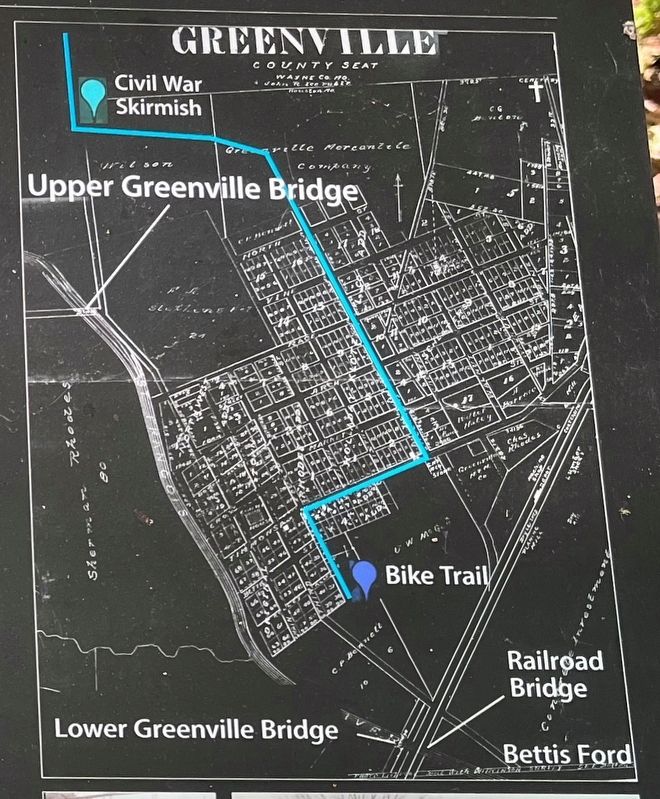
2. Map on the Marker
The map has the route of the bike trail highlighted in blue. Callouts indicate the location of the Upper Greenville Bridge and the Lower (Railroad) Bridge.
Other nearby markers. At least 8 other markers are within walking distance of this marker: The Civil War in the Missouri - Arkansas Borderlands, 1862-1865 (here, next to this marker); The "Surprise at Greenville," July 20, 1862 (here, next to this marker); Greenville School (approx. 0.4 miles away); Tie-Hacking (approx. 0.4 miles away); Sam Brown (approx. 0.4 miles away); Greenville Jailhouse (approx. 0.4 miles away); The Wayne County Courthouse At Old Greenville (approx. half a mile away); Harry S. Truman (approx. half a mile away). Touch for a list and map of all markers in Greenville.
Photographed by Craig Swain, September 28, 2022
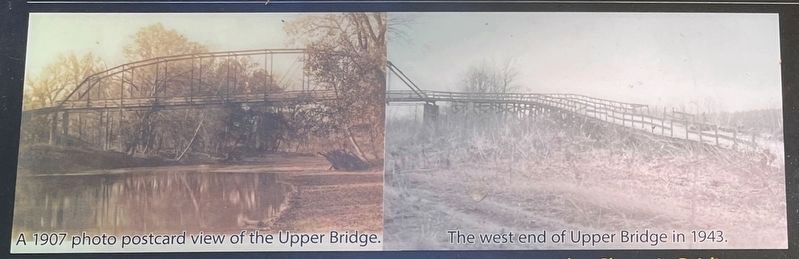
3. The Upper Greenville Bridge
A composite from a 1907 postcard and a 1943 photograph offers a view of the bridge span when in operation.
Photographed by Craig Swain, September 28, 2022
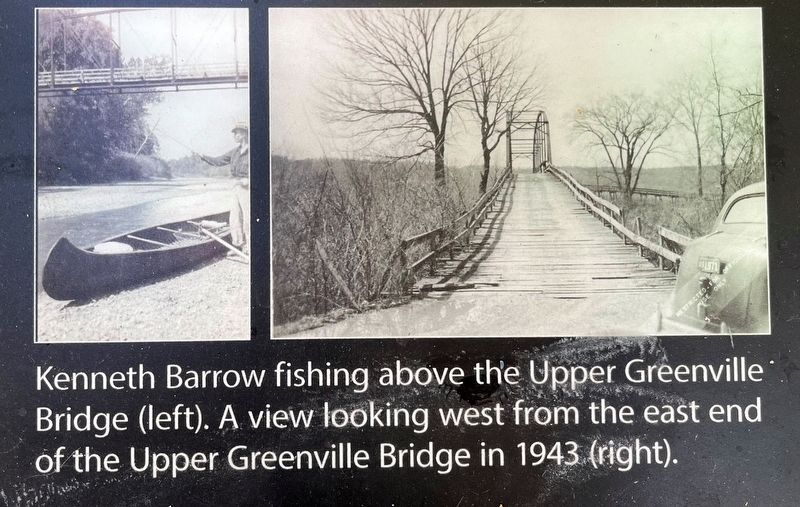
4. Photos on the Lower Right
Kenneth Barrow fishing above the Upper Greenville Bridge (left). A view looking west from the east end of the Upper Greenville Bridge in 1943 (right).
Photographed by Craig Swain, September 28, 2022
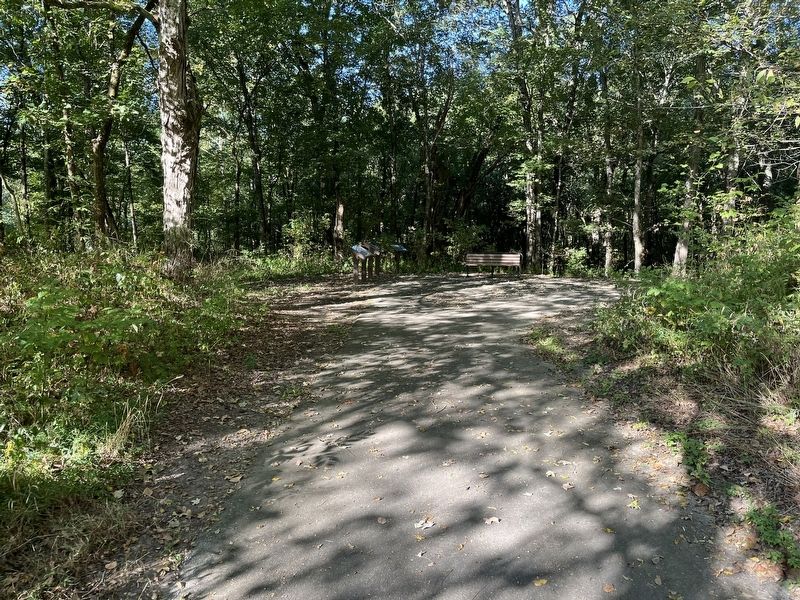
5. Markers along the Bike Trail
As the bike trail turns to the north, there is a bench and three markers.
Photographed by Craig Swain, September 28, 2022
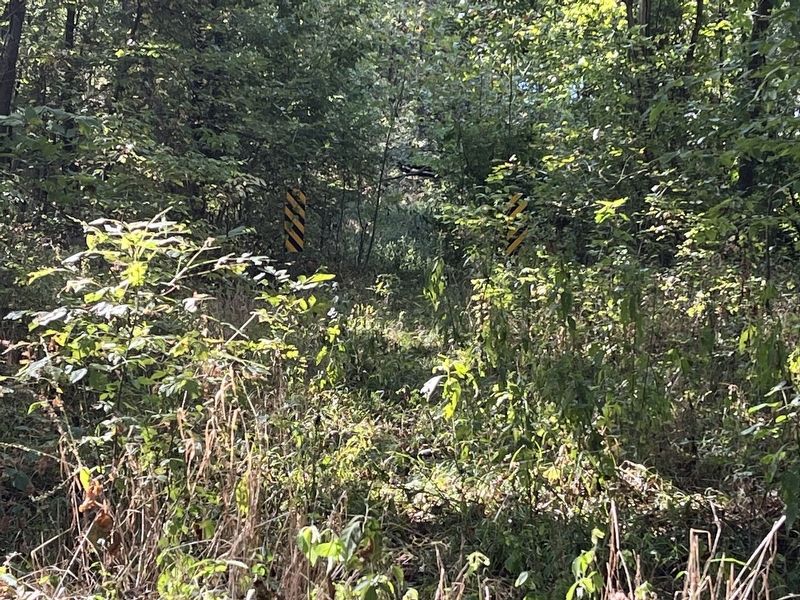
6. Barricades near Bridge Site
Visible beyond the marker are the traces of the old road bed leading to the bridge. All that remains along the old trace are two barricade warning signs. Somewhere just beyond are the remains of bridge piers mentioned on the marker.
Credits. This page was last revised on October 30, 2022. It was originally submitted on October 30, 2022, by Craig Swain of Leesburg, Virginia. This page has been viewed 420 times since then and 20 times this year. Photos: 1, 2, 3, 4, 5, 6. submitted on October 30, 2022, by Craig Swain of Leesburg, Virginia.
Editor’s want-list for this marker. Photos of the eastern and western pier remains. • Can you help?
