Leesburg in Loudoun County, Virginia — The American South (Mid-Atlantic)
Leesburg Freight Station
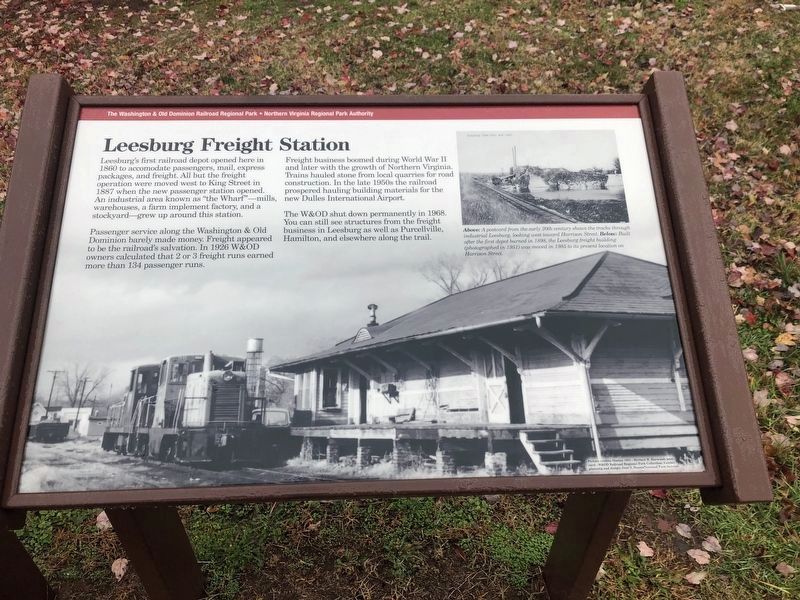
Passenger service along the Washington & Old Dominion barely made money. Freight appeared to be the railroad’s salvation. In 1926 W&OD owners calculated that 2 or 3 freight runs earned more than 134 passenger runs.
Freight business boomed during World War II and later with the growth of Northern Virginia. Trains hauled stone from local quarries for road construction. In the late 1950s the railroad prospered hauling building materials for the new Dulles International Airport.
Erected by The Washington & Old Dominion Railroad Regional Park, Northern Virginia Regional Park Authority.
Topics and series. This historical marker is listed in this topic list: Railroads & Streetcars. In addition, it is included in the NOVA Parks, and the Washington and Old Dominion (W&OD) Railroad
this page online
Location. 39° 6.649′ N, 77° 33.813′ W. Marker is in Leesburg, Virginia, in Loudoun County. It is on Harrison Street, on the left when traveling north. Located about 25 feet west of Harrison Street on the Washington & Old Dominion Railroad Trail. Touch for map. Marker is in this post office area: Leesburg VA 20175, United States of America. Touch for directions.

Regionally, this marker is in the Washington Metropolitan Area and in Northern Virginia. It is also in the American South, specifically in the Upper South, and in the Mid-Atlantic. Globally, it is in North America, the Western Hemisphere, the Western World, and the Anglosphere. Historically, it finds itself in what was once the territory of the Mississippian Culture, one of the original Thirteen Colonies, one of the Confederate States of America, and the Antebellum South.
Other nearby markers. At least 8 other markers are within walking distance of this marker: The Orion Anderson Story (here, next to this marker); This Is W&OD Trail: Leesburg! (within shouting distance of this marker); Raflo Park (within
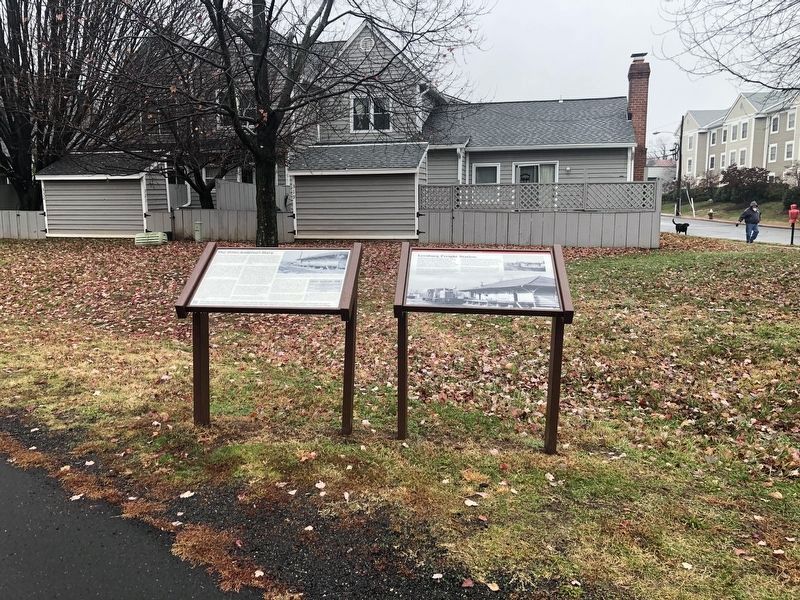
Another marker is no longer nearby. The Lost Locomotive (was here, next to this marker but has been permanently removed).
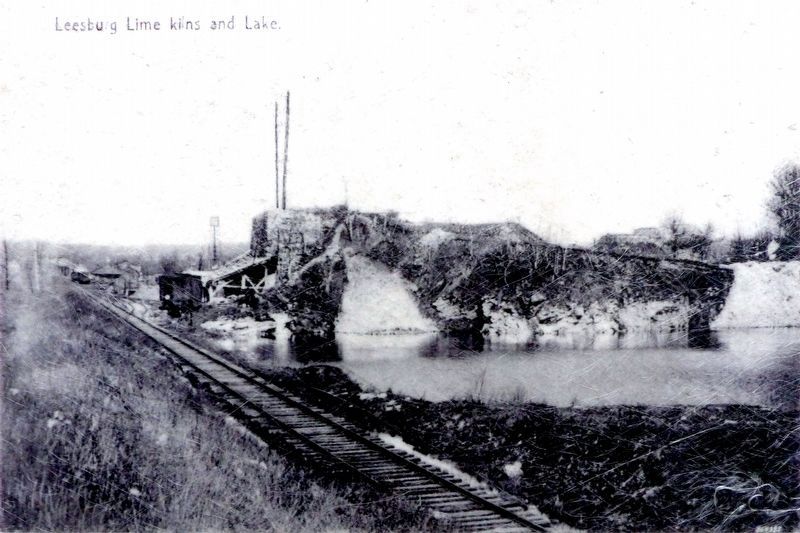
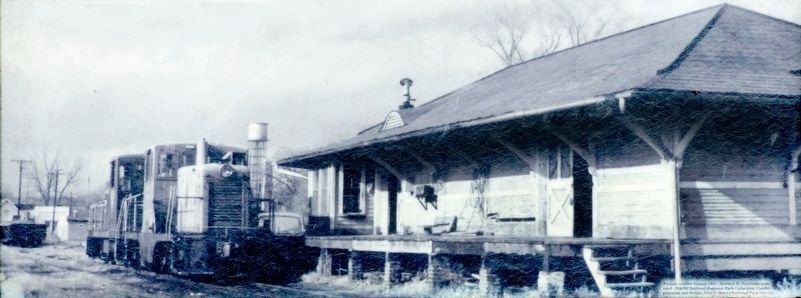
More about this marker. The background of the marker is a picture of the freight depot captioned, “Built after the first depot burned in 1898, the Leesburg freight building (photographed in 1951) was moved in 1985 to the present location on Harrison Street.” A smaller picture of the Leesburg Lime Company is captioned, “A postcard from the early 20th century shows the tracks through industrial Leesburg, looking west toward Harrison Street.”
Related markers. Click here for a list of markers that are related to this marker.
Also see . . .
1. The Washington and Old Dominion. Book by Ames Williams available on Amazon.com (Submitted on May 7, 2008, by Tom Fuchs of Greenbelt, Maryland.)
2. Rails to the Blue Ridge: The Washington and Old Dominion Railroad, 1847 - 1968.
Photographed by Craig Swain, January 26, 2008
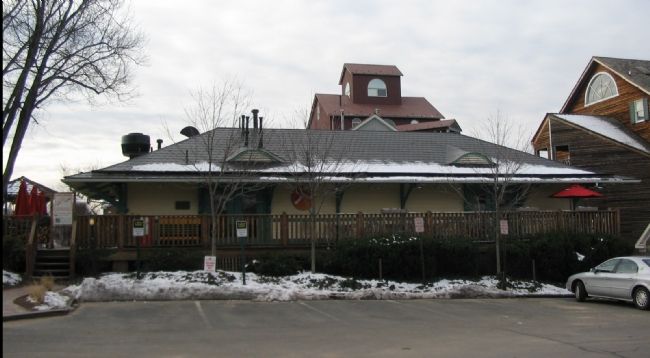
3. The Relocated Freight Depot
Now located a few blocks north on Harrison Street.
Photographed by Allen C. Browne, February 26, 2018
4. Leesburg Lime Kilns and Lake
A Postcard for the early 20th century shows the tracks through industrial Leesburg, looking west toward Harrison Street. -- W&OD Regional Parks Collection.Close-up of photo on marker
Photographed by Allen C. Browne, February 26, 2018
5. Leesburg Freight Building
Built after the first depot burned in 1898, the Leesburg freight building (photographed in 1951) was moved in 1985 to its present location on Harrison Street. (Station 1951 - Herbert H. Harwood.)Close-up of photo on marker
Credits. This page was last revised on December 1, 2019. It was originally submitted on August 17, 2007, by Craig Swain of Leesburg, Virginia. This page has been viewed 4,176 times since then and 82 times this year. Photos: 1, 2. submitted on December 1, 2019, by Devry Becker Jones of Washington, District of Columbia. 3. submitted on August 17, 2007, by Craig Swain of Leesburg, Virginia. 4, 5. submitted on July 30, 2018, by Allen C. Browne of Silver Spring, Maryland. • J. J. Prats was the editor who published this page.
