East Central in Fort Wayne in Allen County, Indiana — The American Midwest (Great Lakes)
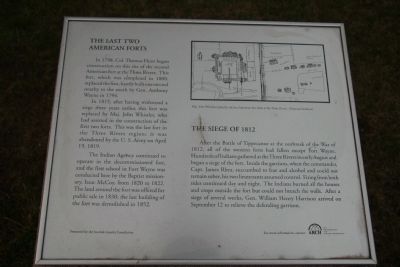
The Last Two American Forts
⎯⎯⎯
The Siege of 1812
Photographed by Dale K. Benington, July 20, 2009
1. The Last Two American Forts/The Siege of 1812 Marker
The Last Two American Forts
In 1798, Col. Thomas Hunt began construction on this site of the second American fort at the Three Rivers. this fort, which was completed in 1800, replaced the first, hastily built one erected nearby to the south by Gen. Anthony Wayne in 1794.
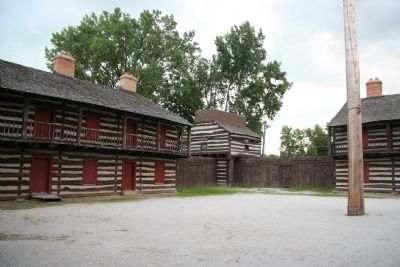
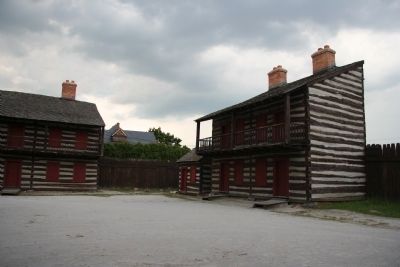
In 1815, after having withstood a siege three years earlier, this fort was replaced by Maj. John Whistler, who had assisted in the construction of the first two forts. This was the last fort in the Three Rivers region; it was abandoned by the U. S. Army on April 1, 1819.
The Indian Agency continued to operate in the decommissioned fort, and the first school in Fort Wayne was conducted by the Baptist missionary, Isaac McCoy, from 1820 to 1822. The land aroun the fort was offered for public sale in 1830; the last building of the fort was demolished in 1852.
The Siege of 1812
After the Battle of Tippecanoe at the outbreak of the War of 1812, all of the western forts had fallen except Fort Wayne. Hundreds of Indians gathered at the Three Rivers in early August and began a siege of the fort. Inside the garrison, when the commander, Capt. James
this page online
Erected by the Journal-Gazzette Foundation.
Topics and series. This historical marker is listed in these topic lists: Forts and Castles • Indigenous Peoples and Communities • Settlements & Settlers • War of 1812 • Wars, US Indian. In addition, it is included in the Former U.S. Presidents: #09 William Henry Harrison series list. A significant historical month for this entry is April 1850.
Location. 41° 4.888′ N, 85° 8.032′ W. Marker is in Fort Wayne, Indiana, in Allen County. It is in East Central. It is at the intersection of East Main Street and Clay Street, on the right when traveling west on East Main Street. This historical marker is located in downtown Fort Wayne, just south of the Three Rivers area (where the St. Mary's and St. Joseph's Rivers come together
Photographed by Dale K. Benington, July 20, 2009
2. The Last Two American Forts/The Siege of 1812 Marker
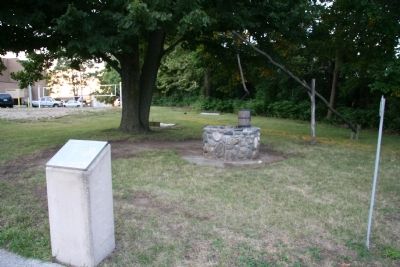
View of the historical marker in the left foreground with the "Old Fort Wayne Well" in the center background, and the downtown fire station's "beach" volleyball court in the far left background.

Regionally, this marker is in Northern Indiana. It is also in the American Midwest and in the Corn Belt. Globally, it is in North America, the Western Hemisphere, the Western World, and the Anglosphere. Historically, it finds itself in what was once the Viceroyalty of New France, the territory of the Mississippian Culture, and the Northwest Territory.
Other nearby markers. At least 8 other markers are within walking distance of this marker: Old Fort Wayne Well (here, next to this marker); First Central Fire House (within shouting distance of this marker); The History of the Bell (within shouting distance of this marker); The Site of General Wayne's Fort (about 400 feet away, measured in a direct line); Takaoka and Fort Wayne Time Capsule (about 700 feet away); Mother George (about 700 feet away); This Barr And Columbia Street Intersection (approx. 0.2 miles away); Barr And Columbia
Photographed by Dale K. Benington, July 20, 2009
3. The Last Two American Forts
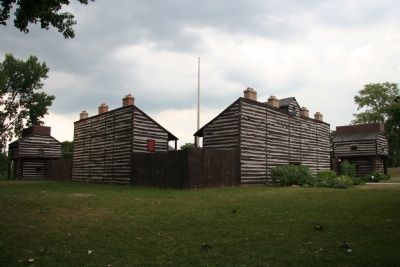
View of the reconstructed 1815 (third) Fort Wayne described by the historical marker, that is located just north and across the St. Mary's River from this historical marker.
Also see . . . Forts of Fort Wayne, Indiana. This web link is published by Wikipedia, the free encyclopedia. (Submitted on July 29, 2009, by Dale K. Benington of Toledo, Ohio.)
Photographed by Dale K. Benington, July 20, 2009
4. The Last Two American Forts
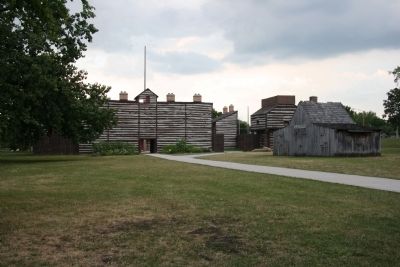
Another view of the reconstructed 1815 (third) Fort Wayne described by the historical marker.
Photographed by Dale K. Benington, July 20, 2009
5. The Last Two American Forts
Interior view of the reconstructed 1815 (third) Fort Wayne described by the historical marker.
Photographed by Dale K. Benington, July 20, 2009
6. The Last Two American Forts
Second interior view of the reconstructed 1815 (third) Fort Wayne described by the historical marker.
Credits. This page was last revised on April 2, 2025. It was originally submitted on July 29, 2009, by Dale K. Benington of Toledo, Ohio. This page has been viewed 4,814 times since then and 95 times this year. Photos: 1, 2, 3, 4, 5, 6. submitted on July 29, 2009, by Dale K. Benington of Toledo, Ohio. • Syd Whittle was the editor who published this page.
