Southside in San Antonio in Bexar County, Texas — The American South (West South Central)
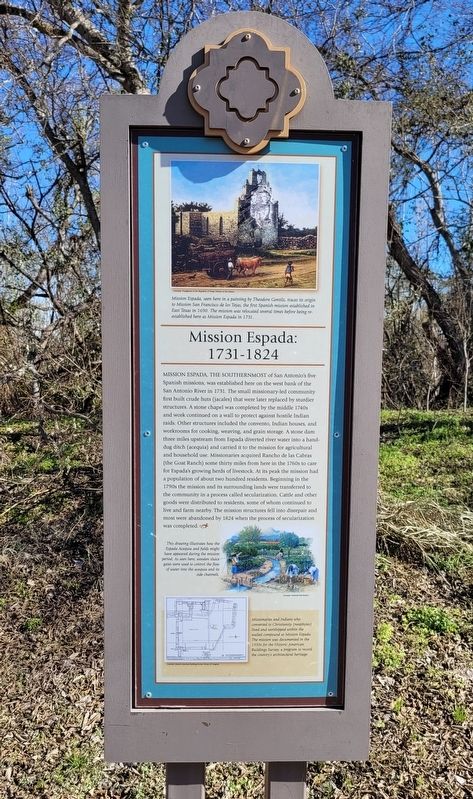
Mission Espada: 1731-1824
Photographed by James Hulse, December 27, 2022
1. Mission Espada: 1731-1824 Marker
Captions
Top: Mission Espada, seen here in a painting by Theodore Gentile, traces its origin to Mission San Francisco de los Tejas, the first Spanish mission established in East Texas in 1690. The mission was relocated several times before being re-established here as Mission Espada in 1731.
Courtesy: Daughters of the Republic of Texas Library at the Alamo.
Bottom 1: This drawing illustrates how the Espada Acequia and fields might have appeared during the mission period. As seen here, wooden sluice gates were used to control the flow of water into the acequia and its side channels.
Courtesy: National Park Service.
Bottom 2: Missionaries and Indians who converted to Christianity (neophytes) lived and worshipped within the walled compound at Mission Espada The mission was documented in the 1930s for the Historic American Buildings Survey, a program to record the country's architectural heritage.
Courtesy: Historic American Building Survey, Library of Congress
Erected by San
this page online
Topics and series. This historical marker is listed in these topic lists: Colonial Era • Hispanic Americans • Indigenous Peoples and Communities • Religion & Religious Structures. In addition, it is included in the Historic American Buildings Survey series list. A significant historical year for this entry is 1731.
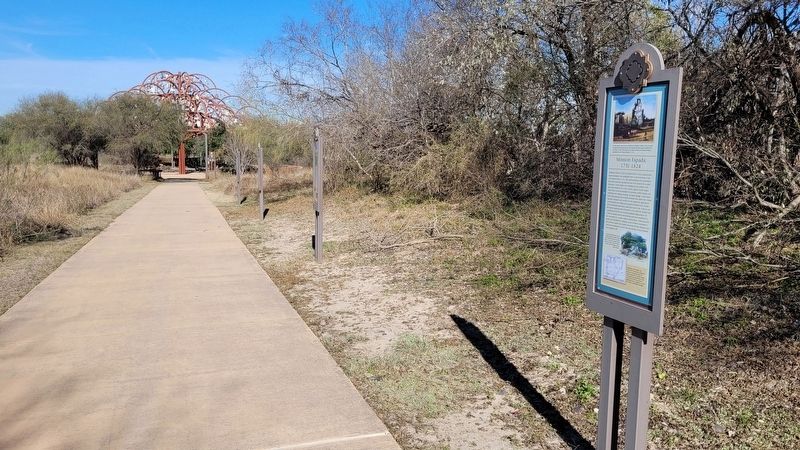
Location. 29° 19.179′ N, 98° 27.057′ W. Marker is in San Antonio, Texas, in Bexar County. It is in Southside. It can be reached from the intersection of Espada Road and Camino Coahuilteca. The marker is located north of the Mission Espada along the River Walk. Touch for map. Marker is at or near this postal address: 10040 Espada Road, San Antonio TX 78214, United States of America. Touch for directions.

Regionally, this marker is in South Texas. It is also in the American South. Globally, it is in North America, a Gulf of Mexico state, the Western Hemisphere, the Western World, and the Anglosphere. Historically, it finds itself in what was once New Spain, the Republic of Texas, and one of the Confederate States of America.
Other nearby markers. At least
Photographed by James Hulse, December 27, 2022
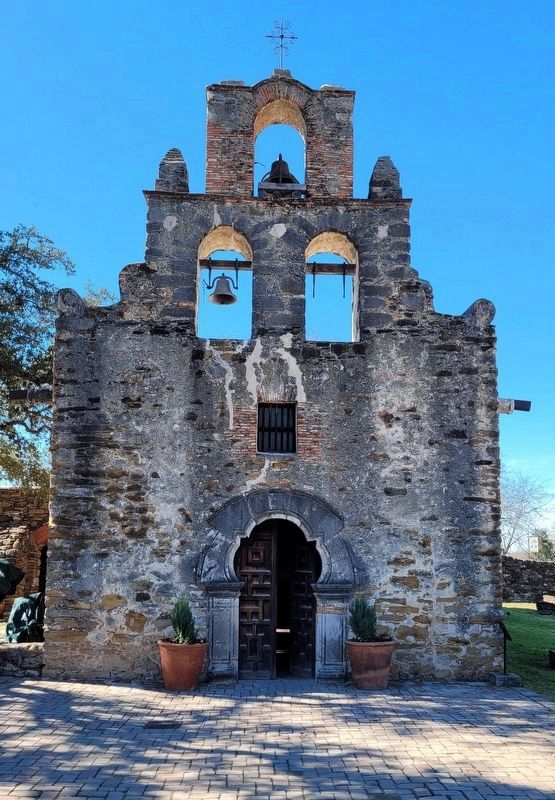
2. The Mission Espada Church
Also see . . . Mission Espada. San Antonio Missions - World Heritage
Mission San Francisco de la Espada was the first Spanish Mission in Texas. It was founded in 1690 as San Francisco de los Tejas near present-day Nacogdoches in East Texas. It was renamed as Mission San Francisco de la Espada when it moved to San Antonio in 1731. Distinctive Spanish design features can be seen in the church doorway, bell tower, and brick archways. Espada’s ranch, Rancho de las Cabras, is 23 miles south of the Mission and had(Submitted on January 9, 2023, by James Hulse of Medina, Texas.)as many as 1,262 head of cattle and 4,000 sheep. Mission Espada’s acequia is the nation’s oldest in continuous use. It still uses San Antonio River water to irrigate local crops today illustrating the connection the river makes between the past and the present.Photographed by James Hulse, December 27, 20223. The view of the Mission Espada: 1731-1824 Marker from the River Walk
Credits. This page was last revised on February 2, 2023. It was originally submitted on January 9, 2023, by James Hulse of Medina, Texas. This page has been viewed 585 times since then and 49 times this year. Photos: 1, 2, 3. submitted on January 9, 2023, by James Hulse of Medina, Texas.
