Southside in San Antonio in Bexar County, Texas — The American South (West South Central)
Spanish Ranching

Photographed by James Hulse, December 27, 2022
1. Spanish Ranching Marker
Cattle, Horses, Sheep, Goats, And Other Livestock were introduced into the New World by Europeans in the 1500s. Spanish exploratory expeditions that moved north out of Mexico released cattle and horses at stream crossings to provide an economic base for future colonists. When missionary-led communities were founded in the early 1700s, cattle and sheep ranches were established to support the missions and also provide meat, leather, and wool for the entire province. These remote ranches prospered as the threat of hostile Indian activity decreased due to the Spanish military presence, success of the missions, and a growing civilian population. When the missions were closed beginning in the late 1700s and their property distributed to community members (a process called secularization), private ranching began to flourish in the San Antonio River valley. Ranching continued to be the area's most important economic activity throughout the Spanish, Mexican, and Republic periods, as well as after Texas became a state in 1845. Overland cattle drives, barbed wire fencing, and rail and truck shipments of livestock to distant markets all transformed ranching in Texas during the 1800s and 1900s, and today it remains a significant sector of the state's economy.
Captions
Top: The Spanish imported cattle and other livestock into Mexico beginning in the 1500s. The descendants of these animals formed the vast herds of Longhorns that roamed Texas for the next 250 years.
Painting: Tom Lea:
Courtesy: Dallas Museum of Art.
Bottom 1: By the end of the 1700s most of the land along the San Antonio River had been converted into ranches. The ample grass and water produced large herds that could be marketed not only locally but also south to Mexico and east to Louisiana.
Source: Jack Jackson, Los Mesteño, 1986;
Courtesy: Jack Jackson Estate, Austin.
Bottom 2: Wild livestock was rounded up on the open range by ranchers and branded to prove ownership before barbed wire made it possible to confine cattle and horses on large land holdings. This brand was used on the Mission Espada ranch.
Source: Jack Jackson, Los Mesteño, 1986;
Courtesy: Jack Jackson Estate, Austin.
Erected by San
this page online
Topics. This historical marker is listed in these topic lists: Animals • Colonial Era • Hispanic Americans • Industry & Commerce. A significant historical year for this entry is 1845.
Location. 29° 19.191′ N, 98° 27.055′ W. Marker is in San Antonio, Texas, in Bexar County. It is in Southside. It can be reached from the intersection of Espada Road and Camino Coahuilteca. The marker is located north of the Mission Espada along the River Walk. Touch for map. Marker is at or near this postal address: 10040 Espada Road, San Antonio TX 78214, United States of America. Touch for directions.

Regionally, this marker is in South Texas. It is also in the American South. Globally, it is in North America, a Gulf of Mexico state, the Western Hemisphere, the Western World, and the Anglosphere. Historically, it finds itself in what was once New Spain, the Republic of Texas, and one of the Confederate States of America.
Other nearby markers. At least 8 other markers are within walking distance of this marker: Rancho de las Cabras (a few steps from this marker); Missions Along the San Antonio River
Photographed by James Hulse, December 27, 2022
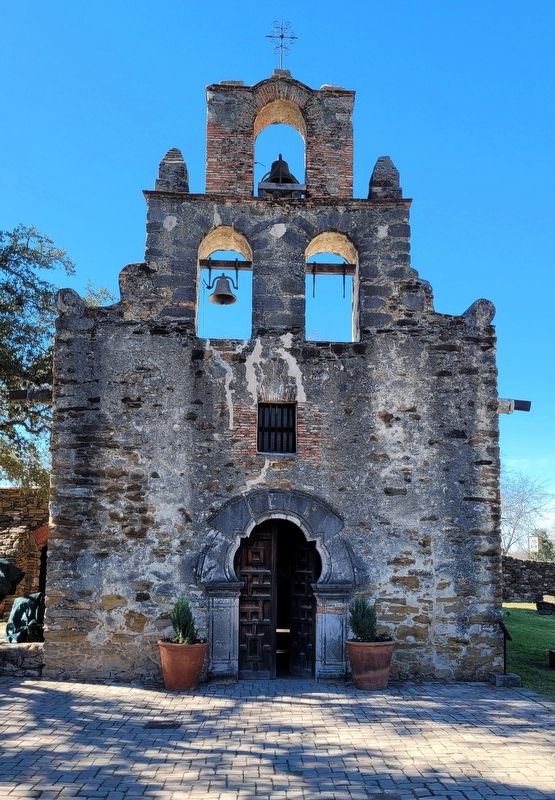
2. The Mission Espada Church
Also see . . . Mission Espada. San Antonio Missions - World Heritage
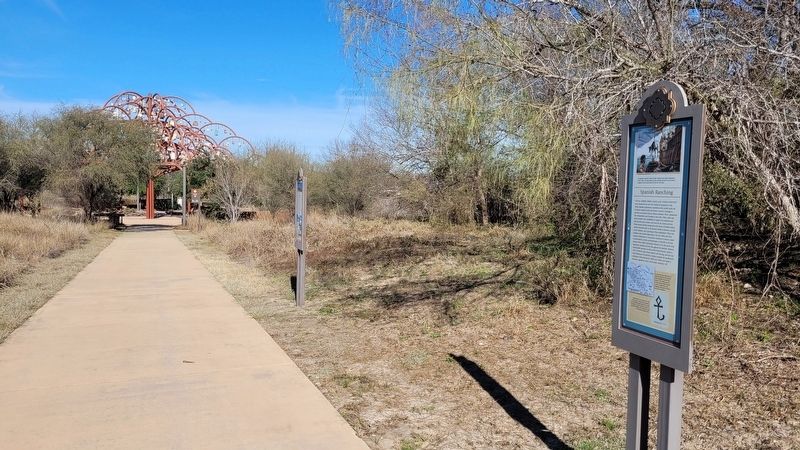
Mission San Francisco de la Espada was the first Spanish Mission in Texas. It was founded in 1690 as San Francisco de los Tejas near present-day Nacogdoches in East Texas. It was renamed as Mission San Francisco de la Espada when it moved to San Antonio in 1731. Distinctive Spanish design features can be seen in the church doorway, bell tower, and brick archways. Espada’s ranch, Rancho de las Cabras, is 23 miles south of the Mission and had as many as 1,262 head of cattle and 4,000 sheep. Mission Espada’s acequia is the nation’s oldest in continuous use. It still uses(Submitted on January 9, 2023, by James Hulse of Medina, Texas.)San Antonio River water to irrigate local crops today illustrating the connection the river makes between the past and the present.Photographed by James Hulse, December 27, 20223. The view of the Spanish Ranching Marker from the River Walk
Credits. This page was last revised on February 19, 2025. It was originally submitted on January 9, 2023, by James Hulse of Medina, Texas. This page has been viewed 320 times since then and 34 times this year. Photos: 1, 2, 3. submitted on January 9, 2023, by James Hulse of Medina, Texas.
