Sault Ste. Marie in Chippewa County, Michigan — The American Midwest (Great Lakes)
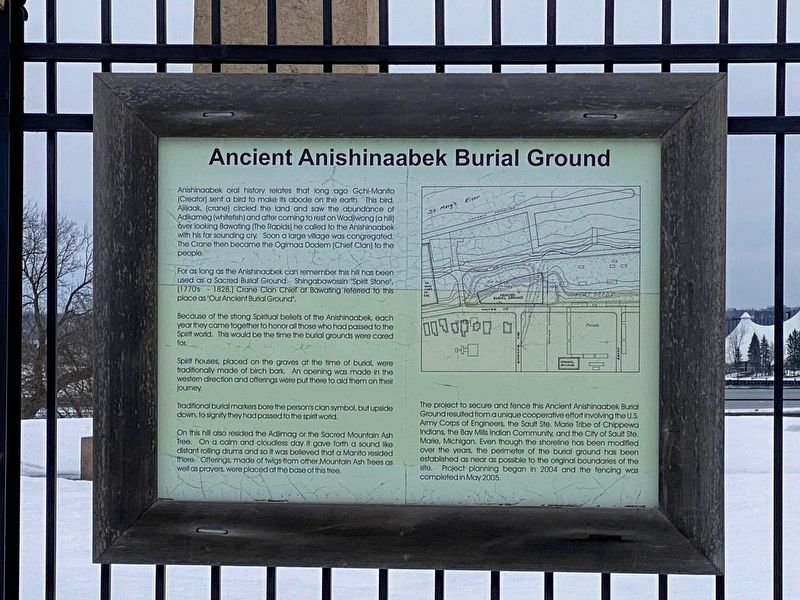
Ancient Anishinaabek Burial Ground
Photographed by J.T. Lambrou, January 3, 2023
1. Ancient Anishinaabek Burial Ground Marker
For as long as the Anishinaabek can remember this hill has been used as a Sacred Burial Ground. Shingabawossin "Spirit Stone", (1770's - 1828.) Crane Clan Chief at Bawating referred to this place as "Our Ancient Burial Ground".
Because of the strong Spiritual beliefs of the Anishinaabek, each year they came together to honor all those who had passed to the Spirit world. This would be the time the burial grounds were cared for.
Spirit houses, placed on the graves at the time of burial, were traditionally made of birch bark. An opening was made in the western direction and offerings were put there to aid them on their journey.
Traditional burial markers bore the person's clan
this page online
On this hill also resided the Adjimag or the Sacred Mountain Ash Tree. On a calm and cloudless day it gave forth a sound like distant rolling drums and so it was believed that a Manito resided there. Offerings, made of twigs from other Mountain Ash Trees as well as prayers, were placed at the base of this tree.
The project to secure and fence this Ancient Anishinaabek Burial Ground resulted from a unique cooperative effort involving the U.S. Army Corps of Engineers, the Sault Ste. Marie Tribe of Chippewa Indians, the Bay Mills Indian Community, and the City of Sault Ste. Marie, Michigan. Even though the shoreline has been modified over the years, the perimeter of the burial ground has been established as near as possible to the original boundaries of the site. Project planning began in 2004 and the fencing was completed in May 2005.
Topics. This historical marker is listed in these topic lists: Indigenous Peoples and Communities • Parks & Recreational Areas. A significant historical month for this entry is May 2005.
Location. 46° 29.963′ N, 84° 20.527′ W. Marker
Photographed by J.T. Lambrou, January 3, 2023
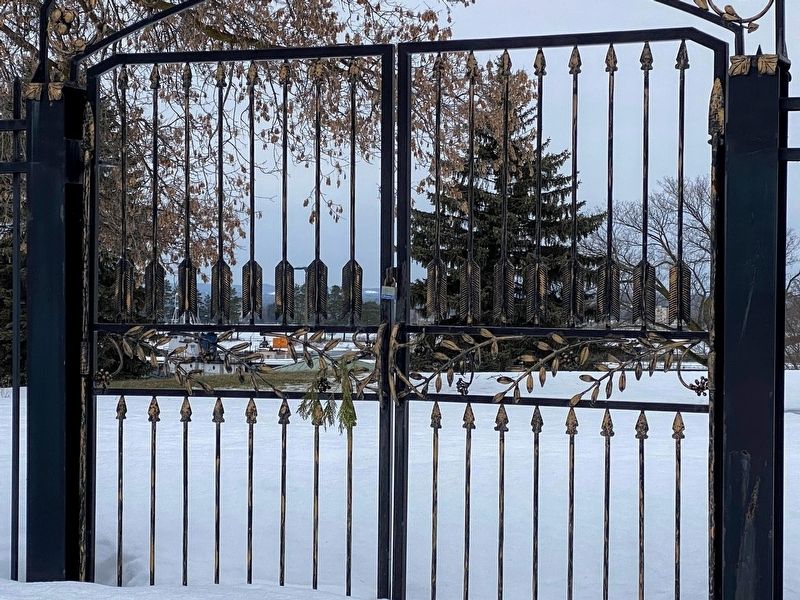
2. Ancient Anishinaabek Burial Ground
This gate controls access to the burial grounds which are not open for normal entry. Note the ornamental Native American metalwork.

Regionally, this marker is on the Upper Peninsula. It is also in the American Midwest and on Lake Superior’s South Shore Region. Globally, it is in North America, in the Great North Woods, on the Great Lakes, in the Western Hemisphere, in the Western World, and in the Anglosphere. Historically, it finds itself in what was once the Viceroyalty of New France and also the Northwest Territory.
Other nearby markers. At least 8 other markers are within walking distance of this marker: Fort Brady 1850 (within shouting distance of this marker); Statue of St. Mary (within shouting distance of this marker); Old Fort Brady (within shouting distance of this marker); Fort Brady (within shouting distance of this marker); A Sampler of Vessels That Have Passed This Spot (about 300 feet away, measured in a
Photographed by J.T. Lambrou, January 3, 2023
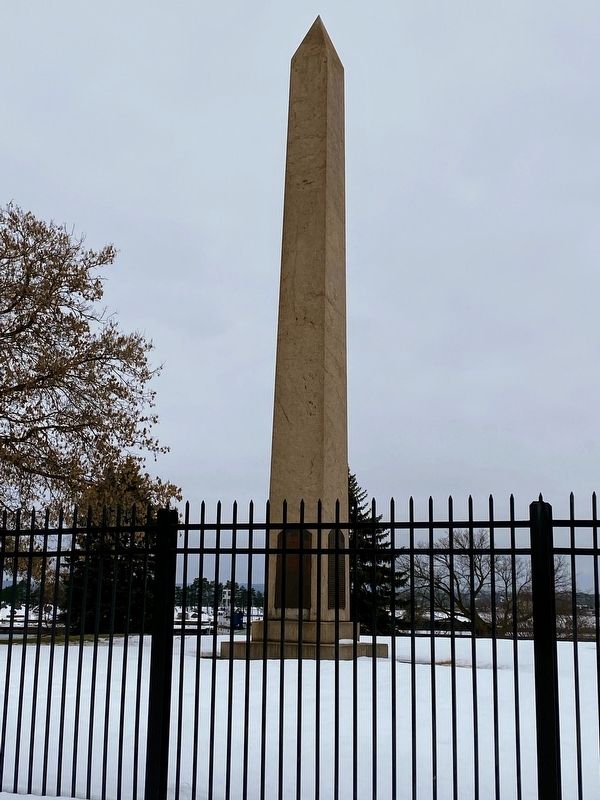
3. Ancient Anishinaabek Burial Ground
Obelisk is located in the center of the burial ground with Canada in the background.
Credits. This page was last revised on November 25, 2024. It was originally submitted on January 16, 2023, by J.T. Lambrou of New Boston, Michigan. This page has been viewed 1,447 times since then and 132 times this year. Photos: 1, 2, 3. submitted on January 18, 2023, by J.T. Lambrou of New Boston, Michigan. • J. Makali Bruton was the editor who published this page.
