
Main/Military Plaza in San Antonio in Bexar County, Texas — The American South (West South Central)
A Poor Settlement Takes Shape at the Northern Frontier of New Spain

Photographed by James Hulse, January 8, 2023
1. A Poor Settlement Takes Shape at the Northern Frontier of New Spain Marker
 By the Early 1720s the mission, presidio, and villa, established by the Spanish on the upper reaches of San Pedro Creek, had been moved downstream and closer to the San Antonio River. The mission was located on the east side of the river, and the presidio was between San Pedro Creek and the river. The main structures of these new establishments were made of adobe and stone, while most of the houses were simple jacales. In 1731, 56 civilian settlers arrived from the Canary Islands with an order from the King of Spain to establish San Fernando de Béxar, the first such official villa in Spanish Texas. While the small military garrison contributed to the local barter economy, the civilian settlers and mission communities were supported by farming and ranching. And, like all isolated and poor frontier outposts, the settlers of early San Antonio eventually had to be self-reliant and produce most of their own domestic and agricultural goods.
Captions
1: After the Canary Islanders arrived at Presidio San Antonio in 1731, the presidial commander, Juan Antonto Almenán, issued land titles to the new settlers, some of which were along the banks of San Pedro Creek. These were the first land grants in Texas from the Spanish crown.
2: This 1764 map shows the relocated presidio and mission and the Villa de San Fernando, the site granted to the Canary Island settlers. The villa buildings are shown between the presidio and the river.
3: In addition to individual land titles, the new Canary Island community a whole was granted lands for use as farms and ranches and a public places where they built their church, San Fernando. The limits of the villa, and ultimately the City of San Antonio, were centered on the front door of the church.
[Spanish
this page online
A Principios De La Década De 1720, la misión, el presidio y la villa, establecidos por los españoles en los tramos superiores de San Pedro Creek, se habían trasladado río abajo y más cerca del Río de San Antonio. La misión estaba ubicada en el lado este del río y el presidio estaba entre San Pedro Creek y el río. Las principales estructuras de estos nuevos establecimientos fueron de adobe y piedra, mientras que la mayoría de las viviendas eran simples jacales. En 1731, 56 colonos civiles llegaron de las Islas Canarias con una orden del Rey de España para establecer San Fernando de Béxar, la primera villa oficial de este tipo en la Texas española. Mientras que la pequeña guarnición militar contribuyó a la economía de trueque local, los colonos civiles y las comunidades misioneras fueron apoyados por la agricultura y la ganadería. Y, como todos los puestos fronterizos pobres y aislados, los primeros colonos de San Antonio finalmente tuvieron que ser autosuficientes y producir la mayoría de sus propios productos domésticos y agrícolas.
Subtítulos
1: Después de la llegado de los conartor al Presidio San Antonio en 1731, el comandante del presidio, Juan Antonio Almazán, otorgd titulos de proptedad a los nuevos pobladores, algunos de los cuales se encontraban a orillas de San Pedro Creek, Estas fueron las primeras concesiones de tierras en Texas de la corona española.
2: Este mapa de 1764 muestra el presidio y la misión reubicados y la Villa de San Fernando, el sitio cedido a los colonos canarios. Los edificios de la villa se muestran entre el presidio y el río.
3: Además de los titulos de propiedad individuales, a la nueva comunidad canaria en su conjunto se le otorgaron tierras para su uso como granjas y ranchos y una plaza pública donde construyeron su iglesia, San Fernando. Los limites de la villa, y finalmente la Ciudad de San Antonio, ce centraron en la entrada de la iglesia.
Erected 2022
Photographed by James Hulse, January 8, 2023
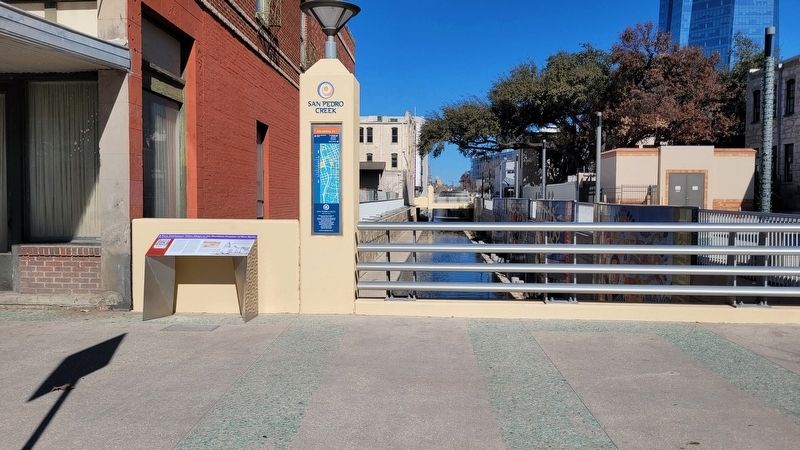
2. The view of the marker from the street
Topics. This historical marker is listed in these topic lists: Colonial Era • Hispanic Americans • Parks & Recreational Areas • Religion & Religious Structures. A significant historical year for this entry is 1731.
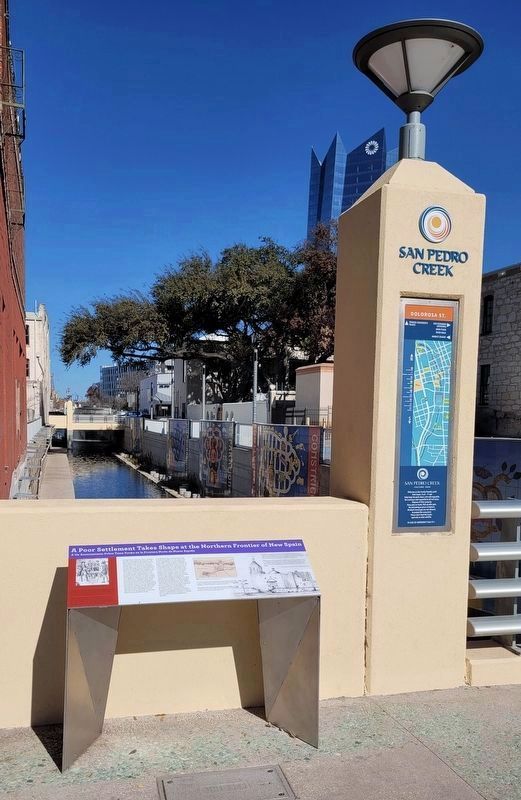
Location. 29° 25.458′ N, 98° 29.785′ W. Marker is in San Antonio, Texas, in Bexar County. It is in Main/Military Plaza. It is on Dolorosa Street 0.1 miles east of South Laredo Street, on the right when traveling west. The marker is located along the north side of Dolorosa Street at the bridge in the park. Touch for map. Marker is at or near this postal address: 601 Dolorosa Street, San Antonio TX 78205, United States of America. Touch for directions.

Regionally, this marker is in South Texas. It is also in the American South. Globally, it is in North America, a Gulf of Mexico state, the Western Hemisphere, the Western World, and the Anglosphere. Historically, it finds itself in what was once New Spain, the Republic of Texas, and one of the Confederate States of America.
Other nearby markers. At least 8 other markers are within walking distance
Photographed by James Hulse, January 8, 2023
3. The view of the marker on the Dolorosa Street Bridge
Also see . . . Where beauty meets purpose. San Pedro Creek Culture Park (Submitted on January 23, 2023, by James Hulse of Medina, Texas.)
Credits. This page was last revised on February 2, 2023. It was originally submitted on January 22, 2023, by James Hulse of Medina, Texas. This page has been viewed 246 times since then and 22 times this year. Photos: 1, 2, 3. submitted on January 23, 2023, by James Hulse of Medina, Texas.
