Southside in San Antonio in Bexar County, Texas — The American South (West South Central)
Building Sanctuaries
Photographed by James Hulse, December 27, 2022
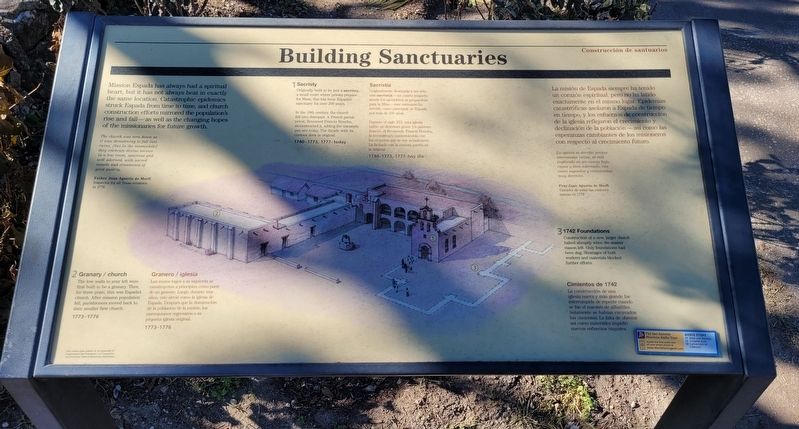
1. Building Sanctuaries Marker
 Mission Espada has always had a spiritual heart, but it has not always beat in exactly the same location. Catastrophic epidemics struck Espada from time to time, and church construction efforts mirrored the population's rise and fall-as well as the changing hopes of the missionaries for future growth.
The church was torn down as it was threatening to fall into ruins, (but in the meanwhile) they celebrate divine service in a los room, spacious and well adorned, with sacred vessels and ornaments of good quality.
Father Juan Agustín de Morti
Inspector for all Texas missions in 1778
1. Sacristy
Originally built to be just a sacristy, a small room where priests prepare for Mass, this has been Espadas sanctuary for over 200 years.
In the 19th century, the church fell into disrepair. A French parish priest, Reverend Francis Bouchu, reconstructed it, adding the transepts you see today The façade with its curious door is original.
1740-1773, 1777-today
2. Granary/church
The low walls to your left were first built to be a granary. Then, for three years, this was Espada's church. After mission population
this page online
1773-1776
3. 1742 Foundations
Construction of a new, larger church halted abruptly when the master mason left. Only foundations had been dug. Shortages of both workers and materials blocked further efforts.
[Spanish Text]
La iglesia se derribó porque amenazaba ruína, se está supliendo en un cuarto bajo, capaz y bien adornado, con vasos sagrados y ornamentas muy decentes.
Fray Juan Agustin de Morfi
Visitador de todas las misiones tejanas en 1778
1. Sacristia
Originalmente destinada a ser sólo una sacristis un courto peque donde los sacerdotes se propamban para la Misa-este santuaria ha servido como parroquia de Espada por más de 200 años.
Durante el siglo XIX,
Photographed by James Hulse, December 27, 2022
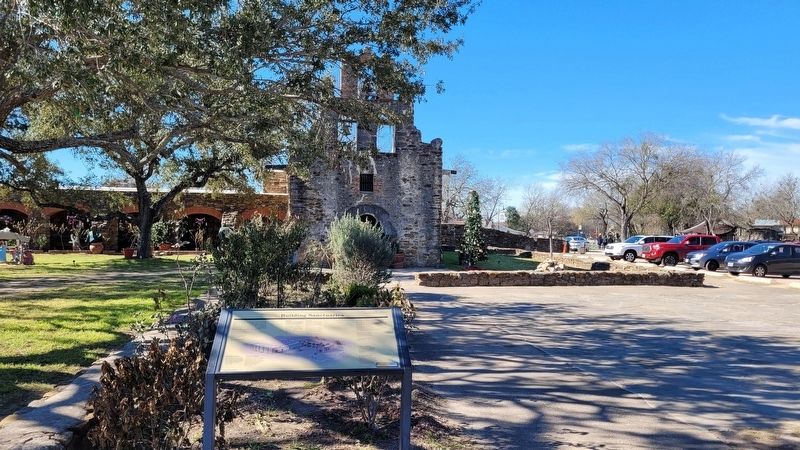
2. The Building Sanctuaries Marker and the Chapel in the background
1740-1773, 1777-hoy día
2. Granero/iglesia
Los muros bajos a su izquierda se construyeron a principios como parte de un granere. Luego, durante tres años, este sirvió como la iglesia de Espada. Después que la disminución de la población de la misión, los parroquianos regresaron a su pequeña iglesia original.
1773-1776
3. Cimientos de 1742
La construcción de una iglesia nueva y más grande fue interrumpida de repente cuando se fue el maestro de albañiles. Solamente se habían excavados los cimientos. La falta de obreros así como materiales impidió nuevos esfuerzos mayores.
Erected by San Antonio Missions National Historical Park.
Topics. This historical marker is listed in these topic lists: Disasters • Hispanic Americans • Indigenous Peoples and Communities • Religion & Religious Structures. A significant historical year for this entry is 1778.
Location. 29° 19.089′ N, 98° 27.051′ W. Marker is in San Antonio,
Photographed by James Hulse, December 27, 2022
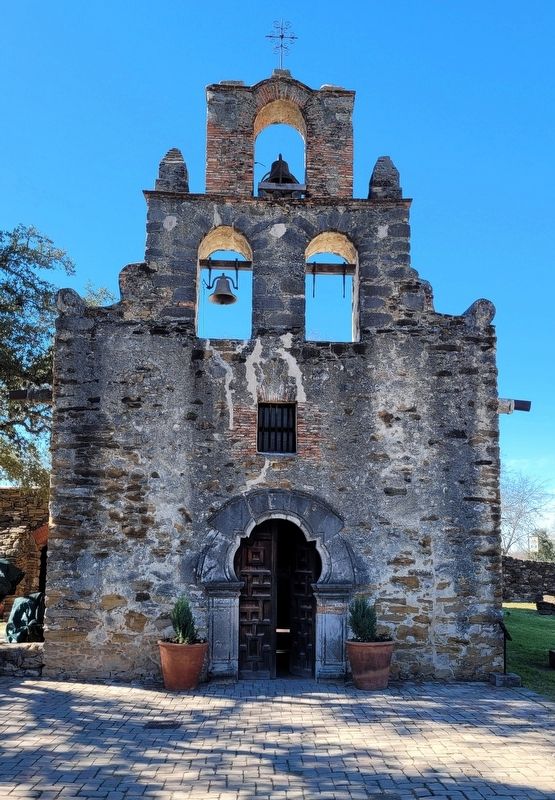
3. The Chapel

Regionally, this marker is in South Texas. It is also in the American South. Globally, it is in North America, a Gulf of Mexico state, the Western Hemisphere, the Western World, and the Anglosphere. Historically, it finds itself in what was once New Spain, the Republic of Texas, and one of the Confederate States of America.
Other nearby markers. At least 8 other markers are within walking distance of this marker: Church Today / La iglesia hoy en día (here, next to this marker); The Church (a few steps from this marker); Granary (within shouting distance of this marker); Espada Mission (within shouting distance of this marker); Defending the Faithful (within shouting distance of this marker); Mastering New Mysteries (within shouting distance of this marker); Mission San Francisco de la Espada (about 300 feet away, measured in a direct line); San Antonio Missions (about 300 feet away). Touch for a list and map of all markers in San Antonio.
Also see . . . Mission Espada. San Antonio Missions - World Heritage
Mission San Francisco de la Espada was the first Spanish Mission in Texas. It was founded in 1690 as San Francisco de los Tejas near present-day Nacogdoches in East Texas. It was renamed as Mission San Francisco de la Espada when it moved to San Antonio in 1731. Distinctive Spanish design features can be seen in the church doorway, bell tower, and brick archways. Espada’s ranch, Rancho de las Cabras, is 23 miles south of the Mission and had as many as 1,262 head of cattle and 4,000 sheep. Mission Espada’s acequia is the nation’s oldest in continuous use. It still uses San Antonio River water to irrigate local crops today illustrating the connection the river makes between the past and the present.(Submitted on January 30, 2023, by James Hulse of Medina, Texas.)
Credits. This page was last revised on January 30, 2023. It was originally submitted on January 30, 2023, by James Hulse of Medina, Texas. This page has been viewed 183 times since then and 18 times this year. Photos: 1, 2, 3. submitted on January 30, 2023, by James Hulse of Medina, Texas.
