Île Saint-Louis in Paris in Département de Paris, Île-de-France, France — Western Europe
Marie Curie

Photographed by Andrew Ruppenstein, July 26, 2022
1. Marie Curie Marker

Marie Curie
1867 - 1934
a habité cet immeuble
de 1912 à 1934
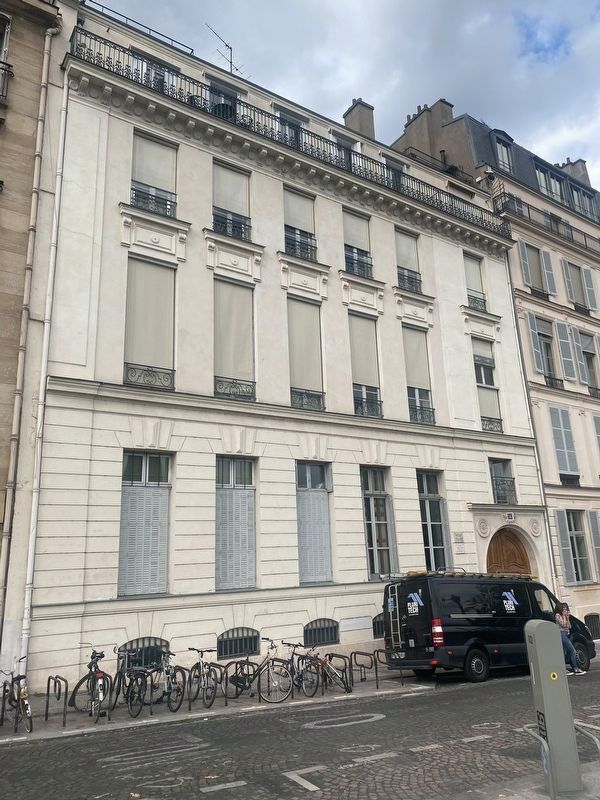
Marie Curie (1867-1934) lived in this building from 1912 to 1934.
Topics. This historical marker is listed in these topic lists: Science & Medicine • Women. A significant historical year for this entry is 1867.
Location. 48° 51.065′ N, 2° 21.38′ E. Marker is in Paris, Île-de-France, in Département de Paris. It is in Île Saint-Louis. It is on Quai de Béthune, on the left when traveling east. Touch for map. Marker is at or near this postal address: 36 Quai de Béthune, Paris, Île-de-France 75004, France. Touch for directions.

Regionally, it is in the North Atlantic Region, Europe, the European Union, Atlantic Europe, the Schengen Area, Western Europe, a coastal Mediterranean country, and the Western World. Historically, it finds itself in what was once a French colony and also the Roman Empire.
Other nearby markers. At least 8 other markers are within walking distance of this marker: Rene Cassin (here, next to this marker); Jean de la Ville de Mirmont (within shouting distance of this marker); Felix Arvers
this page online
Also see . . .
1. Marie Curie (Wikipedia).
Overview: Marie Salomea Skłodowska–Curie (7 November 1867 – 4 July 1934) was a Polish and naturalized-French physicist and chemist who conducted pioneering research on radioactivity. She was the first woman to win a Nobel Prize, the first person and the only woman to win a Nobel Prize twice, and the only person to win a Nobel Prize in two scientific fields. Her husband, Pierre Curie, was a co-winner of her first Nobel Prize, making them the first-ever married couple to win the Nobel Prize and launching the Curie family legacy of five Nobel Prizes. She was, in 1906, the first woman to become a professor at the University of Paris.(Submitted on February 12, 2023.)
2. The genius of Marie Curie (YouTube, 5 min.).

Photographed by Andrew Ruppenstein, July 26, 2022
2. Marie Curie Marker - wide view
The Marie Curie marker is the upper one of the two visible here, while the lower one is for Rene Cassin.
3. A Tribute to Nobel Laureate Madame Marie Sklodowska-Curie (Library of Congress).
Summary of achievements and recognition: Marie Curie was one of the great scientific minds of the 20th century, and one of the first women scientists to gain worldwide fame and recognition. Her pioneering studies of radium and polonium contributed profoundly to understanding radioactivity. She was the first to use the term “radioactivity” and the first woman in Europe to receive a doctorate in science. She was also the first female lecturer, professor, and head of a laboratory at the Sorbonne University in Paris. During her life Marie Curie received 15 gold medals, 19 honorary degrees, and other awards. For her achievements,(Submitted on February 12, 2023.)she was the first woman laid to her final rest under the dome of the famous Panthéon mausoleum in Paris where French luminaries were laid to rest.Photographed by Andrew Ruppenstein, July 26, 20223. Marie Curie Marker - wider viewIt’s worth noting here that Marie Curie’s lab at the Sorbonne and her final resting place in the Pantheon are not far from here, both being less than a 15 minute walk to the south, on the other side of the Seine.

Courtesy of the New York Public Library
4. Madame Curie in her Laboratory
Credits. This page was last revised on February 12, 2023. It was originally submitted on February 12, 2023, by Andrew Ruppenstein of Lamorinda, California. This page has been viewed 547 times since then and 62 times this year. Photos: 1, 2, 3. submitted on February 12, 2023, by Andrew Ruppenstein of Lamorinda, California. 4. submitted on February 12, 2023.
