Crow Agency in Big Horn County, Montana — The American West (Mountains)
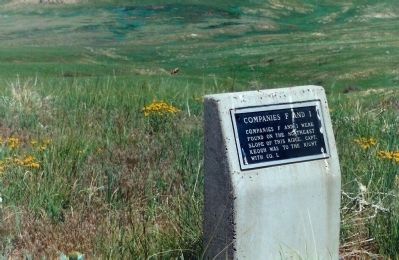
Companies F and I
(Little Bighorn Battlefield)
Photographed by Mike Stroud, June 1992
1. Companies F and I Marker
Companies F and I were found on the northeast slope of this ridge. Capt. Keogh was to the right with Co. I.
Topics. This historical marker is listed in these topic lists: Indigenous Peoples and Communities • Wars, US Indian.
Location. 45° 33.956′ N, 107° 25.341′ W. Marker is in Crow Agency, Montana, in Big Horn County. It is on Battlefield Tour Road. Touch for map. Marker is in this post office area: Crow Agency MT 59022, United States of America. Touch for directions.

Regionally, this marker is in andspecifically he Crow Nation, in Southeast Montana, in Custer Country. It is also in the American Mountain West, in the Lewis & Clark Corridor, on the prairies, on the Great Plains, and specifically on the Northern Plains. Globally, it is in North America, the Rocky Mountains, the Western Hemisphere, the Western World, and the Anglosphere. Historically, it finds itself in what was once Rupert’s Land and also the Louisiana Purchase.
Other nearby markers. At least 8 other markers are within walking distance of this marker: Keogh – Crazy Horse Fight (about
this page online
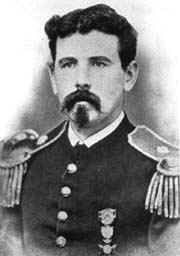
Regarding Companies F and I. Keogh received a permanent commission as Captain of Company I, 7th U.S. Cavalry Regiment commanded by George Armstrong Custer during the Indian Wars of the 1870s.
Also see . . . Miles Keogh. Wikipedia biography (Submitted on March 29, 2021, by Larry Gertner of New York, New York.)
Photographed by Mike Stroud, June 1992
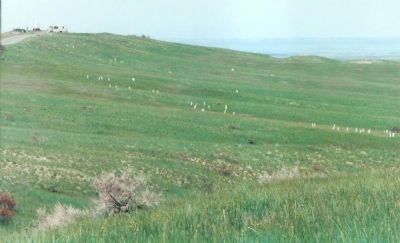
2. Companies F and I were found on the northeast slope of this ridge
Famed warrior Crazy Horse, struck Keough's Co., now combined with survivors of Co.s C and L
Photographed by Wikipedia
3. Myles Keogh
Library of Congress Prints and Photographs Division; John C. H.Grabill, photographer
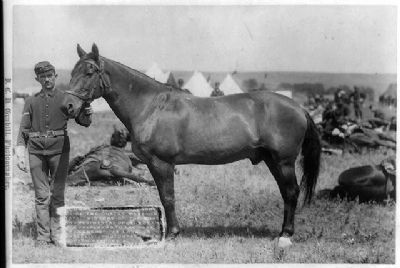
4. The horse named, Comanche.
LC-DIG-ppmsc-02554 (digital file from original print) LC-USZ62-11937 (b&w film copy neg.)
This incredible animal had been shot several times during the battle but when the army rummaged across the battlefield, bodies of both men and horses spread everywhere, the horse called Comanche was discovered, the hand of his dead master , Captain Myles Keogh still clutching the reins. Man and horse had been through much together.
Comanche remained with his owner on Custer Hill. While all around him soldiers slaughtered their horses to hide behind and shoot, evidence and oral tradition shows that Keough crouched between Comanche’s legs, holding onto his reins, while he was fighting. Keough was killed, but his hands still clutched Comanche’s reins. Warriors left the horse alone; it would have been bad medicine to take a horse so closely tied to his owner that the man held the reins even in death.
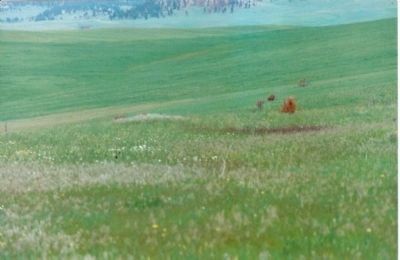
Photographed by Mike Stroud, June 1992
5. remains of Troopers Rifle Pit (NPS)
Internet Archive, January 1891
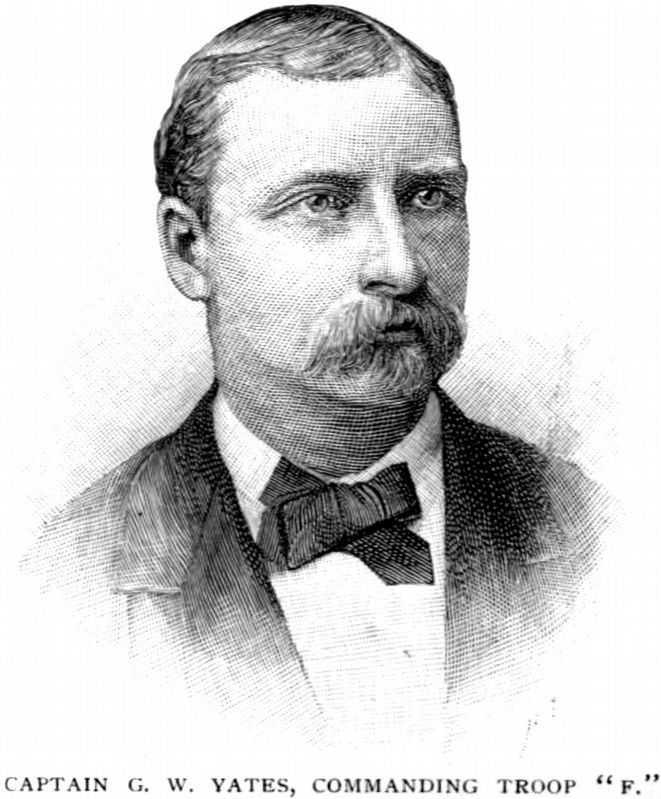
6. Captain G. W. Yates
Commanding Troop "F"
Commanding Troop "F"
From The Century Illustrated, Vol. XLIII, No. 3, January 1891.
Credits. This page was last revised on September 16, 2024. It was originally submitted on August 14, 2009, by Mike Stroud of Bluffton, South Carolina. This page has been viewed 3,203 times since then and 63 times this year. Photos: 1, 2. submitted on August 14, 2009, by Mike Stroud of Bluffton, South Carolina. 3, 4. submitted on June 24, 2012, by Mike Stroud of Bluffton, South Carolina. 5. submitted on August 14, 2009, by Mike Stroud of Bluffton, South Carolina. 6. submitted on December 9, 2018, by Allen C. Browne of Silver Spring, Maryland. • Craig Swain was the editor who published this page.
