Centro Histórico in Ciudad de México, Mexico — The Valley of Mexico (The Central Highlands)
Francisco Zarco
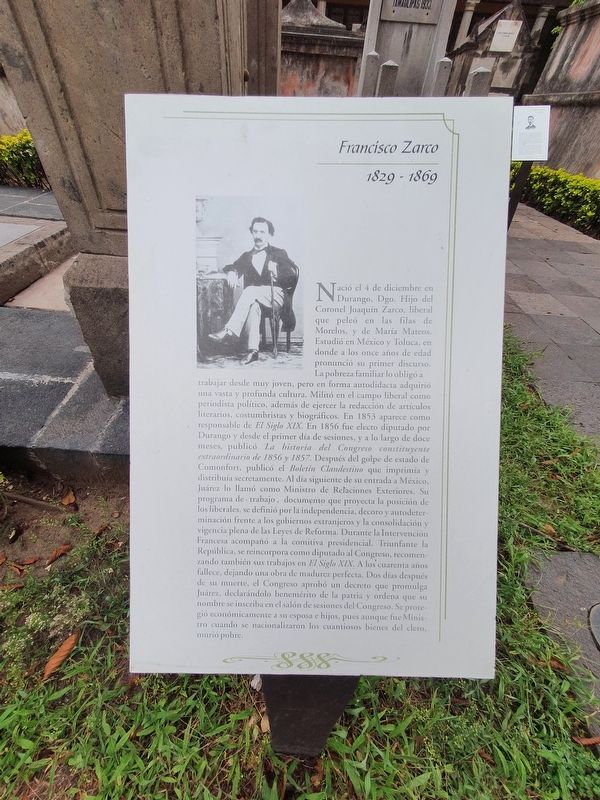
Photographed by J. Makali Bruton, May 24, 2022
1. Francisco Zarco Marker

1829-1869
Nació el 4 de diciembre en Durango, Dgo. Hijo del Coronel Joaquín Zarco, liberal que peleó en las filas de Morelos, y de María Mateos. Estudió en México y Toluca, en donde a los once años de edad pronunció su primer discurso. La pobreza familiar lo obligó a trabajar desde muy joven, pero en forma autodidacta adquirió una vasta y profunda cultura. Militó en el campo liberal como periodista político, además de ejercer la redacción de artículos literarios, costumbristas y biográficos. En 1853 aparece como responsable de El Siglo XIX. En 1856 fue electo diputado por Durango y desde el primer día de sesiones, y a lo largo de doce meses, publicó La historia del Congreso constituyente extraordinario de 1856 y 1857. Después del golpe de estado de Comonfort, publicó el Boletin Clandestino que imprimía y distribuía secretamente. Al día siguiente de su entrada a México, Juárez lo llamó como Ministro de Relaciones Exteriores. Su programa de trabajo, documento que proyecta la posición de los liberales, se definió por la independencia, decoro y autodeterminación frente a los gobiernos extranjeros
this page online
Francisco Zarco
1829-1869
Born December 4 in Durango, Durango. Son of Colonel Joaquín Zarco, a Liberal who fought in the ranks of Morelos, and María Mateos. He studied in Mexico and Toluca, where at the age of eleven he gave his first speech. Family poverty forced him to work from a very young age, but in a self-taught way he acquired a vast and deep culture. He was active in the Liberal field as a political journalist, in addition to writing literary and biographical articles,
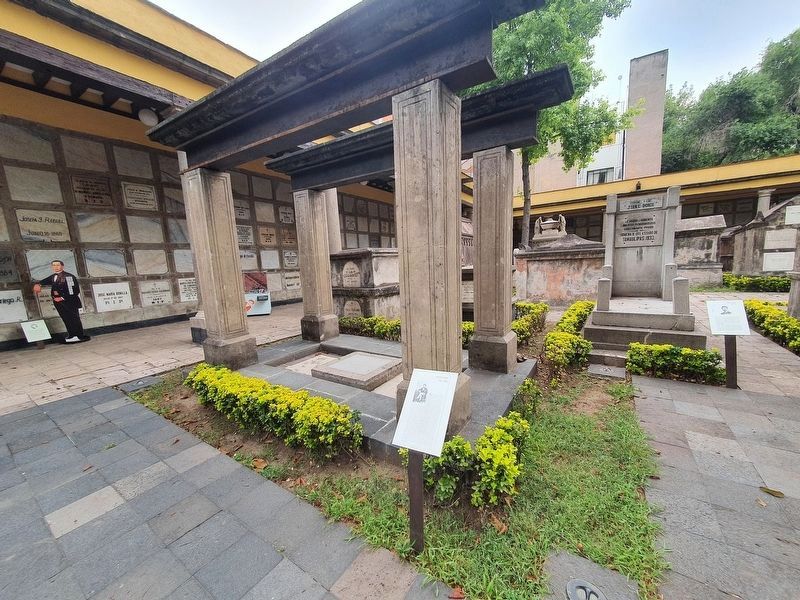
Photographed by J. Makali Bruton, May 24, 2022
2. Francisco Zarco Marker
Topics. This historical marker is listed in these topic lists: Civil Rights • Communications • Wars, Non-US. A significant historical date for this entry is December 4, 1853.
Location. 19° 26.353′ N, 99° 8.877′ W. Marker is in Ciudad de México. It is in Centro Histórico. It can be reached from Calle San Fernando, on the right when traveling west. The marker is on the grounds of the San Fernando Cemetery (Panteón San Fernando). Touch for map. Marker is at or near this postal address: C San Fernando 17, Ciudad de México 06300, Mexico. Touch for directions.

Regionally, this marker is in Central Mexico and specifically in Mexico City Metropolitan Area. Globally, it is in North America, specifically in Mesoamerica, on the Ring of Fire, and in the Western Hemisphere. Historically, it finds itself in what was once New Spain, a Spanish colony, and the Aztec Empire.
Other nearby markers. At least 8 other markers are within walking distance of this marker: Margarita Maza de Juárez (here, next to this marker); Anastacio Zerecero (here, next to this marker); Juan C. Doria (here, next to this marker); Santiago Felipe Xiconténcatl (here, next to this marker); The Children's Wall (here, next to this marker); José María Valdivieso (a few steps from this marker); Margarita Maza Parada (a few steps from this marker); Juan de la Granja (a few steps from this marker). Touch for a list and map of all markers in Ciudad de México.
Credits. This page was last revised on February 26, 2023. It was originally submitted on February 26, 2023, by J. Makali Bruton of Washington, District of Columbia. This page has been viewed 154 times since then and 30 times this year. Photos: 1, 2. submitted on February 26, 2023, by J. Makali Bruton of Washington, District of Columbia.
