Anniston in Calhoun County, Alabama — The American South (East South Central)
The Photograph
| — | Freedom Riders National Monument | — |
Photographed by Duane and Tracy Marsteller, February 26, 2023
1. The Photograph Marker
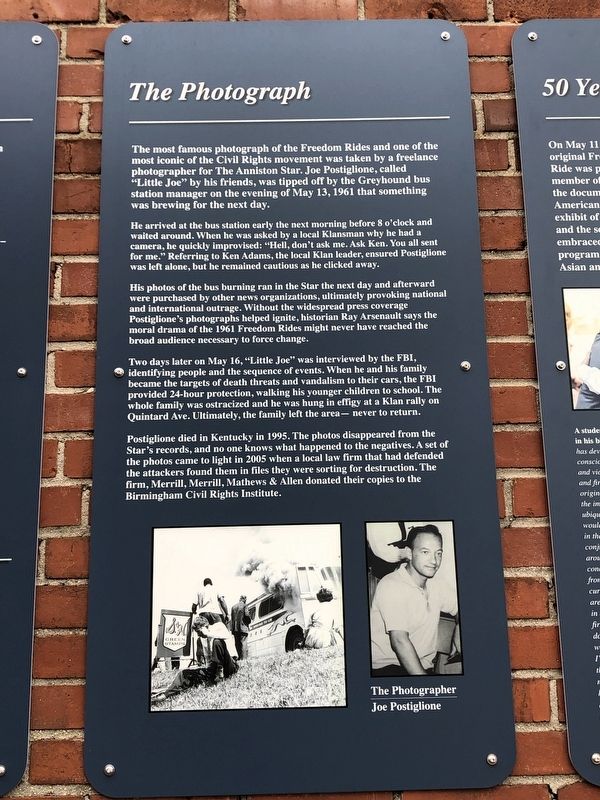
The most famous photograph of the Freedom Rides and one of the most iconic of the Civil Rights movement was taken by a freelance photographer for The Anniston Star. Joe Postiglione, called “Little Joe” by his friends, was tipped off by the Greyhound bus station manager on the evening of May 13, 1961 that something was brewing for the next day.
He arrived at the bus station early the next morning before 8 o'clock and waited around. When he was asked by a local Klansman why he had a camera, he quickly improvised: “Hell, don't ask me. Ask Ken. You all sent for me.” Referring to Ken Adams, the local Klan leader, ensured Postiglione was left alone, but he remained cautious as he clicked away.
His photos of the bus burning ran in the Star the next day and afterward were purchased by other news organizations, ultimately provoking national and international outrage. Without the widespread press coverage Postiglione's photographs helped ignite, historian Ray Arsenault says the moral drama of the 1961 Freedom Rides might never have reached the broad audience necessary to force change.
Two days later on May 16, “Little Joe” was
this page online
Postiglione died in Kentucky in 1995. The photos disappeared from the Star's records, and no one knows what happened to the negatives. A set of the photos came to light in 2005 when a local law firm that had defended the attackers found them in files they were sorting for destruction. The firm, Merrill, Merrill, Mathews & Allen donated their copies to the Birmingham Civil Rights Institute.
Topics. This historical marker is listed in these topic lists: African Americans • Civil Rights • Communications • Roads & Vehicles. A significant historical date for this entry is May 14, 1961.
Location. 33° 39.481′ N, 85° 49.874′ W. Marker is in Anniston, Alabama, in Calhoun County. It can be reached from Gurnee Avenue south of West 11th Street, on the left when traveling
Photographed by Duane and Tracy Marsteller, February 26, 2023
2. The Photograph Marker
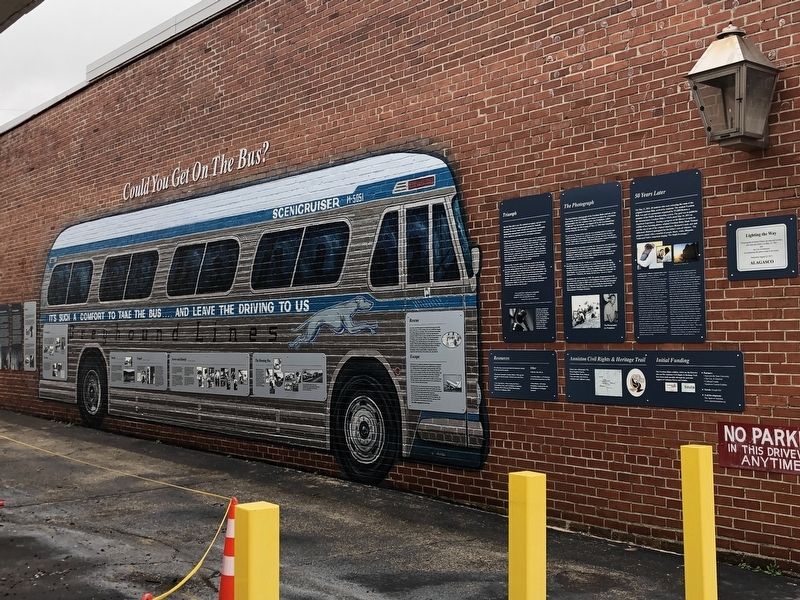
Featured marker is second from right.

Regionally, this marker is in East Alabama. It is also in the American South and specifically in the Deep South. Globally, it is in North America, a Gulf of Mexico state, the Western Hemisphere, the Western World, and the Anglosphere. Historically, it finds itself in what was once the original Cherokee Nation, the territory of the Mississippian Culture, one of the Confederate States of America, and the Antebellum South.
Other nearby markers. At least 8 other markers are within walking distance of this marker: 50 Years Later (here, next to this marker); Triumph (here, next to this marker); Rescue / Escape (here, next to this marker); The Burning Bus (here, next to this marker); Horror and Disbelief (here, next to this marker); Pursuit / Trapped (here, next to this marker); The Ambush / The Police (here, next to this marker); Prelude / Arrival (here, next to this marker). Touch for a list and map of all markers in Anniston.
Related markers. Click here for a list of markers that are related to this marker.
Credits. This page was last revised on June 27, 2025. It was originally submitted on March 3, 2023, by Duane and Tracy Marsteller of Murfreesboro, Tennessee. This page has been viewed 1,584 times since then and 119 times this year. Photos: 1, 2. submitted on March 3, 2023, by Duane and Tracy Marsteller of Murfreesboro, Tennessee.
