
Tzintzuntzan, Michoacán, Mexico — The Pacific Coast (and Central Highlands)
Hospital
Photographed by J. Makali Bruton, December 2, 2022
1. Hospital Marker

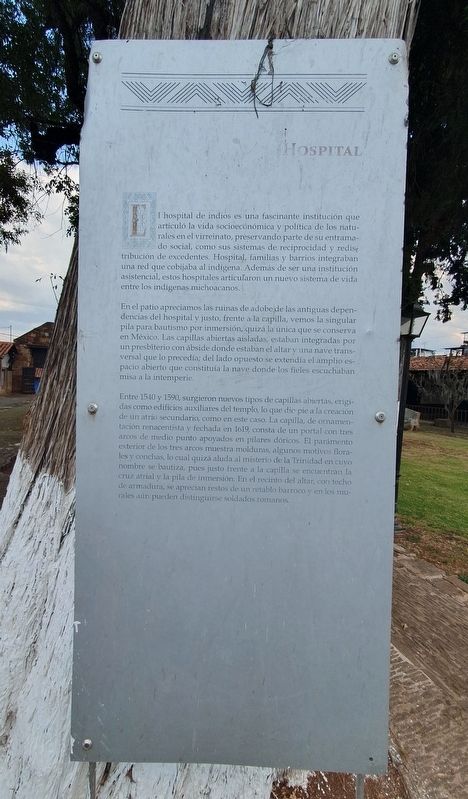
El hospital de indios es una fascinante institución que articuló la vida socioeconómica y política de los naturales en el virreinato, preservando parte de su entramado social, como sus sistemas de reciprocidad y redistribución de excedentes. Hospital, familias y barrios integraban una red que cobijaba al indígena. Además de ser una institución asistencial, estos hospitales articularon un nuevo sistema de vida entre los indígenas michoacanos.
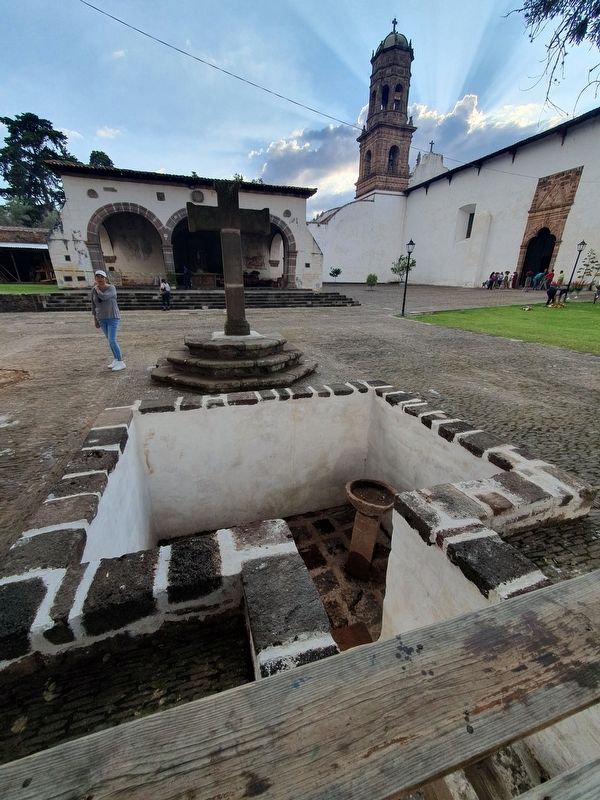
En el patio apreciamos las ruinas de adobe de las antiguas dependencias del hospital y justo, frente a la capilla, vemos la singular pila para bautismo por inmersión, quizá la única que se conserva en México. Las capillas abiertas aisladas, estaban integradas por un presbiterio con ábside donde estaban el altar y una nave transversal que lo precedía; del lado opuesto se extendía el amplio espacio abierto que constituía la nave donde los fieles escuchaban misa a la intemperie.
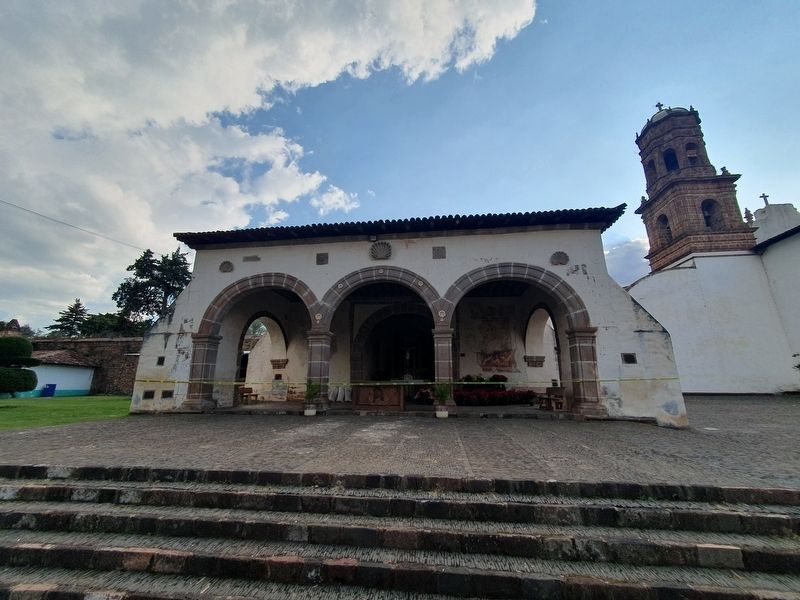
Entre 1540 y 1590, surgieron nuevos tipos de capillas abiertas, erigidas como edificios auxiliares del templo, lo que dic pie a la creación de un atrio secundario, como en este caso. La capilla, de ornamentación renacentista y fechada en 1619, consta de un portal con tres arcos de medio punto apoyados en pilares dóricos. El paramento exterior de los tres arcos muestra molduras, algunos motivos flora les y conchas, lo cual quizá aluda al misterio de la Trinidad en cuyo nombre se bautiza, pues justo frente a la capilla se encuentran la cruz atrial y la pila de inmersión. En el recinto del altar, con techo de armadura, se aprecian restos de un retablo barroco y en los murales aún pueden distinguirse soldados romanos.
Hospital
The Indian hospital is a fascinating institution that articulated the socioeconomic and political life of the natives in the viceroyalty,
this page online
In the courtyard we appreciate the adobe ruins of the old hospital dependencies and just in front of the chapel, we see the unique font for baptism by immersion, perhaps the only one preserved in Mexico. The isolated open chapels were composed of a presbytery with apse where the altar was and a transverse nave that preceded it; on the opposite side extended the wide open space that constituted the nave where the faithful listened to mass outdoors.
Between 1540 and 1590, new types of open chapels emerged, erected as auxiliary buildings of the temple, which led to the creation of a secondary atrium, as in this case. The chapel, of Renaissance ornamentation and dated 1619, consists of a portal with three semicircular arches supported by Doric pillars. The exterior face of the three arches includes moldings, some floral
Photographed by J. Makali Bruton, December 2, 2022
2. Hospital Marker
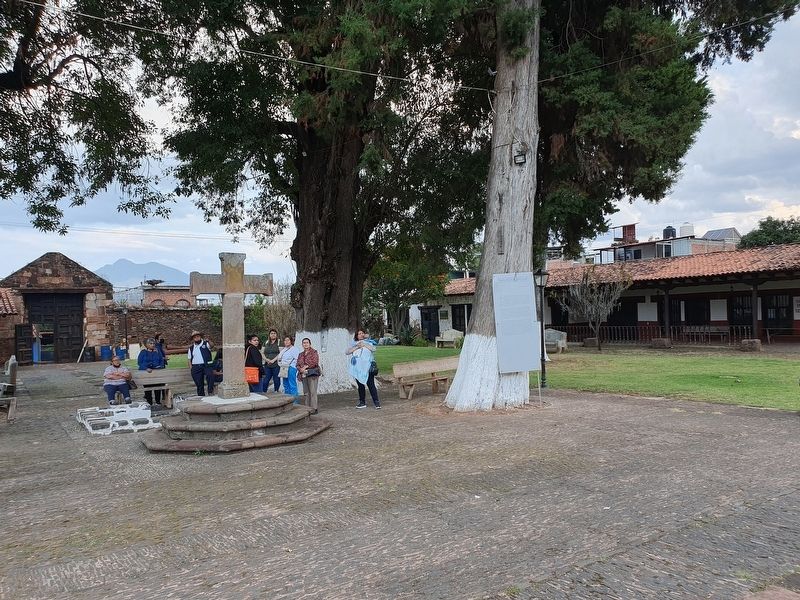
Note the atrial cross near the marker.
Topics. This historical marker is listed in these topic lists: Architecture • Colonial Era • Indigenous Peoples and Communities • Religion & Religious Structures. A significant historical year for this entry is 1540.
Location. 19° 37.615′ N, 101° 34.713′ W. Marker is in Tzintzuntzan, Michoacán. It can be reached from Tariacuri west of Calle Progreso, on the left when traveling east. The marker is on the grounds of the Templo de la Soledad. Touch for map. Marker is in this post office area: Tzintzuntzan MIC 58440, Mexico. Touch for directions.

Regionally, this marker is in Western Mexico, in the Bajío, and on the Pacific Coast. Globally, it is in North America, specifically in Mesoamerica, on the Ring of Fire, on the Pacific Rim, and in the Western Hemisphere. Historically, it
Photographed by J. Makali Bruton, December 2, 2022
3. The three-arch portal mentioned in the marker text
Other nearby markers. At least 8 other markers are within walking distance of this marker: Entryway of the Convent of Santa Ana (about 120 meters away, measured in a direct line); First Mass in Michoacán (about 120 meters away); The Atrium of the Convent of Santa Ana (about 120 meters away); Franciscan Monastery of Tzintzuntzan (about 150 meters away); Tzintzuntzan Named as Municipality (about 180 meters away); Lake Patzcuaro (approx. 0.6 kilometers away); Imparting Justice (approx. 0.6 kilometers away); Terraces and the Great Platform (approx. 0.6 kilometers away). Touch for a list and map of all markers in Tzintzuntzan.
Photographed by J. Makali Bruton, December 2, 2022
4. The baptismal font mentioned in the marker text
Credits. This page was last revised on April 4, 2025. It was originally submitted on March 20, 2023, by J. Makali Bruton of Washington, District of Columbia. This page has been viewed 130 times since then and 15 times this year. Photos: 1, 2, 3, 4. submitted on March 20, 2023, by J. Makali Bruton of Washington, District of Columbia.
