Castolon in Big Bend National Park in Brewster County, Texas — The American South (West South Central)
La Harmonia Store
Big Bend National Park
Photographed by James Hulse, March 15, 2023
1. La Harmonia Store Marker
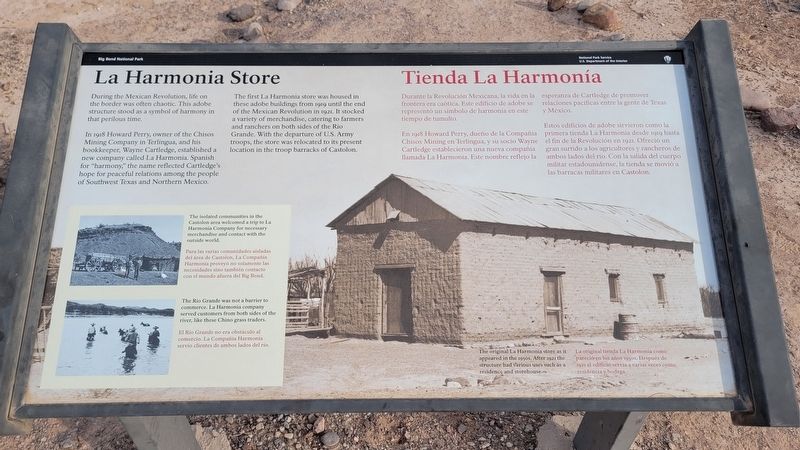
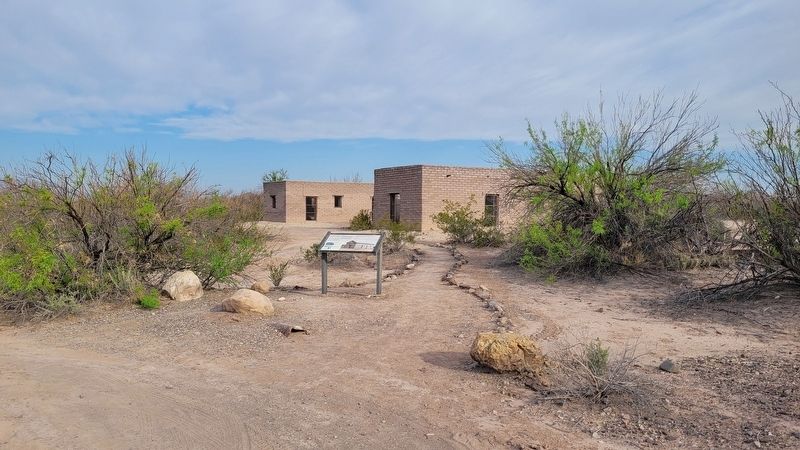
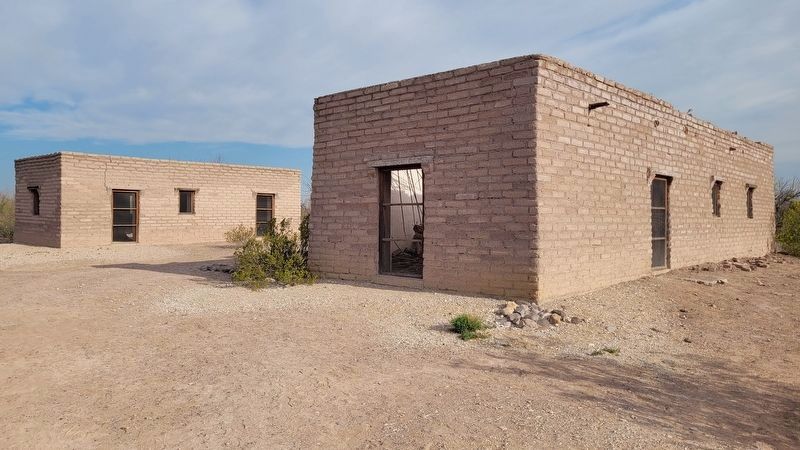
 During the Mexican Revolution, life on the border was often chaotic. This adobe structure stood as a symbol of harmony in that perilous time.
In 1918 Howard Perry, owner of the Chisos Mining Company in Terlingua, and his bookkeeper, Wayne Cartledge, established a new company called La Harmonia. Spanish for "harmony," the name reflected Cartledge's hope for peaceful relations among the people of Southwest Texas and Northern Mexico.
The first La Harmonia store was housed in these adobe buildings from 1919 until the end of the Mexican Revolution in 1921. It stocked a variety of merchandise, catering to farmers and ranchers on both sides of the Rio Grande. With the departure of U.S. Army troops, the store was relocated to its present location in the troop barracks of Castolon.
Captions
The isolated communities in the Castolon area welcomed a trip to La Harmonia Company for necessary merchandise and contact with the outside world.
The Rio Grande was not a barrier to commerce. La Harmonia company served customers from both sides of the river, like these Chino grass traders.
The original La Harmonia store as it appeared in the 1950s. After 1921 the structure had various uses such as a residence and storehouse.
Spanish:
Durante
this page online
En 1918 Howard Perry, dueño de la Compañía Chisos Mining en Terlingua, y su socio Wayne Cartledge establecieron una nueva compañía llamada La Harmonía. Este nombre reflejo la esperanza de Cartledge de promover relaciones pacificas entre la gente de Texas y México.
Estos edificios de adobe sirvieron como la primera tienda La Harmonía desde 1919 hasta el fin de la Revolución en 1921. Ofreció un gran surtido a los agricultores y rancheros de ambos lados del río. Con la salida del cuerpo militar estadounidense, la tienda se movió a las barracas militares en Castolon.
Subtítulos
Para las varias comunidades aisladas del área de Castolon, La Compañía Harmonía proveyó no solamente las necesidades sino también contacto con el mundo afuera del Big Bend.
El Río Grande no era obstáculo al comercio. La Compañía Harmonía servio clientes de ambos lados del río.
La original tienda La Harmonía como pareció en los años 1950s. Después de 1921 el edificio servia a varias veces como residencia y bodega.
Erected by National
Photographed by James Hulse, March 15, 2023
2. La Harmonia Store and Marker
Topics. This historical marker is listed in these topic lists: Hispanic Americans • Industry & Commerce • Wars, Non-US. A significant historical year for this entry is 1918.
Location. 29° 8.349′ N, 103° 31.454′ W. Marker is in Big Bend National Park, Texas, in Brewster County. It is in Castolon. It is on Santa Elena Canyon Road 0.7 miles west of River Road, on the right when traveling west. The marker is located on the north side of the road at a small road side pullout. Touch for map. Marker is in this post office area: Big Bend National Park TX 79834, United States of America. Touch for directions.

Regionally, this marker is in Texas’ Trans-Pecos & Big Bend Region. It is also in the American Borderlands and in the Southwest. Globally, it is in North America, a Gulf of Mexico state, the Western Hemisphere, the Western World, and the Anglosphere. Historically, it finds itself in what was once New Spain, the Comanchería, the Republic of Texas, and one of the Confederate States of America.
Other nearby markers. At least 8 other markers are within 6 miles of
Photographed by James Hulse, March 15, 2023
3. La Harmonia Store
More about this marker. The marker is located on the grounds of the Big Bend National Park which requires an entrance fee to access.
Also see . . . History of the Castolon Area. National Park Service
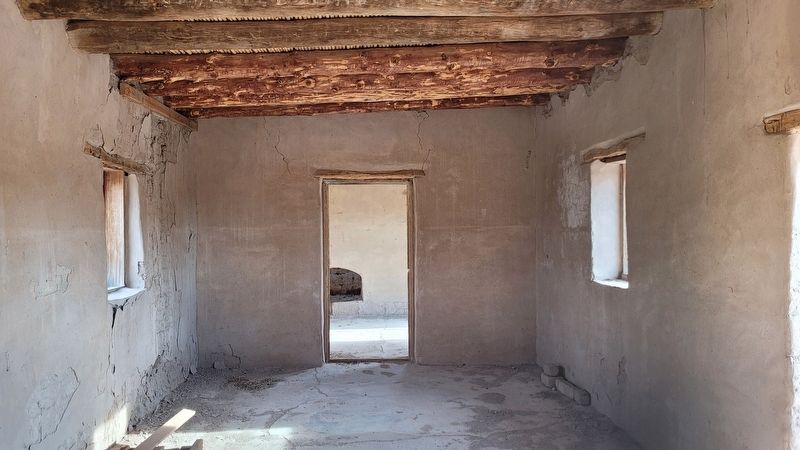
In the early 1900s, people began to live and farm along the banks of the Rio Grande, downstream from Santa Elena Canyon. The fields were fertile and the community grew. Farmers in the area raised corn, beans, wheat, squash, tomatoes, and melons. In 1901, Cipriano Hernandez started the first store in the area and sold goods to his neighbors and to the mining community in Terlingua. He operated the store out of his home, which is today known as the Alvino House(Submitted on March 29, 2023, by James Hulse of Medina, Texas.)(named for Alvino Ybarra who lived there with his family from 1918 to 1957).Photographed by James Hulse, March 15, 20234. Inside view of the La Harmonia Store
Credits. This page was last revised on March 29, 2023. It was originally submitted on March 28, 2023, by James Hulse of Medina, Texas. This page has been viewed 662 times since then and 62 times this year. Photos: 1, 2, 3, 4. submitted on March 29, 2023, by James Hulse of Medina, Texas.
