Edgewater in Anne Arundel County, Maryland — The American Northeast (Mid-Atlantic)
Archaeology at London Town
Photographed by F. Robby, July 23, 2009
1. Archaeology at London Town Marker
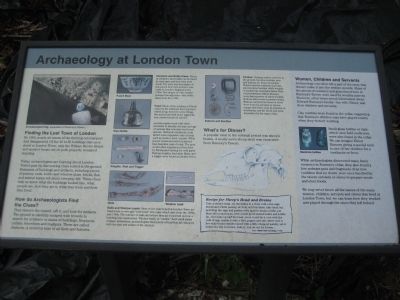
Finding the Lost Town of London
Today, archaeologists are learning about London Town's past by discovering clues buried in the ground. Remnants of buildings and artifacts, including pieces of pottery, nails, bottle and window glass, bricks, fish, and animal bones tell about everyday life. These clues help us know what the buildings looked like, what people ate, how they ate it, what they wore and how they lived.
How do Archaeologists Find the Clues?
They remove the topsoil, sift it, and look for artifacts. The ground is carefully scraped with trowels to search for evidence or stains of buildings, fireplaces, cellars, fencelines and trashpits. These are called features. A record is kept of all find and features.
Ceramics and Bottle Glass: Pieces of ceramics and bottles can be dates by their style and how they were made. The style and decoration of this punch bowl tell us that it was made in London, England in the 1720s. The shapes of wine bottles changed through time - this bottle dates from the 1730s.
Food: Much of the evidence of foods eaten by the colonists has long since rotted away, however a few things,
this page online
Archaeologists work with other scientists to identify the type and age of animals that colonists butchered and ate. Well-to-do residents could afford more expensive cuts of meat such as mutton, beef, or pork. While poorer residents boiled or stewed less desirable cuts of meat. The poor would often supplement their diets by fishing and hunting for wild game. Fishing weights, lead shot, flints, and a trigger were found at London Town.
What's for Dinner?
A popular meal in the colonial period was sheep's brains. A neatly sawn sheep skull was excavated from Rumney's Tavern.
Recipe for Sheep's Head and Brains
Take a sheep's head...tie the brains in a cloth with a few sage leaves and a little parsley, an hour will boil them; take them out and chop the sage and parsley will, and the brains a little, put them in to a sauce-pan, with a little good melted butter and a little fat...then take up half the head, score it and do it over with the yolk of egg, season it with a little pepper and salt, strew over a few stale bread crumbs mixed with a little chopped parsley,
Photographed by F. Robby, July 23, 2009
2. Archaeology at London Town
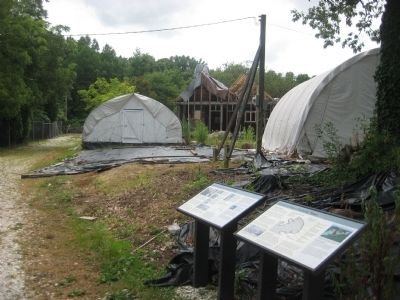
Active digs are taking place under the tents, while a building is being restored in the background.
Women, Children and Servants
Archaeology can often tell a part of the story that doesn't make it into the written records. Many of the pieces of ceramics and glass found here at Rumney's Tavern were used by wealthy patrons. However, other items reveal information about Edward Rumney's family - his wife, Elinor, and their children and servants.
Clay marbles were found in the cellar, suggesting that Rumney's children may have played nearby when they weren't working.
Small glass bottles or vials, which once held medicines, were also found in the cellar. We can imagine Elinor Rumney giving a special tonic to one of her children for a toothache or fever.
While archaeologists discovered many fancy ceramics in Rumney's cellar, they also found a few redware pots and fragments of an iron cauldron that no doubt, were once handled by the tavern servants or slaves to prepare meals and store foods.
We may never know all the names of the many women, children, servants and slaves that lived at London Town, but we can learn how they worked and played through the clues they left behind.
[Captions:]
Nails and Window Leads: Most of the nails found at London Town are hand-made or wrought "rose-head" iron nails which date from the 1600s and 1700s. The number of nails and where they are found tell us how a building was constructed. Window leads, or "cames," held small panes of glass. Sometimes, archaeologists find pieces of lead that are stamped with the date and maker of the window.
Clothes: Clothing seldom survives in the ground, but shoe buckles, pins and buttons do. Some of London Town's poorest residents wore simple iron shoe buckles, while wealthier people like merchant James Dick or tarvernkeeper, Elinor Rumney wore fancy pewter or silver buckles. Button also reveal a person's status. Button carved from bone or wood were worn by servants or slaves; copper and silver ones by planters or merchants; and the finest and most decorative by the upper class.
Topics. This historical marker is listed in these topic lists: Anthropology & Archaeology • Colonial Era • Industry & Commerce • Settlements & Settlers. A significant historical year for this entry is 1965.
Location. This marker has been replaced by another marker nearby. It was located near 38° 56.471′ N, 76° 32.384′ W. Marker was in Edgewater, Maryland, in Anne Arundel County. It could be reached from Londontown Road 1.3 miles north of Mayo Road (Route 253). Marker is on the grounds of London Town Park, at the end of Londowntown Road, near the brick house. Touch for map. Marker was in this post office area: Edgewater MD 21037, United States of America. Touch for directions.

Regionally, this marker was in Central Maryland. It was also in the American Mid-Atlantic, in the Chesapeake Bay Region, and on the Eastern Seaboard. Globally, it was in the North Atlantic Region, North America, the Western Hemisphere, the Western World, and the Anglosphere. Historically, it found itself in what was once one of the original Thirteen Colonies and also the Antebellum South.
Other nearby markers. At least 8 other markers are within walking distance of this location: William Brown House (here, next to this marker); The Almshouse (a few steps from this marker); Scott Street (a few steps from this marker); The Carpenter's Shop (within shouting distance of this marker); Slavery at London Town (within shouting distance of this marker); The South River (within shouting distance of this marker); London Town Ferry (within shouting distance of this marker); Tobacco Barn (within shouting distance of this marker). Touch for a list and map of all markers in Edgewater.
Other markers no longer nearby. Establishing a Colonial Town (was here, next to this marker but has been replaced with another marker now near it); a different marker also named William Brown House (was a few steps from this marker but has been replaced with another marker now near it); Dr. Hill's Medicinal Plants (was within shouting distance of this marker but has been replaced with another marker now near it); The Lord Mayor's Tenement (was within shouting distance of this marker but has been replaced with another marker now near it); The Ferry at London Town (was within shouting distance of this marker but has been replaced with another marker now near it).
Credits. This page was last revised on August 1, 2026. It was originally submitted on September 2, 2009, by F. Robby of Baltimore, Maryland. This page has been viewed 1,484 times since then and 46 times this year. Photos: 1, 2. submitted on September 2, 2009, by F. Robby of Baltimore, Maryland.
