South Elmwood in Providence in Providence County, Rhode Island — The American Northeast (New England)
Unexpected Consequences

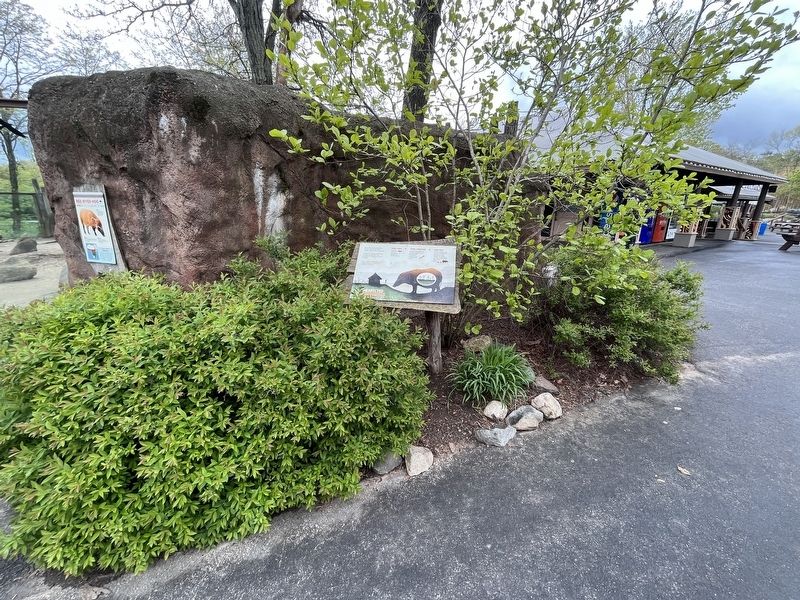
Did you know that many people who live near red river hogs actually consider them a nuisance?
Humans, by changing the land, are partially responsible for the consumption of crops by the red river hog.
This is another example of how the people, animals and land are all intricately connected.
More Farms + Fewer Predators = More Hogs
🌳 Sections of Africa within the red river hog habitat have been gradually been turned into farmland.
🐆 The forests that are destroyed to make way for agriculture are also the habitat of the hogs' biggest predator: leopards. This has led to a significant decrease in the number of leopards.
🐗 With fewer predators to hunt them and an easily obtainable food supply on farms, the number of these tough, adaptable river hogs has increased. These larger herds of river hogs can consume and destroy human gardens very quickly.
Erected by Roger Williams Park Zoo.
Topics. This historical marker is listed in these topic lists: Agriculture • Animals • Environment.
Location. 41° 47.342′ N, 71° 25.019′ W.
this page online

Regionally, this marker is on Rhode Island’s Narragansett Bay. It is also in the American Northeast, in New England, and on the Eastern Seaboard. Globally, it is in the North Atlantic Region, North America, the Western Hemisphere, the Western World, and the Anglosphere. Historically, it finds itself in what was once one of the original Thirteen Colonies.
Other nearby markers. At least 8 other markers are within walking distance of this marker: Derrig Overlook (within shouting distance of this marker); Masai Giraffe (about 300 feet away, measured in a direct line); a different marker also named Masai Giraffe (about 400 feet away); Wild Turkey (about 500 feet away); Red Wolf (about 500 feet away); A Conservation Success Story (about 500 feet
Additional commentary.
1. About the marker
This sign serves as a historical marker because it provides insight into how the history of human interaction has affected the population of the red river hog.
— Submitted May 6, 2023, by Devry Becker Jones of Washington, District of Columbia.
Credits. This page was last revised on May 6, 2023. It was originally submitted on May 6, 2023, by Devry Becker Jones of Washington, District of Columbia. This page has been viewed 127 times since then and 10 times this year. Photos: 1, 2. submitted on May 6, 2023, by Devry Becker Jones of Washington, District of Columbia.
