Dyberry Township in Wayne County, Pennsylvania — The American Northeast (Mid-Atlantic)
"A Bulwark of Protection"

Photographed by William Fischer, Jr., May 6, 2023
1. "A Bulwark of Protection" Marker
Excerpts from the address delivered by General Lyman L. Lemnitzer, Army Chief of Staff, at the dedication of the Dyberry Dam on Wednesday, Aug. 19, 1959:
Today, as always, it is a very genuine pleasure to be in Wayne County and see my many friends here - particularly on this occasion.
This visit today, which permits me to join you in commemorating the completion of a great dam, is doubly gratifying to me personally. The main reason for my personal satisfaction is that this dam will serve to protect this area of Pennsylvania that I have known all my life and people whom I shall always consider neighbors and friends. In the second place, the Army's Corps of Engineers has played an important part in building this dam.
There is no need for me to tell you that flood protection has been critically needed in this community for a very long time. I recall most vividly the terrible flood of May 1942. You will remember that, in that flood, the raging waters of the Lackawaxen took 24 lives in Honesdale, Hawley, and White Mills. More than six million dollars in property was lost.
Dyberry Dam, which we dedicate
this page online
Because of my special interest. I have closely followed the progress of these dam projects for a long time. This ceremony today marks the culmination of years of planning and effort by a large number of people representing many different groups. As you know, this project had its official beginning in 1948, when it was authorized by Congress in the Flood.Control Act of that year. Its beginnings, however, go back beyond 1948.
The real beginning of both Dyberry and Prompton Dams is to be found in the aftermath of the 1942 flood, which I mentioned earlier, and of the later flood of August 1955. Through the efforts of leading individuals here in Wayne County, working through the Honesdale Flood Control Committee, under Dr. K. A. Gillespie as chairman, and of members of the Congress, all obstacles were finally overcome, funds were made available, and construction was begun. Today, we see the first major part of the project carried through to completion.
Photographed by William Fischer, Jr., May 6, 2023
2. Flood Aftermath Photos on "A Bulwark of Protection" Marker
It is valuable as a symbol of the combination of skill and energy and devotion to the best interests of the community. It typifies, too, what can be accomplished by the combination of private individuals, local and state government, and federal agencies.
It is such cooperative effort - this democracy in action - which has made this country what it is today. It is such democracy in action which will provide one of our greatest sources of strength for the future, whatever challenges and tests that the future may bring.
The Night of Terror
On the night of Friday, May 22, 1942 the courage of the people of Northeastern Pennsylvania was put to a severe test as a result of a flash flood which ravaged this portion of the State.
The flood waters came suddenly to Honesdale, when three days of heavy rains were climaxed with an unprecedented cloudburst. The catastrophe struck late at night, while many residents were asleep. Honesdale was hardest hit when a dam on the Lackawaxen River above Honesdale
Photographed by William Fischer, Jr., May 6, 2023
3. Ground-breaking Photo on "A Bulwark of Protection" Marker
The morning light revealed a scene of awesome destruction. No one who viewed it could have been convinced that the community would ever be restored to normalcy.
In Honesdale, with only one bridge left standing, sections of the town were severed from each other. One entire residential section, Delaware Street, was completely wiped out, and at least sixty business establishments were seriously damaged. Approximately 1,000 homes in the valley of the Lackawaxen River suffered total or partial damage and loss of property and furnishings. Saddest fact of all was that in Wayne County twenty-two persons lost their lives, and of this number fifteen were Honesdalians.
A highway connection with the community was not established until Sunday morning, and, at best, it was a lengthy, debris-strewn route to the sole bridge remaining. Over it came Red Cross aid, Pennsylvania Motor Police, Coast Guard mobile units, Pennsylvania Home Guard, utility repair crews, pumps
Photographed by William Fischer, Jr., May 6, 2023
4. "A Bulwark of Protection" Marker
Immediately after the flood, the American Red Cross supplied meals to several thousand persons in Honesdale and its vicinity. Doctors and nurses, who had been rushed into the area, were offering aid to the sick and injured and conducting mass inoculations against typhoid.
The Pennsylvania Department of Health personnel here looked after the sanitary conditions and the contamination of waters. In short order, the drinking water, the milk supply, electricity, and telephone services, which had been cut off, were soon temporarily dispensed again.
By Monday, May 25, salvage work was well under way. Six hundred W.P.A. workers and thousands of volunteers began the rehabilitation. Schools were closed, Girl and Boy Scouts joined in the work. Fifty men of the Pennsylvania Motor Police also went on duty in the area.
In the midst of the rehabilitation the residents of Honesdale were frightened by a false report of a second flood. Rumors that the dam at Lake Lodore, ten miles above Honesdale, had burst, spread through the community like wildfire. Hundreds of people panicked. The exodus to higher land was marked by
Photographed by William Fischer, Jr., May 6, 2023
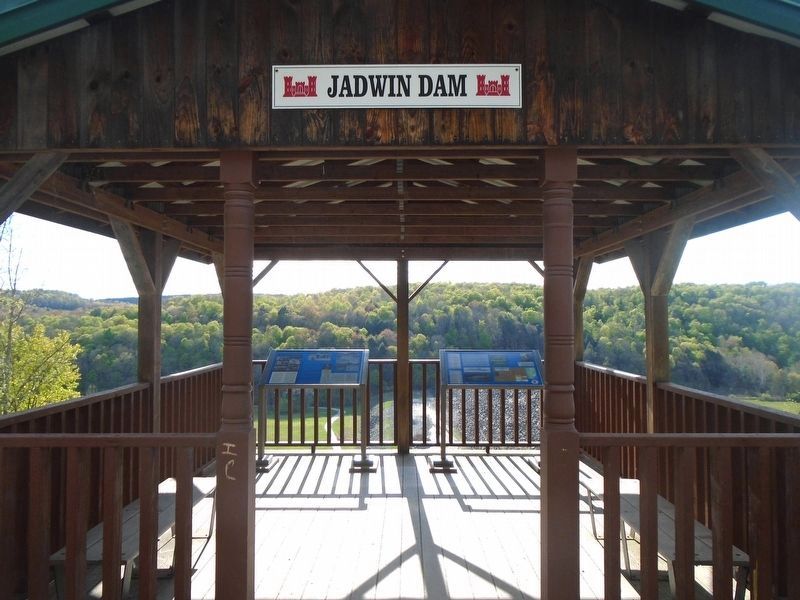
5. General Edgar Jadwin Dam & Reservoir
In Honesdale it was found that the flood affected 2,886 people. A total of 882 cellars were flooded, 835 homes had water on the first floor, 37 properties had water on the second floor, and 24 buildings were completely destroyed.
In surveys that followed, it was learned that residential damage in Honesdale totaled $2,668,000, while commercial damage reached over $800,000; industrial and utility damage, $103,500, and public damage, $193, 505, or a total of $4,999,800 out of a county total damage of $8,000,000.
Although floods were not unknown to the native residents, this was undoubtedly the greatest catastrophe to have ever hit this pleasant community. Newspaper accounts of other days describe the damaging floods of 1865, 1902, 1903, 1934, and 1936, and even those of 1952 and 1955 which followed, but none of them matched the flood of 1942 in the number of deaths and destruction.
The people of Honesdale and vicinity shall be ever grateful and indebted to the numerous agencies and the many individuals from the outside, from both Pennsylvania and New York State, who donated
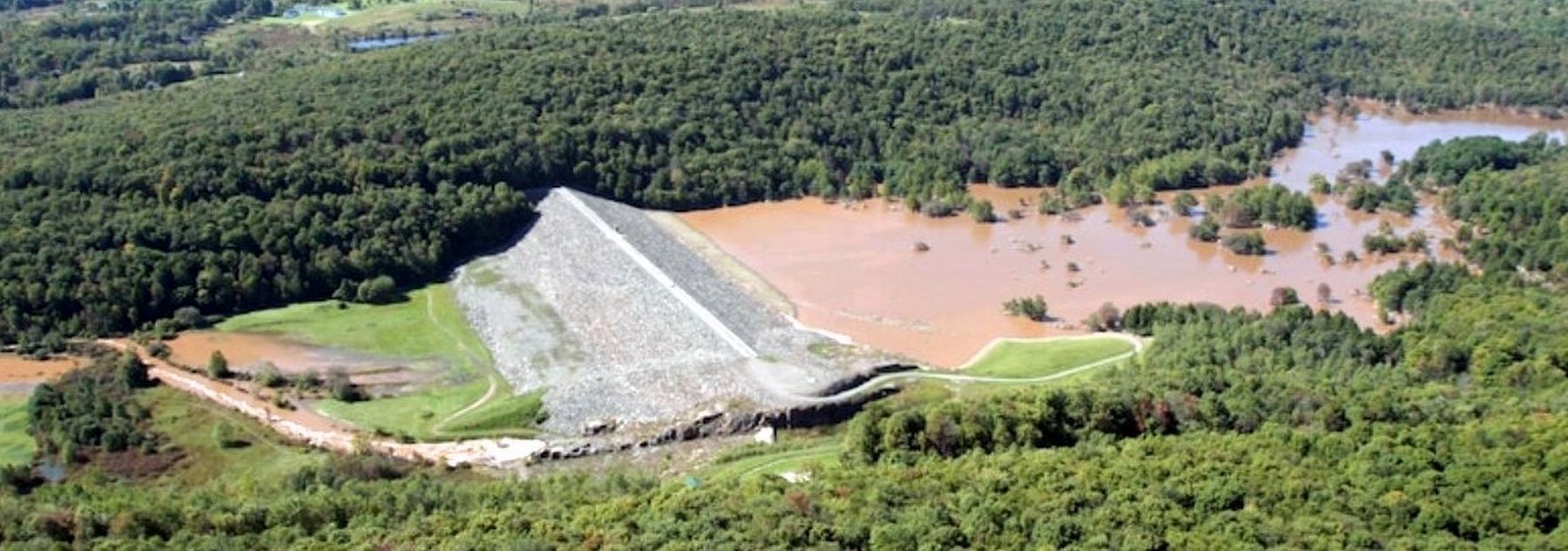
via U.S. Army Corps of Engineers, 2004
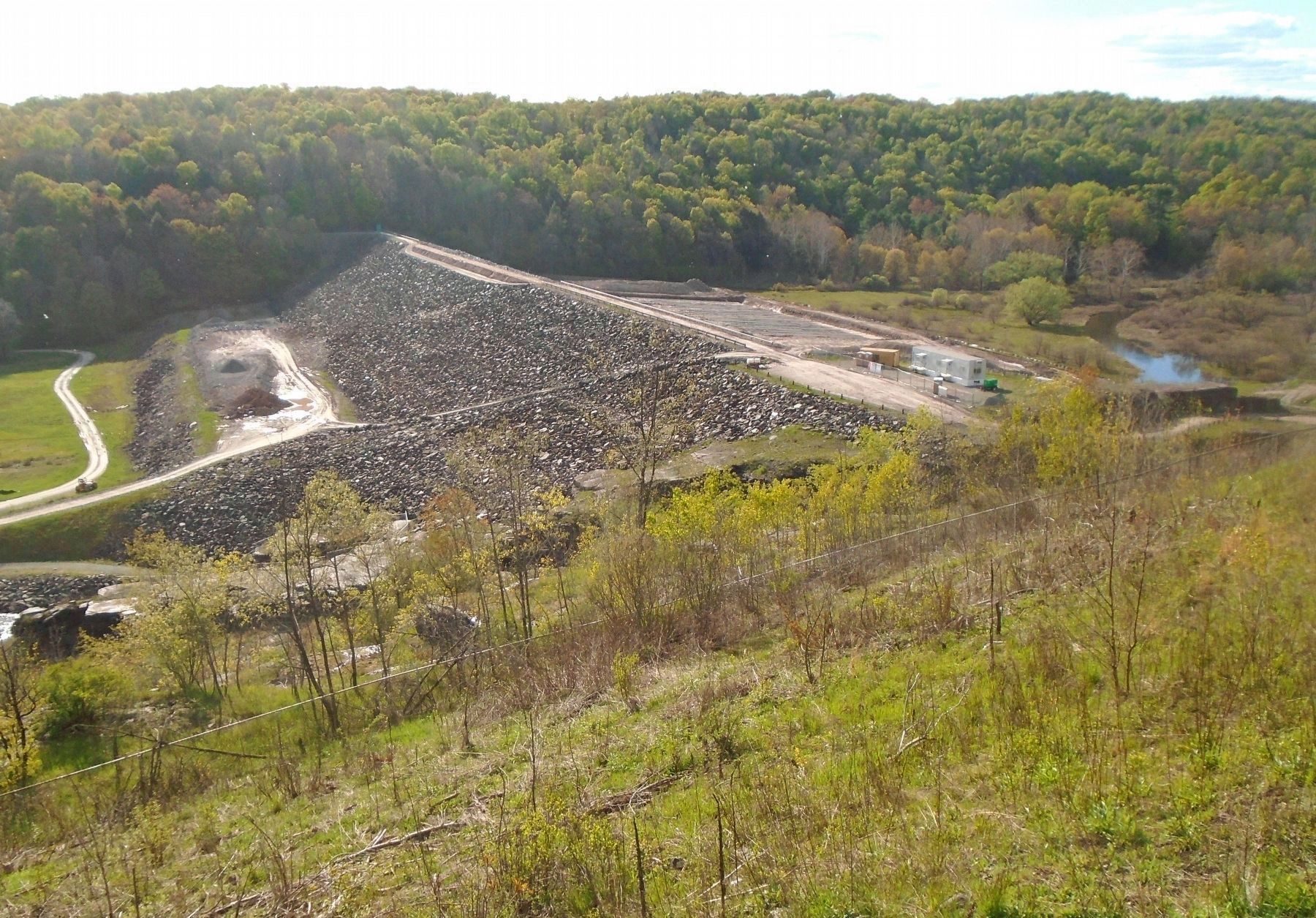
6. General Edgar Jadwin Dam
Located approximately three miles above the confluence of Dyberry Creek with Lackawaxen River, in Honesdale, Pa, it experienced high water conditions following Hurricane Ivan in 2004.
Click for more information.
Click for more information.
While the greatly reduced value of homes and business establishments in the area can be expressed in terms of monetary value, there is no standard for measuring the damages sustained from the loss of life or those resulting from fear. That the community did rebuild in the face of these losses and despair is a permanent testimony to the great courage, sterling character, and pioneering spirit of the people who live in Honesdale and the other nearby affected communities.
Project Background & History
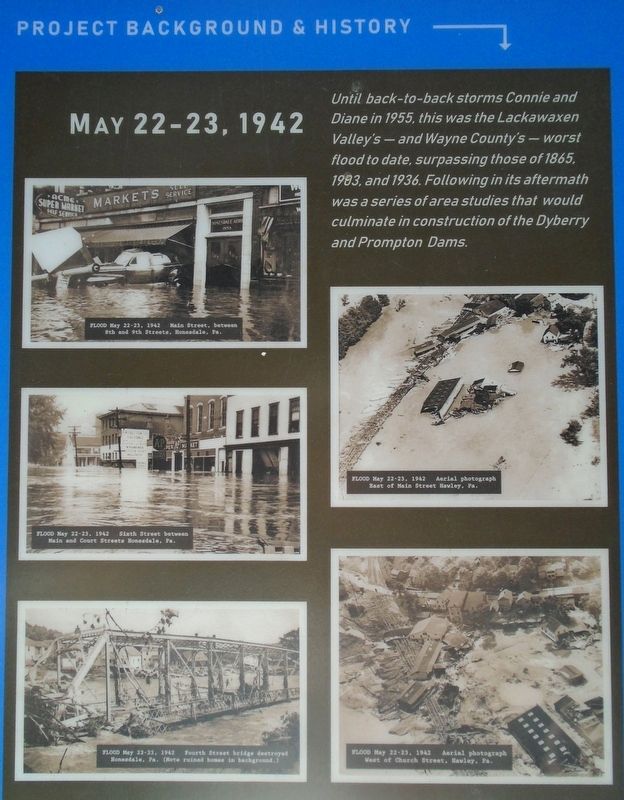
May 22-23, 1942
Until back-to-back storms Connie and Diane in 1955, this was the Lackawaxen Valley's - and Wayne County's - worst flood to date, surpassing those of 1865, 1903, and 1936. Following in its aftermath was a series of area studies that would culminate in construction of the Dyberry and Prompton Dams.
[Section photo captions, counterclockwise from top left, read]
• Main Street, between 8th and 9th Streets, Honesdale, Pa.
• Sixth Street between Main and Court Streets Honesdale, Pa.
• Fourth Street bridge destroyed Honesdale, Pa. (Note ruined homes in background.)
• Aerial photograph West of Church Street, Hawley, Pa.
• Aerial photograph East of Main Street, Hawley, Pa.
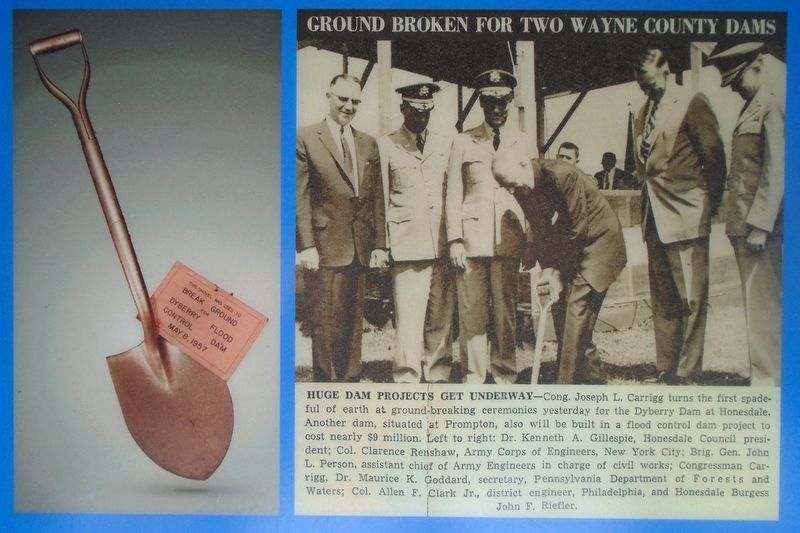
[Newspaper photo]
HUGE DAM PROJECTS GET UNDERWAY—Cong. Joseph L. Carrigg turns the first spadeful of earth at ground-breaking ceremonies yesterday for the Dyberry Dam at Honesdale. Another dam, situated at Prompton, also will be built in a flood control dam project to cost nearly $9 million. Left to right: Dr. Kenneth A. Gillespie, Honesdale Council president; Col. Clarence Renshaw, Army Corps of Engineers, New York City; Brig. Gen. John L. Person, assistant chief of Army Engineers in charge of civil works; Congressman Carrigg, Dr. Maurice K. Goddard, secretary, Pennsylvania Department of Forests and Waters; Col. Allen F. Clark, Jr., district engineer, Philadelphia, and Honesdale Burgess John F. Riefler.
General Lyman Louis Lemnitzer
United States Army, 1916-69
Supreme Allied Commander Europe, 1962-69
Chairman of the Joint Chiefs of Staff, 1960-62
Army Chief of Staff, 1957-60
Commander, Eighth Army, 1955-57
Born: Aug. 29, 1899, Honesdale, Pa.
Died: Nov. 12, 1988, Washington, D.C.
Buried in Arlington National Cemetery
Erected by US Army Corps of Engineers.
Topics. This historical marker is listed in these topic lists: Disasters • Man-Made Features • Waterways & Vessels. A significant historical month for this entry is May 1942.
Location. 41° 36.683′ N, 75° 15.688′ W. Marker is in Dyberry Township, Pennsylvania, in Wayne County. It is on Hancock Highway (Pennsylvania Route 191), on the left when traveling north. Touch for map. Marker is in this post office area: Honesdale PA 18431, United States of America. Touch for directions.

Regionally, this marker is in Pennsylvania’s Pocono Mountains. It is also in the American Northeast, in the Mid-Atlantic, in Appalachia, and specifically in Northern Appalachia. Globally, it is in North America, the Western Hemisphere, the Western World, and the Anglosphere. Historically, it finds itself in what was once the Haudenosaunee (Iroquois) Confederacy and also one of the original Thirteen Colonies.
Other nearby markers. At least 8 other markers are within 3 miles of this marker, measured as the crow flies: General Edgar Jadwin Dam & Reservoir (here, next to this marker); David Wilmot (approx. 1.2 miles away); Veterans Park (approx. 1.3 miles away); Saint Mary Magdalen Parish Cemetery Children's Memorial (approx. 1.7 miles away); Gen. Lyman L. Lemnitzer (approx. 2.2 miles away); Gibbons Memorial Park (approx. 2.3 miles away); Washington Irving and the "Irving Cliff" Hotel (approx. 2.3 miles away); Lackawaxen River (approx. 2.4 miles away).
Related markers. Click here for a list of markers that are related to this marker.
Also see . . . Floods helped mark our history. (Becker, Tri-County Independent, 2010) (Submitted on May 7, 2023, by William Fischer, Jr. of Reynoldsburg, Ohio.)
Credits. This page was last revised on May 27, 2023. It was originally submitted on May 7, 2023, by William Fischer, Jr. of Reynoldsburg, Ohio. This page has been viewed 427 times since then and 58 times this year. Photos: 1, 2, 3, 4, 5. submitted on May 7, 2023, by William Fischer, Jr. of Reynoldsburg, Ohio. 6. submitted on May 27, 2023, by Larry Gertner of New York, New York.
