Glencoe Village near Burlington in Alamance County, North Carolina — The American South (South Atlantic)
Cotton Dust and Poverty
Photographed by Patrick G. Jordan, June 27, 2010
1. Cotton Dust and Poverty Marker
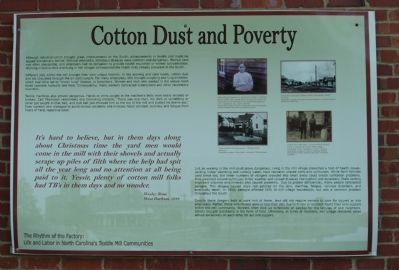
Different jobs within the mill brought their own unique hazards. In the opening and card rooms, cotton dust and lint circulated through the air continuously. For many employees, this brought coughing and lung irritation, which over time led to “brown lung” disease, or byssinosis. Women and men who worked in the weave room faced constant humidity and heat. Consequently, many workers contracted tuberculosis and other respiratory disorders.
Textile machines also proved dangerous. Hands or arms caught in the machine’s belts were easily skinned or broken. Carl Thompson remembers one harrowing incident, “There was one man, his shirt or something or other caught in that belt, and that belt just
this page online
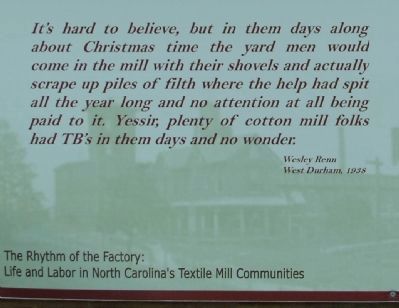
It’s hard to believe, but in them days along about Christmas time the yard men would come in the mill with their shovels and actually scrape up piles of filth where the help had spit all the year long and no attention at all being paid to it. Yessir, plenty of cotton mill folks had TB’s in them days and no wonder.
Wesley Renn West Durham, 1938.
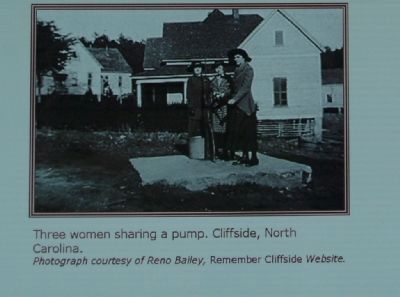
Just as working in the mill could prove dangerous, living in the mill village presented a host of health issues. Lacking indoor plumbing and running water, most residents shared wells and outhouses. While farm families used these too, the sheer numbers of villagers crowded into small areas could create sanitation problems. Flies swarmed around outhouses in hot weather and spread diseases like typhoid and dysentery. Diets lacking important vitamins and minerals also caused problems. Due to protein deficiencies, many people contracted pellagra. This disease caused scaly red patches on the
Photographed by Patrick G. Jordan, June 27, 2010
2. Cotton Dust and Poverty Marker
Despite these dangers both at work and at home, laws did not require owners to care for injured or sick employees. Rather, those who missed work or lost their jobs due to illness or accident found their only support within the mill community. Workers often took up collections on payday for the families of sick neighbors. Others brought assistance in the form of food. Ultimately, in times of hardship, mill village residents relied almost exclusively on each other for aid and support.
Topics. This historical marker is listed in these topic lists: Civil Rights • Industry & Commerce • Science & Medicine • Settlements & Settlers. A significant historical year for this entry is 1938.
Location. 36° 8.343′ N, 79° 25.684′ W. Marker is near Burlington, North Carolina, in Alamance County. It is in Glencoe Village. It is on Glencoe Street, on the left when traveling west. Glencoe Village is 3 miles north of Burlington, NC from NC Highway 62. Touch for map. Marker
Photographed by Patrick G. Jordan, June 27, 2010
3. Cotton Dust and Poverty Marker

Regionally, this marker is in the Piedmont and specifically in Piedmont Triad. It is also in the American South and specifically in the Upper South. Globally, it is in North America, the Western Hemisphere, the Western World, and the Anglosphere. Historically, it finds itself in what was once the territory of the Mississippian Culture, one of the original Thirteen Colonies, one of the Confederate States of America, and the Antebellum South.
Other nearby markers. At least 8 other markers are within walking distance of this marker: Power, Wheel House and Turbine (here, next to this marker); Working the Shift (here, next to this marker); The Rise of the Textile Mill Communities (here, next to this marker); Calling the Mill Village 'Home' (here, next to this marker); Neighbors Divided (here, next to this marker); Women in the Mill Village (a few steps from this marker); Picker House and Dye House (a few steps from this marker); Children in the Mill Village (a few steps from this marker). Touch for a list and map
Photographed by Patrick G. Jordan, June 27, 2010
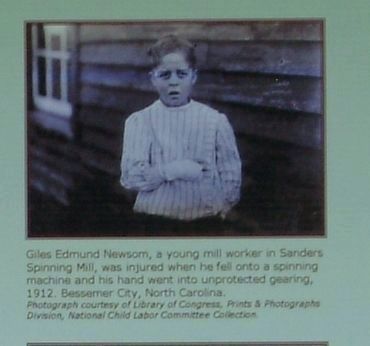
4. Giles Edmund Newsom
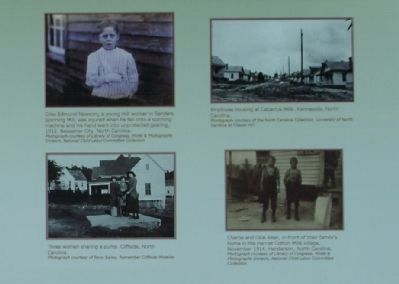
a young mill worker in Sanders Spinning Mill, was injured when he fell onto a spinning machine and his hand went into unprotected gearing, 1912. Bessemer City, North Carolina.
Related markers. Click here for a list of markers that are related to this marker. To better understand the relationship, study each marker in the order shown.
Additional keywords. Alamance Cotton Mill, Glencoe, Fabric, Textiles, Company Shops, Holt
Photographed by Patrick G. Jordan, June 27, 2010
5. Three women sharing a pump, Cliffside, North Carolina.
Photographed by Patrick G. Jordan, June 27, 2010
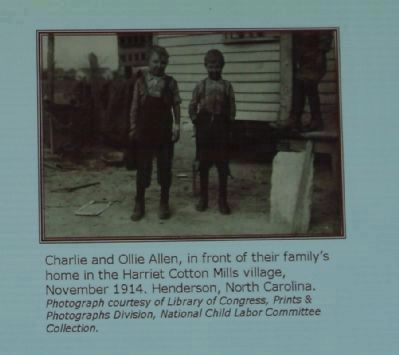
6. Charlie and Ollie Allen,
in front of their family's home in the Harriet Cotton Mills village, November 1914.
Photographed by Patrick G. Jordan, June 27, 2010
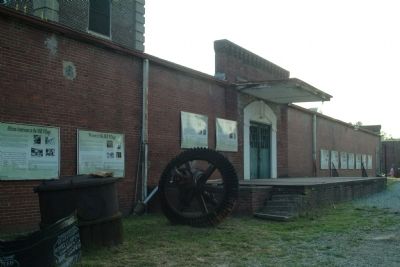
7. Rhythm of the Factory Series of Markers - on Glencoe Mill
Photographed by Patrick G. Jordan, June 27, 2010
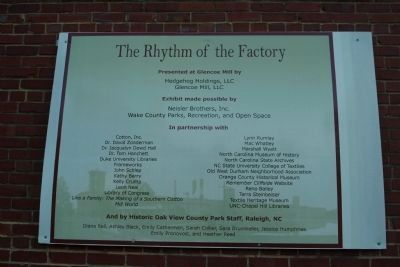
8. Rhythm of the Factory Marker
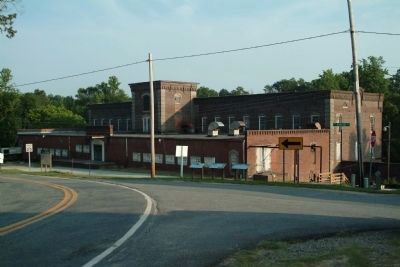
Photographed by Patrick G. Jordan, June 27, 2010
9. Glencoe Mill
Credits. This page was last revised on May 11, 2023. It was originally submitted on July 19, 2010, by Patrick G. Jordan of Graham, North Carolina. This page has been viewed 1,281 times since then and 47 times this year. Last updated on May 9, 2023, by Michael Buckner of Durham, North Carolina. Photos: 1, 2, 3, 4, 5, 6, 7, 8, 9. submitted on July 19, 2010, by Patrick G. Jordan of Graham, North Carolina. • J. Makali Bruton was the editor who published this page.
