Key West in Monroe County, Florida — The American South (South Atlantic)
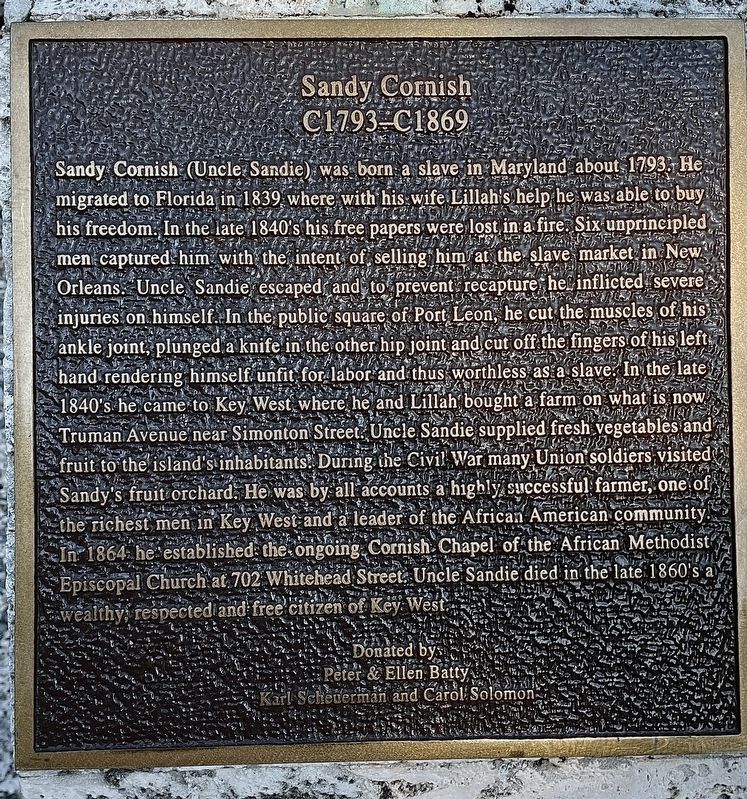
Sandy Cornish
C1793-C1869
| — | Key West Historic Memorial Sculpture Garden | — |
Photographed by Brandon D Cross, May 4, 2023
1. Sandy Cornish Marker
this page online
Peter & Ellen Batty
Karl Scheuerman and Carol Solomon
Erected by Peter & Ellen Batty, Karl Scheuerman and Carol Solomon.
Topics. This historical marker is listed in these topic lists: African Americans • Agriculture • Charity & Public Work • Religion & Religious Structures • War, US Civil. A significant historical year for this entry is 1839.
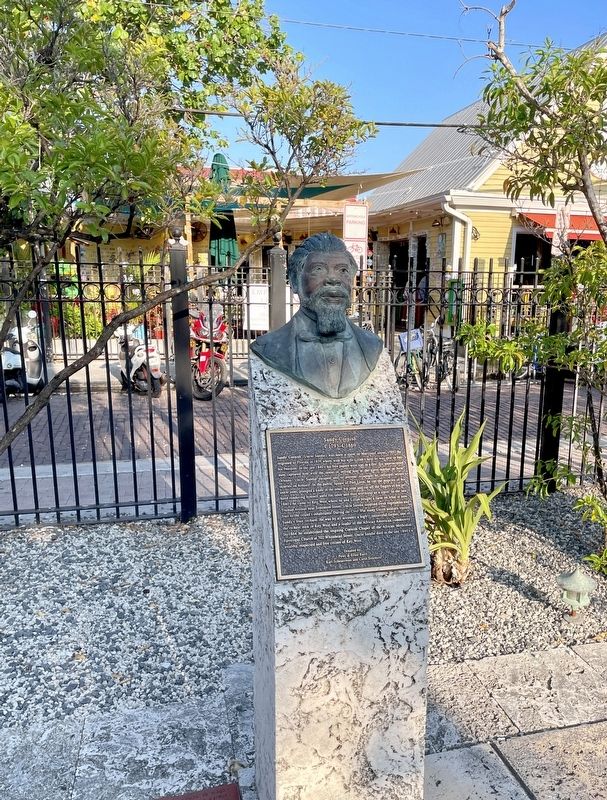
Location. 24° 33.583′ N, 81° 48.411′ W. Marker is in Key West, Florida, in Monroe County. It can be reached from the intersection of Wall Street and Tift’s Street, on the left when traveling north. The marker is located within the Key West Historic Memorial Sculpture Garden. Touch for map. Marker is at or near this postal address: 401 Wall Street, Key West FL 33040, United States of America. Touch for directions.

Regionally, this marker is on the Florida Keys. It is also in the American South and on the Gulf Coast. Globally, it is in the North Atlantic Region, North America, a Gulf of Mexico state, the Western Hemisphere, the Western World,
Photographed by Brandon D Cross, May 4, 2023
2. Sandy Cornish Marker
Other nearby markers. At least 8 other markers are within walking distance of this marker: Senator John M. Spottswood (here, next to this marker); Stephen R. Mallory (here, next to this marker); Dr. J.Y. Porter (here, next to this marker); Ellen Russell Mallory (here, next to this marker); Harry S. Truman (here, next to this marker); Joe Pearlman (here, next to this marker); Sister Louis Gabriel (here, next to this marker); Elisabetha Merklin Knight Beiglett Smith (here, next to this marker). Touch for a list and map of all markers in Key West.
Also see . . .
1. Sandy Cornish – A real man. No scrubs allowed!. (Submitted on May 14, 2023, by Brandon D Cross of Flagler Beach, Florida.)
2. The Key West Sculpture Garden – Where History Meets Art. (Submitted on May 14, 2023, by Brandon D Cross of Flagler Beach, Florida.)
Credits. This page was last revised on May 16, 2023. It was originally submitted on May 14, 2023, by Brandon D Cross of Flagler Beach, Florida. This page has been viewed 996 times since then and 123 times this year. Photos: 1, 2. submitted on May 14, 2023, by Brandon D Cross of Flagler Beach, Florida. • Bernard Fisher was the editor who published this page.
