
Cessna Township near Kenton in Hardin County, Ohio — The American Midwest (Great Lakes)
Hull’s Trail
Photographed by Dale K. Benington, June 17, 2008
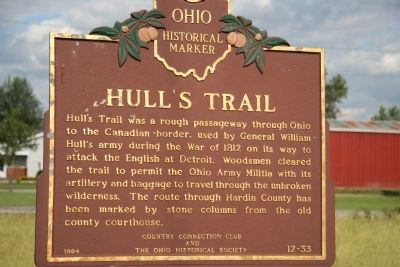
1. Hull’s Trail Marker
Hull’s Trail was a rough passageway through Ohio to the Canadian border, used by General William Hull’s army during the War of 1812 on its way to attack the English at Detroit. Woodsmen cleared the trail to permit the Ohio Army Militia with its artillery and baggage to travel through the unbroken wilderness. The route through Hardin County has been marked by stone columns from the old county courthouse.
Erected 1994 by Country Connection Club and the Ohio Historical Society. (Marker Number 12-33.)
Topics and series. This historical marker is listed in these topic lists: Roads & Vehicles • War of 1812. In addition, it is included in the Battlefield Trails - War of 1812, and the Ohio Historical Society / The Ohio History Connection series lists. A significant historical year for this entry is 1812.
Location. 40° 43.915′ N, 83° 39.209′ W. Marker is near Kenton, Ohio, in Hardin County. It is in Cessna Township. It is at the intersection of Ohio Route 701 and County Road 135 on Ohio Route 701. Immediately beyond the intersection that is located just east of this historical marker is one of several of the old Hardin County
this page online

Regionally, this marker is in Ohio’s Till Plains. It is also in the American Midwest and in the Corn Belt. Globally, it is in North America, the Western Hemisphere, the Western World, and the Anglosphere. Historically, it finds itself in what was once the Haudenosaunee (Iroquois) Confederacy, the territory of the Mississippian Culture, and the Northwest Territory.
Other nearby markers. At least 8 other markers are within 5 miles of this marker, measured as the crow flies: Hull's Trail, 1812 (within shouting distance of this marker); Dunkirk Veterans Memorial (approx. 3.1 miles away); a different marker also named Hull's Trail, 1812 (approx. 3.4 miles away); To Remember Veterans Of All Wars (approx. 4 miles away); Dunkirk Field of Honors (approx. 4 miles away); a different marker also named To Remember Veterans Of All Wars
Photographed by Dale K. Benington, June 17, 2008
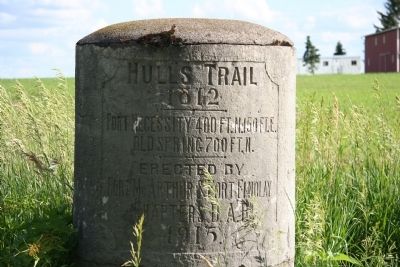
2. Hull’s Trail Marker
This Hull's Trail marker is located on County Road 2 at map location 40.49.172N by 083.40.151W.
Regarding Hull’s Trail. Shortly before the start of the War of 1812 the American General William Hull, the commander of the American fortification on Michigan's border with Canada (located in Detroit), knew that unless his position was reinforced with additional troops, that his command would be in serious trouble once the war finally got under way. So he took it upon himself to travel down to southern Ohio in order to raise those additional troops.
As soon as General Hull had raised himself an army of soldiers, he began to march northward from Urbana, Ohio. The route that Hull's army took through Hardin County has been marked by stone columns from the old county courthouse. Pictures and map locations of these markers has been included, in sequence, from south to north.
Related markers. Click here for a list of markers that are related to this marker. Hull's Trail markers.
Also see . . . Hull's Trace (North Huron River Corduroy Segment). Wikipedia entry (Submitted on September 26, 2024, by Larry Gertner of New York, New York.)
Photographed by Dale K. Benington, June 17, 2008
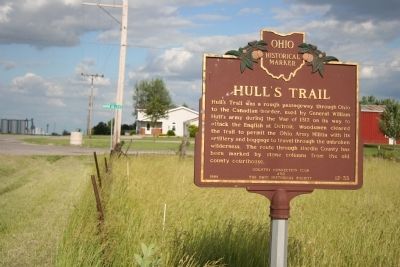
3. Hull’s Trail Marker
In the background behind the historical marker is one of several of the old Hardin County courthouse stone columns that was used by the county leaders back in 1912 to mark the route that Hull used in 1812 as he marched his army northward towards Detroit.
Photographed by Dale K. Benington, June 17, 2008
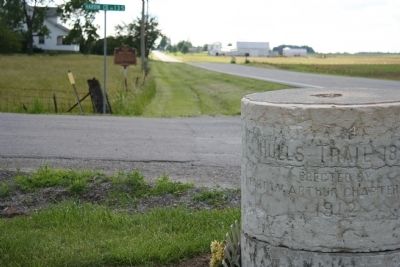
4. Hull’s Trail Marker
The trail marker that is in the foreground (with the historical marker in the background) is one of several of the old Hardin County courthouse stone columns that was used by the county leaders back in 1912 to mark the route that Hull used in 1812 as he marched his army northward towards Detroit.
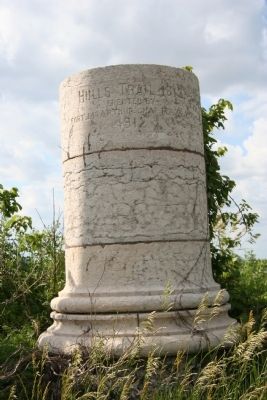
Photographed by Dale K. Benington, June 17, 2008
5. Hull’s Trail Marker
This Hull's Trail marker is located on State Route 67 at map location 40.36.676N by 083.40.908W.
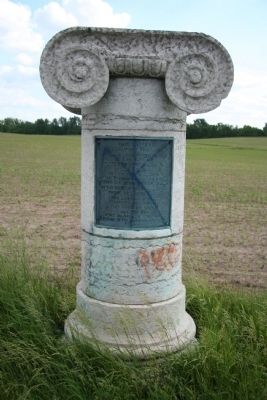
Photographed by Dale K. Benington, June 17, 2008
6. Hull’s Trail Marker
This Hull's Trail marker is located on County Road 106 at map location 40.39.829N by 083.39.877W.
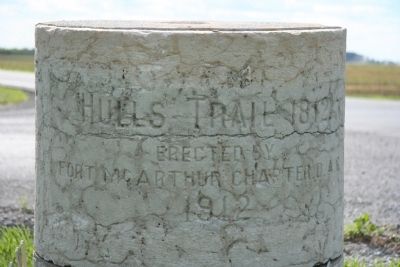
Photographed by Dale K. Benington, June 17, 2008
7. Hull’s Trail Marker
This Hull's Trail marker is located at the intersection of State Route 701 and County Road 135, at map location 40.43.913N by 083.39.169W.
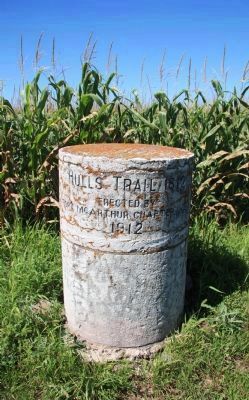
Photographed by Dale K. Benington, August 16, 2010
8. Hull’s Trail Marker
This Hull's Trail marker is located on County Road 200 at map location 40.32.883N by 083.43.094W.
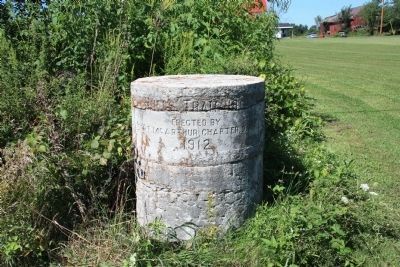
Photographed by Dale K. Benington, August 16, 2010
9. Hull’s Trail Marker
This Hull's Trail marker is located on County Road 180 at map location 40.35.265N by 083.41.270W.
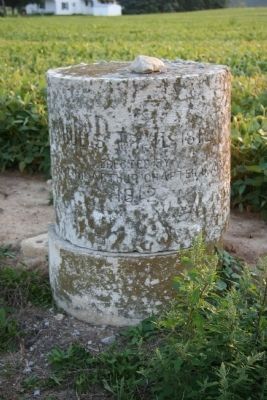
Photographed by Dale K. Benington, September 5, 2009
10. Hull’s Trail Marker
This Hull's Trail marker is located on County Road 135 at map location 40.46.827N by 083.39.120W.
Credits. This page was last revised on July 17, 2025. It was originally submitted on April 30, 2009, by Dale K. Benington of Toledo, Ohio. This page has been viewed 8,188 times since then and 310 times this year. Last updated on May 11, 2025, by Darryl R Smith of Cincinnati, Ohio. Photos: 1, 2, 3, 4, 5, 6, 7. submitted on April 30, 2009, by Dale K. Benington of Toledo, Ohio. 8, 9, 10. submitted on September 3, 2010, by Dale K. Benington of Toledo, Ohio. • Devry Becker Jones was the editor who published this page.
