Fort Wayne in Allen County, Indiana — The American Midwest (Great Lakes)
Lost Birds of Canal Days

Photographed by Tom Bosse, June 2, 2023
1. Lost Birds of Canal Days Marker
If you had walked along this path back in the 1840s, you might have seen some birds that you don’t see today. One might have been the greater prairie-chicken. First you might have heard a low-pitched call, like the sound of blowing across a bottle. Then you’d have seen several brown birds strutting about, calling and stamping their feet. As you got closer, you could see that they had bright orange sacs on their necks that they could inflate. And they have feathers on their necks that stick up like ears! The are the males showing off on their “lek” or special display grounds. The females, nearby, seem not to be paying attention, but why else would they be here?
Prairie-chickens are extirpated from Indiana, but can still be found in southern Illinois and farther west, in tallgrass prairie habitat.
You might also have seen a huge flock of passenger pigeons as you walked the towpath. Unfortunately, they are now extinct, not just extirpated. The flocks that darkened the sky when our country was young were hunted so severely that the last one, named Martha, died in the Cincinnati Zoo in 1914. Find a Mourning Dove and
this page online
Did you know that Indiana used to have parrots? Yes, we had flocks of Carolina parakeets. That ate cockleburs and sycamore seed balls – and the settlers’ fruit crops. They could survive Indiana winters by roosting in big hollow trees, so why are they gone? They may have gotten sick from poultry diseases, but also they would come to “help” a wounded parakeet. That behavior was effective against animal predators, but when hunters came, it only made it easier to shoot more parakeets.
Here's a mystery that can never be solved: If a cat were to eat the entrails of a Carolina parakeet, the cat would die. Several early naturalists told this story. Is it true, or just a legend? There’s no way to tell now: the very last Carolina parakeet died in the Cincinnati Zoo in 1918.
[Captions]:
Places like Eagle Marsh help all birds survive. If enough people care, we won’t lose any more species. This sign was funded by the Canal Society of Indiana, which honors the colorful history of the Wabash and Erie Canal (1832-1874). Information about the birds was provided by members of Stockbridge Audubon Society.
When the Wabash and Erie Canal was new, a contest was held on July 4, 1837 to see which canal boat could be the first to travel from Fort Wayne to Wabash. The winner was the “Prairie Hen.” Its captain, Ed Patchin, won a $50 prize after quietly sneaking past Dana Columbia’s “Indiana” in the dark.
Erected by Little
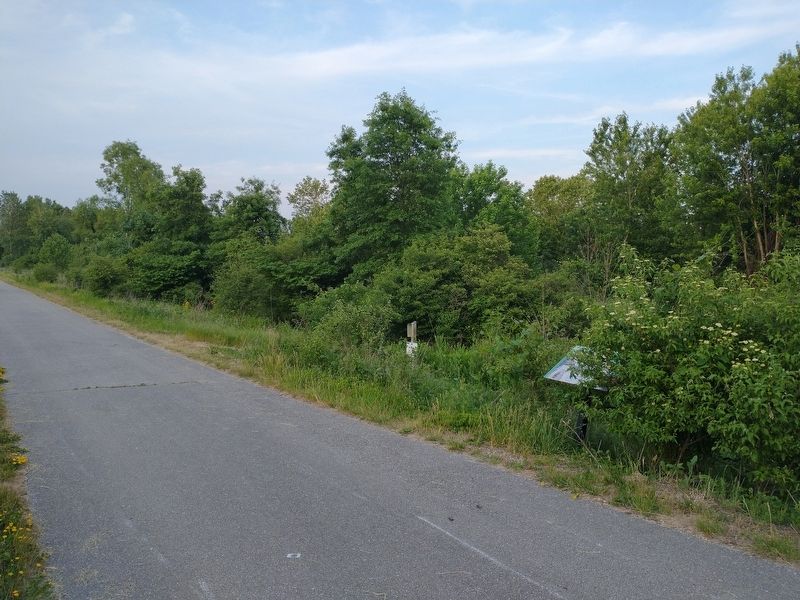
Photographed by Tom Bosse, June 2, 2023
2. Lost Birds of Canal Days Marker
Topics. This historical marker is listed in these topic lists: Animals • Environment • Waterways & Vessels. A significant historical date for this entry is July 4, 1837.
Location. 41° 2.129′ N, 85° 14.461′ W. Marker is in Fort Wayne, Indiana, in Allen County. It is at the intersection of Towpath / Eagle Marsh Trail and Trail 1, on the right when traveling north on Towpath / Eagle Marsh Trail. Touch for map. Marker is at or near this postal address: 7833 W Jefferson Blvd, Fort Wayne IN 46804, United States of America. Touch for directions.

Regionally, this marker is in Northern Indiana. It is also in the American Midwest and in the Corn Belt. Globally, it is in North America, the Western Hemisphere, the Western World, and the Anglosphere. Historically, it finds itself in what was once the Viceroyalty of New France, the territory of the Mississippian Culture, and the Northwest Territory.
Other nearby markers. At least 8 other markers are within 4 miles of this marker, measured as the crow flies: The Towpath Trail History (about 500 feet away, measured in a direct line); The Little River Valley Story
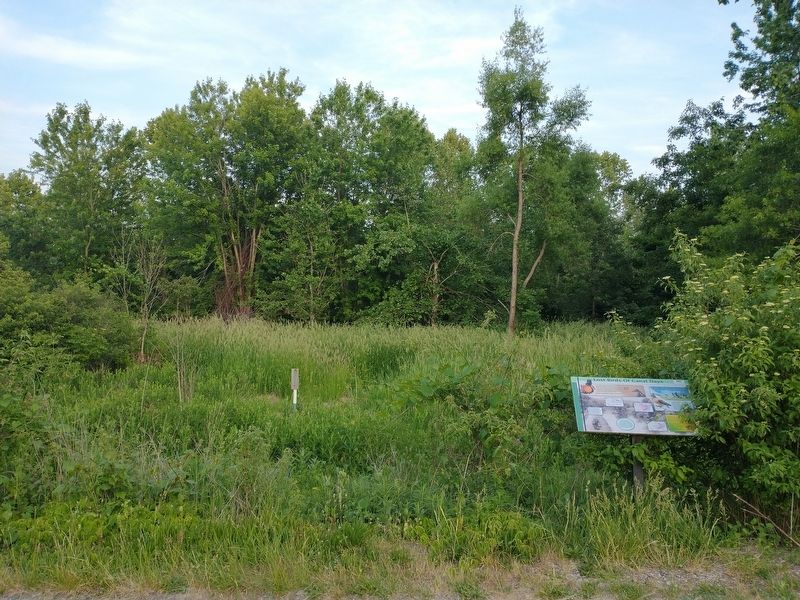
Photographed by Tom Bosse, June 2, 2023
3. Lost Birds of Canal Days Marker
Credits. This page was last revised on June 20, 2023. It was originally submitted on June 13, 2023, by Tom Bosse of Jefferson City, Tennessee. This page has been viewed 290 times since then and 26 times this year. Photos: 1, 2, 3. submitted on June 13, 2023, by Tom Bosse of Jefferson City, Tennessee. • Devry Becker Jones was the editor who published this page.
