North Side in Richmond, Virginia — The American South (Mid-Atlantic)
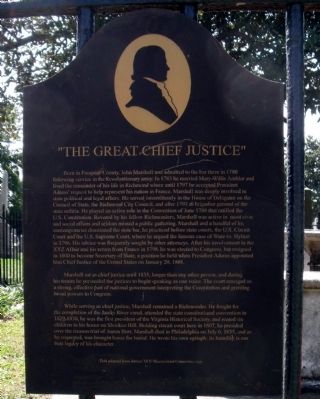
"The Great Chief Justice"
Photographed by Bernard Fisher, September 20, 2009
1. "The Great Chief Justice" Marker
this page online
Marshall sat as chief justice until 1835, longer than any other person, and during his tenure he persuaded the justices to begin speaking as one voice. The court emerged as a strong, effective part of national government interpreting the Constitution and granting broad powers to Congress.
While serving as chief justice, Marshall remained a Richmonder. He fought for the completion of the James River canal, attended the state constitutional convention in 1829-1830, he was the first president of the Virginia Historical Society, and reared six children in his house on Shockoe Hill. Holding circuit court here in 1807, he presided over the treason trial of Aaron Burr. Marshall died in Philadelphia on July 6, 1835, an as he requested, was brought home for burial. He wrote his own epitaph: its humility is our best legacy of his character.
Text adapted from former VCU Bicentennial Committee sign.
Topics and series. This historical marker is listed in these topic lists: Cemeteries & Burial Sites
Photographed by Bernard Fisher, September 20, 2009
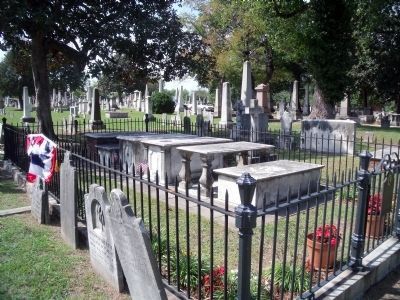
2. "The Great Chief Justice" Marker in Shockoe Hill Cemetery
Location. 37° 33.13′ N, 77° 25.895′ W. Marker is in Richmond, Virginia. It is in the North Side. It can be reached from Hospital Street near North 4th Street. This marker is located at the grave site of John Marshall in Shockoe Hill Cemetery. Touch for map. Marker is in this post office area: Richmond VA 23219, United States of America. Touch for directions.

Regionally, this marker is in Central Virginia. It is also in the American South and specifically in the Upper South. Globally, it is in North America, the Western Hemisphere, the Western World, and the Anglosphere. Historically, it finds itself in what was once the territory of the Mississippian Culture, one of the original Thirteen Colonies, one of the Confederate States of America, and the Antebellum South.
Other nearby markers. At least 8 other markers are within walking distance of this marker: Shockoe Hill Cemetery (within shouting distance of this marker); Union POW Memorial
Photographed by Bernard Fisher, September 20, 2009
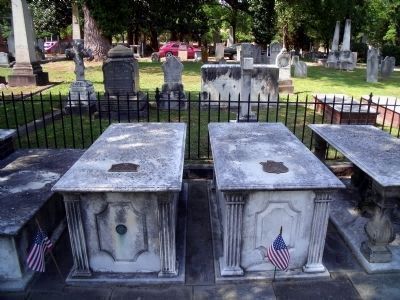
3. John and Mary Willis Ambler Marshall
Two days before his death, Marshall enjoined his friends to place only a plain slab over his and his wife's graves, and he wrote the simple inscription himself:
John Marshall
Son of Thomas and Mary Marshall was born the 24th of September 1755. Intermarried with Mary Willis Ambler the 3rd of January 1783. Departed this life the 6th day of July 1835.
Also see . . .
1. Friends of Shockoe Hill Cemetery. (Submitted on September 21, 2009.)
2. John Marshall Center for Constitutional History & Civics. (Submitted on September 21, 2009.)
Photographed by Southern Bargain House, Richmond, Va.
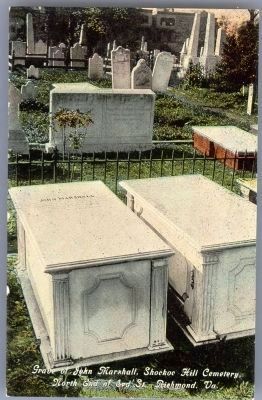
4. Grave of John Marshall, Shockoe Hill Cemetery, North End of 3rd St., Richmond, Va.
The limited area on this cemetery having been filled with graves, no interments have been made therein for several years. The grave of Chief Justice Marshall, side by side of that of his wife, is shown in this view. Marshall's modest and unassuming simplicity of character is evidenced by the inscription he directed for his tombstone, as follows: - 'John Marshall, son of Thomas and Mary Marshall, was born the 24th of Sept. 1755. Intermarried with Mary Willis Ambler the 3rd of January, 1783. Departed this life the 6th of July, 1835.' VCU Libraries Digital Collections - Rarely Seen Richmond
Credits. This page was last revised on February 1, 2023. It was originally submitted on September 21, 2009, by Bernard Fisher of Richmond, Virginia. This page has been viewed 1,263 times since then and 24 times this year. Photos: 1, 2, 3. submitted on September 21, 2009, by Bernard Fisher of Richmond, Virginia. 4. submitted on May 10, 2012, by Bernard Fisher of Richmond, Virginia.
