Luray in Page County, Virginia — The American South (Mid-Atlantic)
Bethany Veney
"Aunt Betty’s Story"
| — | The Long Road to Freedom | — |
Photographed by Linda Walcroft, June 25, 2023
1. Bethany Veney Marker
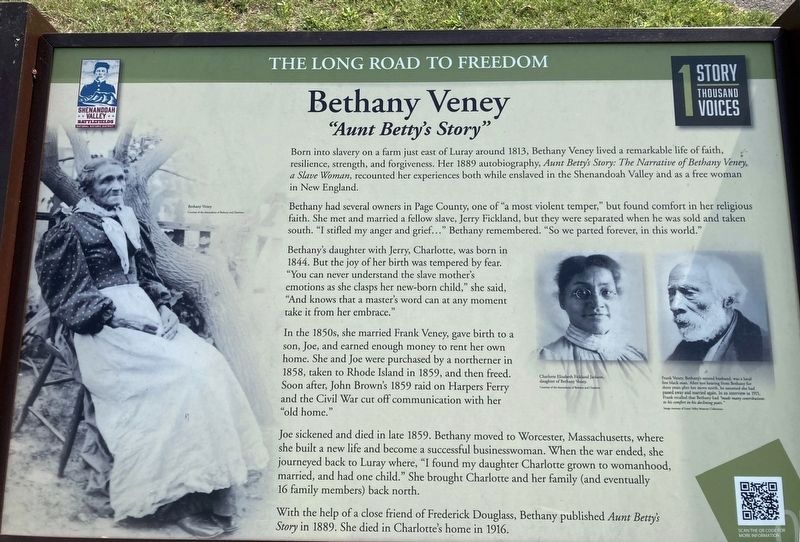
Born into slavery on a farm just east of Luray around 1813, Bethany Veney lived a remarkable life of faith, resilience, strength, and forgiveness. Her 1889 autobiography, Aunt Betty’s Story: The Narrative of Bethany Veney, a Slave Woman, recounted her experiences both while enslaved in the Shenandoah Valley, and as a free woman in New England.
Bethany had several owners in Page County, one of "a most violent temper," but found comfort in her religious faith. She met and married a fellow slave, Jerry Fickland, but they were separated when he was sold and taken south. "I stifled my anger and grief..." Bethany remembered. "So we parted forever, in this world."
Bethany's daughter with Jerry, Charlotte, was born in 1844. But the joy of her birth was tempered by fear. "You can never understand the slave mother's emotions as she clasps her new-born child," she said, "And knows that a master's word can at any moment take it from her embrace."
In the 1850s, she married Frank Veney, gave birth to a son, Joe, and earned enough money to rent her own home. She and Joe were purchased by a northerner in 1858, taken to Rhode
this page online
Joe sickened and died in late 1859. Bethany moved to Worcester, Massachusetts, where she built a new life and become a successful businesswoman. When the war ended, she journeyed back to Luray where, "I found my daughter Charlotte grown to womanhood, married, and had one child." She brought Charlotte and her family (and eventually 16 family members) back north.
With the help of a close friend of Frederick Douglass, Bethany published Aunt Betty's Story in 1889. She died in Charlotte's home in 1916.
Erected 2023 by Shenandoah Valley Battlefields.
Topics. This historical marker is listed in these topic lists: African Americans • War, US Civil • Women. A significant historical year for this entry is 1813.
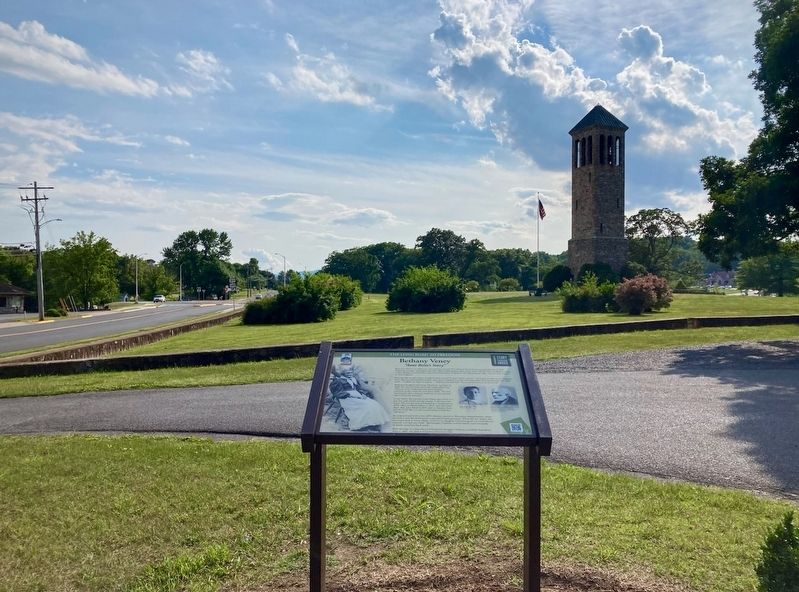
Location. 38° 39.815′ N, 78° 28.642′ W. Marker is in Luray, Virginia, in Page County. It can be reached from the intersection of West Main Street (Business U.S. 211) and Carillon Drive (Business U.S. 211), on the right when traveling west. Located in the Bethany Veney Remembrance
Photographed by Linda Walcroft, June 25, 2023
2. Bethany Veney Marker and Luray Carillon

Regionally, this marker is in the Shenandoah Valley. It is also in the American South and specifically in the Upper South. Globally, it is in North America, the Western Hemisphere, the Western World, and the Anglosphere. Historically, it finds itself in what was once the territory of the Mississippian Culture, one of the original Thirteen Colonies, one of the Confederate States of America, and the Antebellum South.
Other nearby markers. At least 8 other markers are within walking distance of this marker: Fort Philip Long (approx. ¼ mile away); Andrew Jackson School (approx. ¼ mile away); 1901 A.B. Farquhar Company Threshing Steam Engine (approx. 0.3 miles away); The World's First Bluegrass Festival (approx. 0.3 miles away); Shenandoah Heritage Village/Luray Valley Museum (approx. 0.3 miles away); Luray Caverns Virginia (approx. 0.3 miles away); Ajax Portable Steam Engine, circa 1900 (approx. 0.3 miles away); Luray Caverns (approx. 0.3 miles away). Touch for a list and map of all markers in Luray.
Another marker is no longer nearby. The Luray Valley Museum (was approx. 0.3 miles away but has been replaced with another marker now near it).
Also see . . . Bethany Veney. The Long Road to Freedom website. (Submitted on July 4, 2023, by Linda Walcroft of Woodstock, Virginia.)
Credits. This page was last revised on November 3, 2024. It was originally submitted on July 4, 2023, by Linda Walcroft of Woodstock, Virginia. This page has been viewed 579 times since then and 72 times this year. Photos: 1, 2. submitted on July 4, 2023, by Linda Walcroft of Woodstock, Virginia. • Bernard Fisher was the editor who published this page.
