Fort Snelling in Hennepin County, Minnesota — The American Midwest (Upper Plains)
US–Dakota War of 1862

Photographed by McGhiever, June 30, 2023
1. US–Dakota War of 1862 Marker
Following the murder of white farmers by four Dakota hunters on August 17, some akicita, or warriors, resolved to drive white settlers from the Dakota homelands. In the ensuing days, akicita attacked government agencies, homesteads, and towns, killing hundreds, and forcing almost 30,000 settlers to flee.
Col. Henry Sibley led volunteers from Fort Snelling to fight against the Dakota people. In September 1862, six weeks after the fighting began, the war ended at the Battle of Wood Lake. Though estimates vary, at least 500 white settlers and close to 100 Dakota people were killed. More than one-quarter of the Dakota who surrendered in 1862 died during the following year.
Families and communities were divided over the conflict
this page online
People escaping from fighting during the US-Dakota War of 1862. Photograph by Adrian John Ebell
Taoyateduta's wife and children at Fort Snelling, 1864. Photograph by Benjamin Franklin Upton
Erected by Minnesota Historical Society.
Topics. This historical marker is listed in these topic lists: Indigenous Peoples and Communities • Wars, US Indian. A significant historical date for this entry is August 17, 1862.
Location. 44° 53.558′ N, 93° 10.963′ W. Marker is in Fort Snelling, Minnesota, in Hennepin County. It is on Tower Avenue when traveling east. The marker is at Historic Fort Snelling, on the paved path between the visitor center and the old fort. Touch for map. Marker is at or near this postal address: 200 Tower Avenue, Saint Paul MN 55111,
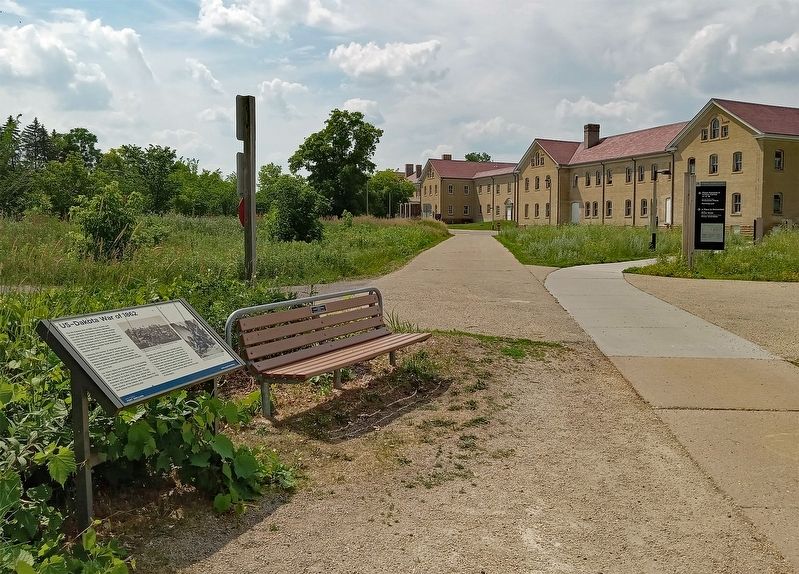
Photographed by McGhiever, June 30, 2023
2. US–Dakota War of 1862 marker and the Historic Fort Snelling Visitor Center

Regionally, this marker is in the Twin Cities Metropolitan Area. It is also in the American Midwest, in the Corn Belt, and in the Great River Road Region. Globally, it is in North America, the Western Hemisphere, the Western World, and the Anglosphere. Historically, it finds itself in what was once Rupert’s Land, the territory of the Mississippian Culture, and the Louisiana Purchase.
Other nearby markers. At least 8 other markers are within walking distance of this marker: Imprisonment of Dakota Families (a few steps from this marker); Executions at Fort Snelling (a few steps from this marker); Pride (a few steps from this marker); Perseverance (within shouting distance of this marker); St. Peters Agency (within shouting distance of this marker); DAR Commemorative Plaques (within shouting distance of this marker); Sacrifice (within shouting distance of this marker); The Round Tower (within shouting distance of this marker). Touch for a list and map of all markers in Fort Snelling.
Another marker is no longer nearby. The Prairie (was within shouting distance of this marker but has been permanently removed).
Credits. This page was last revised on July 10, 2023. It was originally submitted on July 9, 2023, by McGhiever of Minneapolis, Minnesota. This page has been viewed 345 times since then and 57 times this year. Photos: 1, 2. submitted on July 9, 2023, by McGhiever of Minneapolis, Minnesota. • J. Makali Bruton was the editor who published this page.
