University in Blacksburg in Montgomery County, Virginia — The American South (Mid-Atlantic)
Enslaved People and the Prestons
⎯⎯⎯
From Plantation to College Campus
Photographed by Duane and Tracy Marsteller, June 17, 2023
1. Enslaved People and the Prestons side of marker
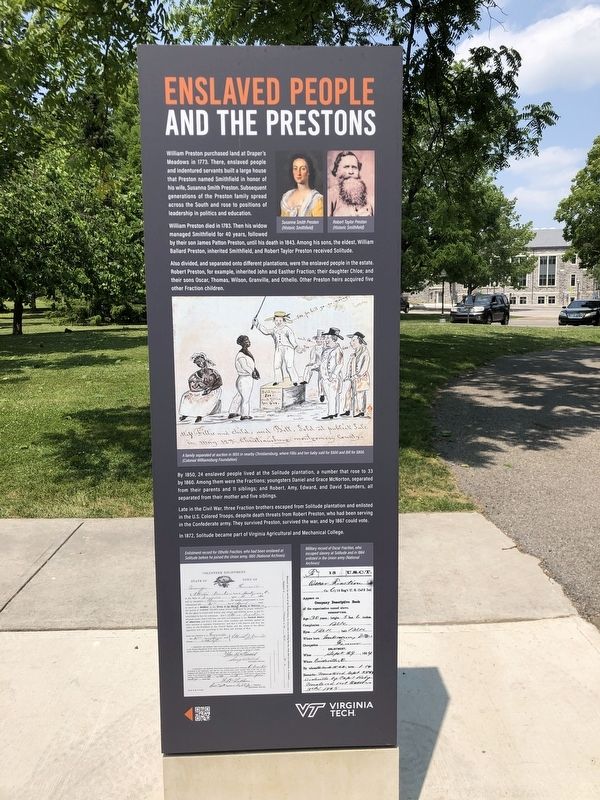
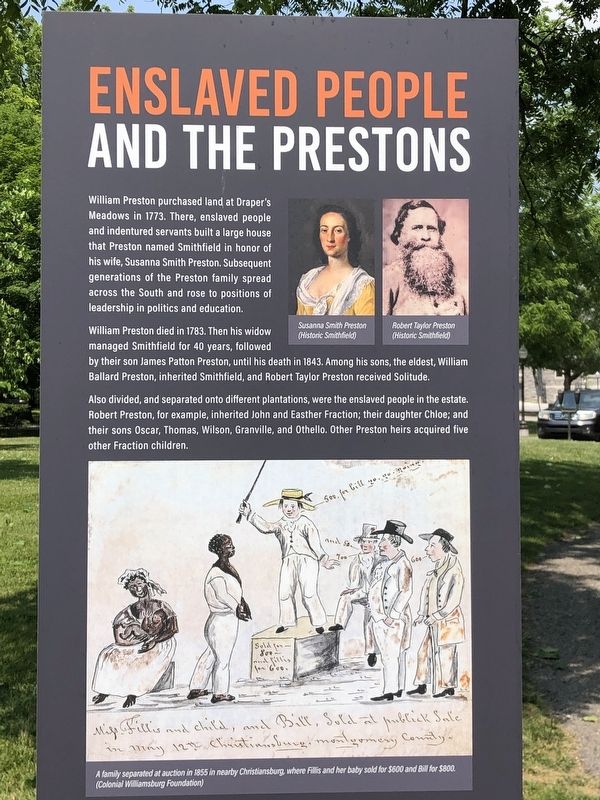
William Preston died in 1783. Then his widow managed Smithfield for 40 years, followed by their son James Patton Preston, until his death in 1843. Among his sons, the eldest, William Ballard Preston, inherited Smithfield, and Robert Taylor Preston received Solitude.
Also divided, and separated onto different plantations, were the enslaved people in the estate. Robert Preston, for example, inherited John and Easther Fraction; their daughter Chloe; and their sons Oscar, Thomas, Wilson, Granville, and Othello. Other Preston heirs acquired five other Fraction children.
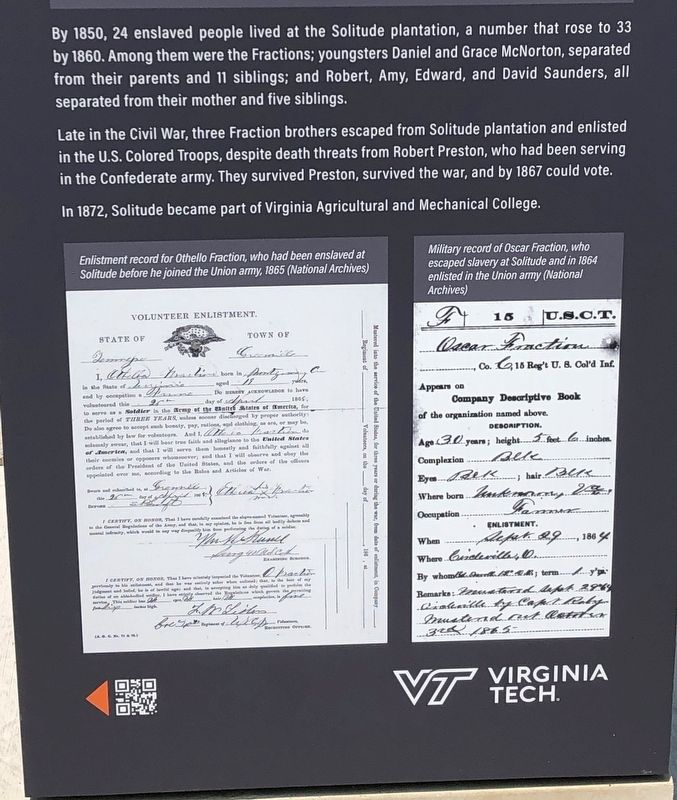
By 1850, 24 enslaved people lived at the Solitude plantation, a number that rose to 33 by 1860. Among them were the Fractions: youngsters Daniel and Grace McNorton, separated from their parents
this page online
Late in the Civil War, three Fraction brothers escaped from Solitude plantation and enlisted in the U.S. Colored Troops, despite death threats from Robert Preston, who had been serving in the Confederate Army. They survived Preston, survived the war, and by 1867 could vote.
In 1872, Solitude became part of Virginia Agricultural and Mechanical College.
[Captions (top to bottom)]
• (Left) Susanna Smith Preston (Historic Smithfield); (Right) Robert Taylor Preston (Historic Smithfield)
• A family separated at auction in 1855 in nearby Christiansburg, where Fillis and her baby sold for $600 and Bill for $800. (Colonial Williamsburg Foundation)
• (Left) Enlistment record for Othello Fraction, who had been enslaved at Solitude before he joined the Union army, 1865 (National Archives); (Right) Military record of Oscar Fraction, who escaped slavery at Solitude and in 1864 enlisted in the Union army (National Archives)
From Plantation to College Campus – The Solitude house originated about 1801 as a one-room log structure

Photographed by Duane and Tracy Marsteller, June 17, 2023
2. From Plantation to College Campus side of marker
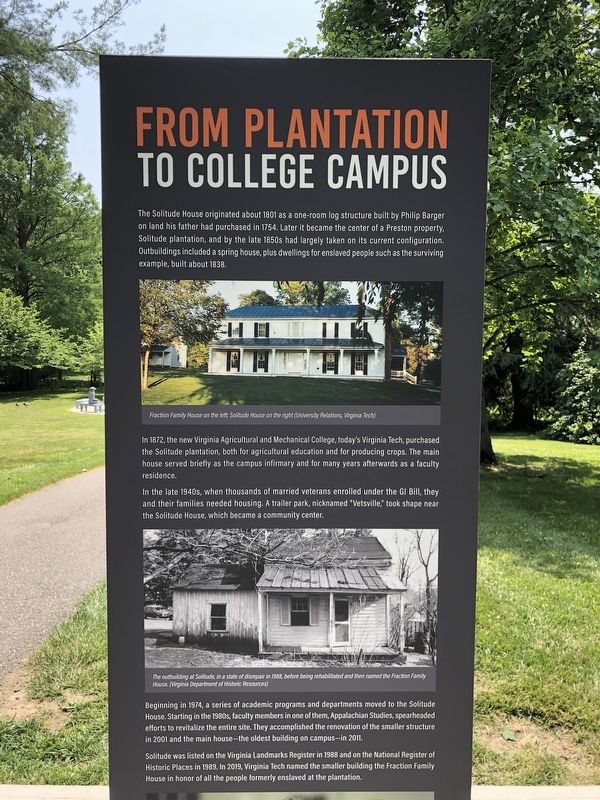
In 1872, the new Virginia Agricultural and Mechanical College, today's Virginia Tech, purchased the Solitude plantation, both for agricultural education and for producing crops. The main house served briefly as the campus infirmary and for many years afterwards as a faculty residence.
In the late 1940s, when thousands of married veterans enrolled under the GI Bill, they and their families needed housing. A trailer park, nicknamed “Vetsville,” took shape near the Solitude House, which became a community center.
Beginning in 1974, a series of academic programs and departments moved to the Solitude House. Starting in the 1980s, faculty members in one of them, Appalachian Studies, spearheaded efforts to revitalize the entire site. The accomplished the renovation of the smaller structure in 2001 and the main
Photographed by Duane and Tracy Marsteller, June 17, 2023
3. Enslaved People and the Prestons Marker closeup
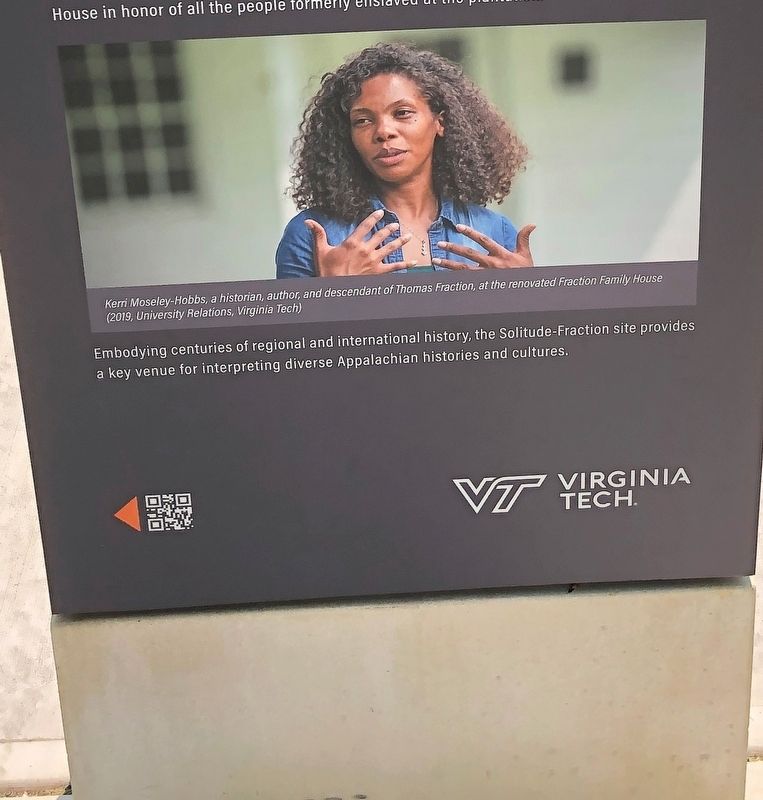
Solitude as listed on the Virginia Landmarks Register in 1988 and on the National Register of Historic Places in 1989. In 2019, Virginia Tech named the smaller building the Fraction Family House in honor of all the people formerly enslaved at the plantation.
Embodying centuries of regional and international history, the Solitude-Fraction site provides a key venue for interpreting diverse Appalachian histories and cultures.
[Captions (top to bottom)]
• Fraction Family House on the left, Solitude House on the right (University Relations, Virginia Tech)
• The outbuilding at Solitude, in a state of disrepair in 1988, before being rehabilitated and then named the Fraction Family House (Virginia Department of Historic Resources)
• Kerri Moseley-Hobbs, a historian, author, and descendant of Thomas Fraction, at the renovated Fraction Family House (2019, University Relations, Virginia Tech)
Erected by Virginia Tech.
Topics. This historical marker is listed in these topic lists: African Americans • Civil Rights • Settlements & Settlers • War, US Civil. A significant historical year for this entry is 1773.
Location. 37° 13.569′ N,
Photographed by Duane and Tracy Marsteller, June 17, 2023
4. Enslaved People and the Prestons Marker closeup

Regionally, this marker is in Southwest Virginia, in the Blue Ridge Highlands, and in the New River Gorge. It is also in the American South, specifically in the Upper South, in Appalachia, and specifically in Southern Appalachia. Globally, it is in North America, the Western Hemisphere, the Western World, and the Anglosphere. Historically, it finds itself in what was once the territory of the Mississippian Culture, one of the original Thirteen Colonies, one of the Confederate States of America, and the Antebellum South.
Other nearby markers. At least 8 other markers are within walking distance of this marker: Solitude (about 300 feet away, measured in a direct line); Native Stewardship / The Monacan Peoples (about 300 feet away); Robert James Davidson
Photographed by Duane and Tracy Marsteller, June 17, 2023
5. From Plantation to College Campus Marker closeup
Also see . . . Solitude (PDF). National Register nomination and photographs submitted for the site, which was listed in 1989. (National Archives) (Submitted on July 14, 2023, by Duane and Tracy Marsteller of Murfreesboro, Tennessee.)
Photographed by Duane and Tracy Marsteller, June 17, 2023
6. From Plantation to College Campus Marker closeup

Photographed by Duane and Tracy Marsteller, June 17, 2023
7. Enslaved People and the Prestons / From Plantation to College Campus Marker
Marker is to the rear of Solitude House.

Photographed by Duane and Tracy Marsteller, June 17, 2023
8. Solitude House
Front view of the house.

Photographed by Duane and Tracy Marsteller, June 17, 2023
9. The Fraction Family House
It is named in honor of an enslaved family who worked on Solitude plantation.
Credits. This page was last revised on July 16, 2023. It was originally submitted on July 14, 2023, by Duane and Tracy Marsteller of Murfreesboro, Tennessee. This page has been viewed 778 times since then and 112 times this year. Photos: 1, 2, 3, 4, 5, 6, 7, 8, 9. submitted on July 14, 2023, by Duane and Tracy Marsteller of Murfreesboro, Tennessee.
