Rione X Campitelli in Roma in Città metropolitana di Roma Capitale, Latium, Rome, Italy — Central Italy (Tyrrhenian Coast)
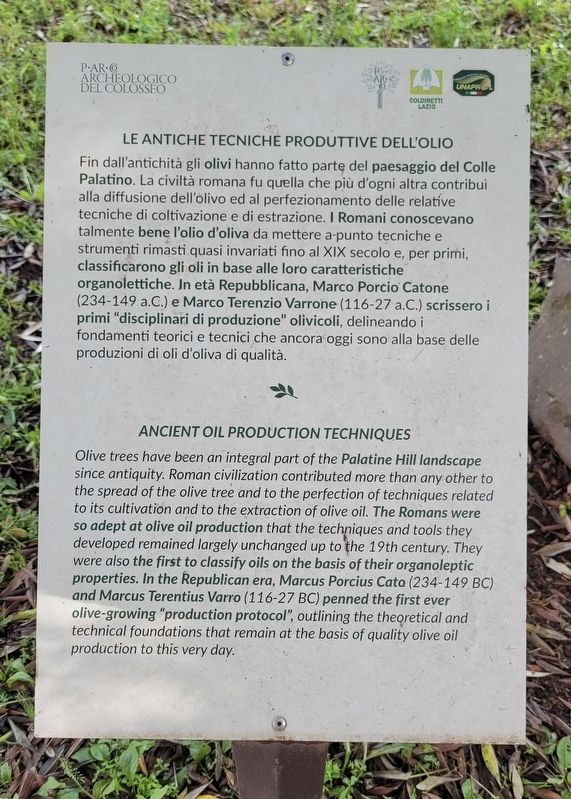
Le Antiche Tecniche Produttive Dell'olio
⎯⎯⎯
Ancient Oil Production Techniques
Photographed by James Hulse, June 14, 2023
1. Le Antiche Tecniche Produttive Dell'olio / Ancient Oil Production Techniques Marker

Olive trees have been an integral part of the Palatine Hill landscape since antiquity. Roman civilization contributed more than any other to the spread of the olive tree and to the perfection of techniques related to its cultivation and to the extraction of olive oil. The Romans were so adept at olive oil production that the techniques and tools they developed remained largely unchanged
this page online
Erected by Parco Archeologico del Colosseo.
Topics. This historical marker is listed in these topic lists: Agriculture • Anthropology & Archaeology.
Location. 41° 53.379′ N, 12° 29.263′ E. Marker is in Roma, Lazio (Latium, Rome), in Città metropolitana di Roma Capitale. It is in Rione X Campitelli. It is at the intersection of Via Sacra and Via Nova on Via Sacra. The marker is located south of the Arch of Titus in the park. Touch for map. Marker is in this post office area: Roma, Lazio 00186, Italy. Touch for directions.

Regionally, it is in Europe, the European Union, the Schengen Area, a coastal Mediterranean country, and the Western World. Historically, it finds itself in what
Photographed by James Hulse, June 14, 2023
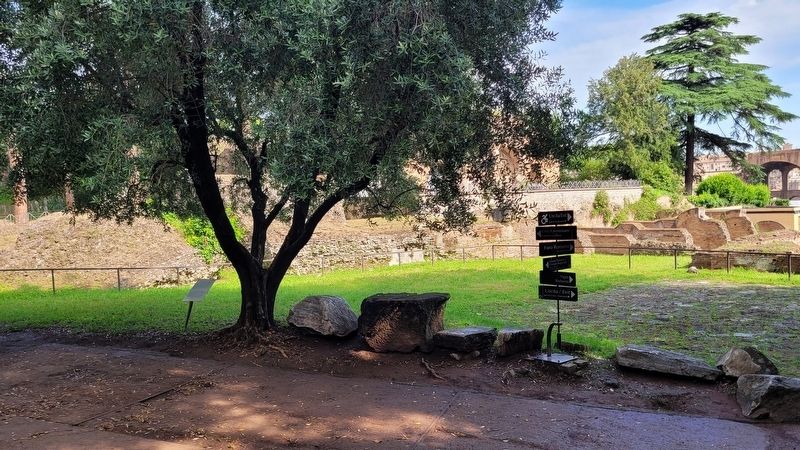
2. The Olive tree and Marker along the pathway
Other nearby markers. At least 8 other markers are within walking distance of this marker: Basamento di un Tempio / Platform of a Temple (a few steps from this marker); L'area della ex Vigna Barberini / Area of the Former Barberini Vineyard (within shouting distance of this marker); Imperial Palace (within shouting distance of this marker); L'Olivo, Albero della Salute e della Prosperità / The Olive, Tree of Health and Prosperity (within shouting distance of this marker); Neronian Cryptoporticus / Criptoportico Neroniano (within shouting distance of this marker); Domus Flavia. Cd. Larario / Domus Flavia. So-called Larario (within shouting distance of this marker); Domus Flavia, so-called Lararium / Cd. Larario (within shouting distance of this marker); Chiesa di San Sebastiano / Church of San Sebastiano (within shouting distance of this marker). Touch for a list and map of all markers in Roma.
More about this marker. The marker is located in the Parco Archeologico del Colosseo (Roman Forum Archaeological Park) and it does require an entry fee to visit.
Also see . . . Parco Archeologico del Colosseo. Roma Turismo
Parco Archeologico del Colosseo includes the extraordinary ancient complexes forming part of the central archaeological area, namely Colosseum, Roman Forum and Palatine.(Submitted on July 30, 2023, by James Hulse of Medina, Texas.)
Credits. This page was last revised on July 30, 2023. It was originally submitted on July 29, 2023, by James Hulse of Medina, Texas. This page has been viewed 169 times since then and 10 times this year. Photos: 1, 2. submitted on July 30, 2023, by James Hulse of Medina, Texas.
