Chattahoochee in Gadsden County, Florida — The American South (South Atlantic)
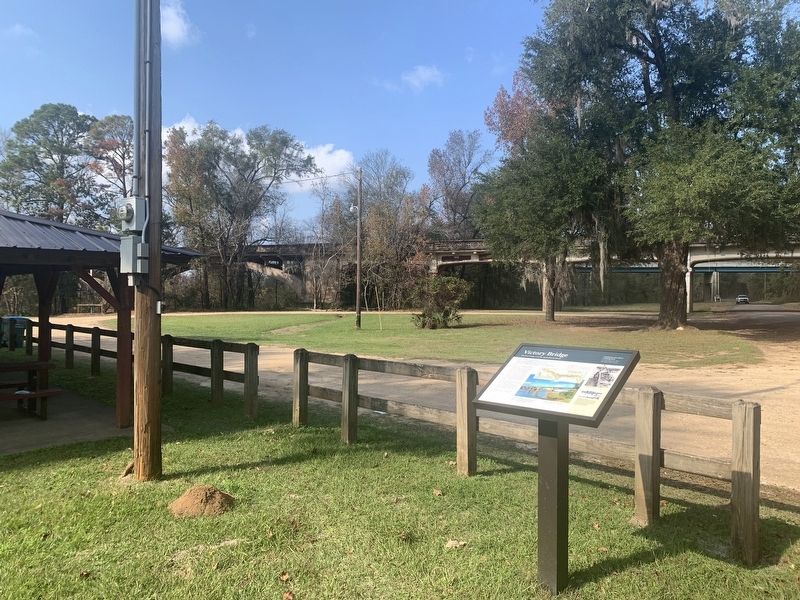
Victory Bridge
The first bridge over the Apalachicola River

Photographed by Tim Fillmon, December 9, 2022
1. Victory Bridge Marker
Its name honors the Allied victory in World War I, then believed to be a "war that would end all wars."
Jackson and Gadsden Counties paid for the bridge, with help from the Federal government. The main section required 1,200,000 pounds of steel and 12,000 cubic yards of concrete. Workers built cofferdams in the river to allow access to dry bottom for the construction of the piers and arches.
The seven arch spans were each 110-feet long. There was also a bascule lift span or drawbridge of 100-feet that opened to allow paddlewheel riverboats to pass beneath. The Converse Bridge Company of Chattanooga, Tennessee, fabricated the lift or drawbridge. Pensacola Shipbuilding Company put it in place.
The classic structure was designed by James Austin Mortland, a bridge engineer with the Florida State Roads Department (today’s FDOT). The main structure is 2,100 feet long, while an approach structure across the Pope Lake Swamp west
this page online
An important crossing.
Victory bridge replaced licensed ferries that ran at this site for 100 years after the United States acquired Florida from Spain in 1821. Prior to that time, travelers used dugout canoes to cross the Apalachicola River. The graceful arches of the historic structure parallel the mid 20th century US 90 bridge.
The Old Spanish Trail.
Victory bridge was an important link on America’s first coast to coast tourist route. Called the Old Spanish Trail National Highway, it commemorated earlier colonial roads and linked San Francisco. California to Jacksonville, Florida.
The Old meets the New.
The paddlewheel steamer John W Callahan, Jr. passes through the lift span of the bridge on dedication day in 1922. The completion of modern highways spelled the end for the beautiful old "floating palaces".
Erected by Chattahoochee River Landing Park - An Apalachicola River
Photographed by Tim Fillmon, December 9, 2022
2. Victory Bridge Marker
Topics. This historical marker is listed in these topic lists: Roads & Vehicles • Waterways & Vessels. A significant historical year for this entry is 1922.
Location. 30° 42.077′ N, 84° 51.388′ W. Marker is in Chattahoochee, Florida, in Gadsden County. It is on River Landing Road 0.3 miles south of Washington Street (U.S. 90), on the right when traveling west. Located near the end of River Landing Road in the Chattahoochee River Landing Park. Touch for map. Marker is in this post office area: Chattahoochee FL 32324, United States of America. Touch for directions.

Regionally, this marker is in Greater Tallahassee and on the Florida Panhandle. It is also in the American South and specifically in the Deep South. Globally, it is in the North Atlantic Region, North America, a Gulf of Mexico state, the Western Hemisphere, the Western World, and the Anglosphere. Historically, it finds itself in what was once New Spain, the territory of the Mississippian Culture, one of the Confederate States of America, and the Antebellum South.
Other nearby markers. At least 8 other markers are within walking distance of this marker: The Chattahoochee Landing Mound Group (within shouting distance of this marker); The Scott Massacre (within shouting distance of this marker); Nicoll's Outpost (within shouting distance of this marker); The Scott Battle of 1817 (within shouting distance of this marker); Ellicott's Camp and Observatory (within shouting distance of this marker); a different marker also named Nicolls' Outpost (within shouting distance of this marker); a different marker also named Chattahoochee Landing Mound Group (within shouting distance of this marker); The Treaty of Nicolls' Outpost (within shouting distance of this marker). Touch for a list and map of all markers in Chattahoochee.
Also see . . . Victory Bridge. (Submitted on August 13, 2023, by Tim Fillmon of Webster, Florida.)
Credits. This page was last revised on August 13, 2023. It was originally submitted on August 13, 2023, by Tim Fillmon of Webster, Florida. This page has been viewed 669 times since then and 71 times this year. Photos: 1, 2. submitted on August 13, 2023, by Tim Fillmon of Webster, Florida.
