Chattahoochee in Gadsden County, Florida — The American South (South Atlantic)
The First Seminole War
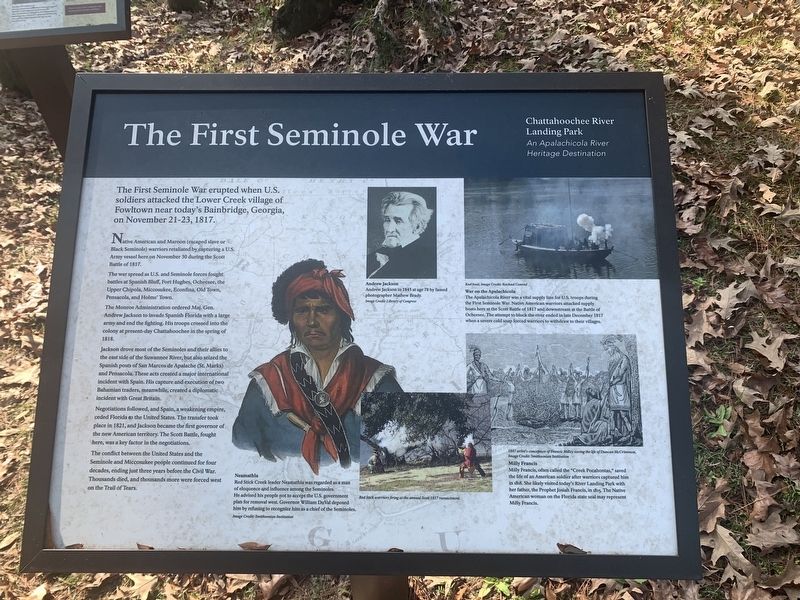
Photographed by Tim Fillmon, December 9, 2022
1. The First Seminole War Marker
Native American and Maroon (escaped slave or Black Seminole) warriors retaliated by capturing a U.S. Army vessel here on November 30 during the Scott Battle of 1817.
The war spread as U.S. and Seminole forces fought battles at Spanish Bluff, Fort Hughes, Ocheesee, the Upper Chipola, Miccosukee, Econofina, Old Town, Pensacola, and Holms' Town.
The Monroe Administration ordered Maj. Gen. Andrew Jackson to invade Spanish Florida with a large army and end the fighting. His troops crossed into the colony at present-day Chattahoochee in the spring of 1818.
Jackon drove most of the Seminoles and their allies to the east side of the Suwannee River, but also seized the Spanish posts of San Marcos de Apalache (St. Marks) and Pensacola. These acts created a major international incident with Spain. His capture and execution of two Bahamian traders, meanwhile, created a diplomatic incident with Great Britian.
The conflict between the United States and the Seminole and Miccosukee
this page online
Neamathla
Red Stick Creek leader Neamathla was regarded as a man of eloquence and influence among the Seminoles. He advised his people not to accept the U.S. government plan for removal west. Governor William DuVal deposed him by refusing to recognize him as a chief of the Seminoles.
War of the Apalachicola
The Apalachicola River was a vital supply line for U.S. troops during the First Seminole War. Native American warriors attacked supply boats here at the Scott Battle of 1817 and downstream at the Battle of Ocheesee. The attempt to block the river ended in late December 1817 when a severe cold snap forced warriors to withdraw to their villages.
Milly Francis
Milly Francis, often called the "Creek Pocahontas," saved the life of an American soldier after warriors captured him in 1818. She likely visited today's River Landing Park with her father, the Prophet Josiah Francis, in 1815. The native American woman on the Florida state seal may represent Milly Francis.
Erected by Chattahoochee
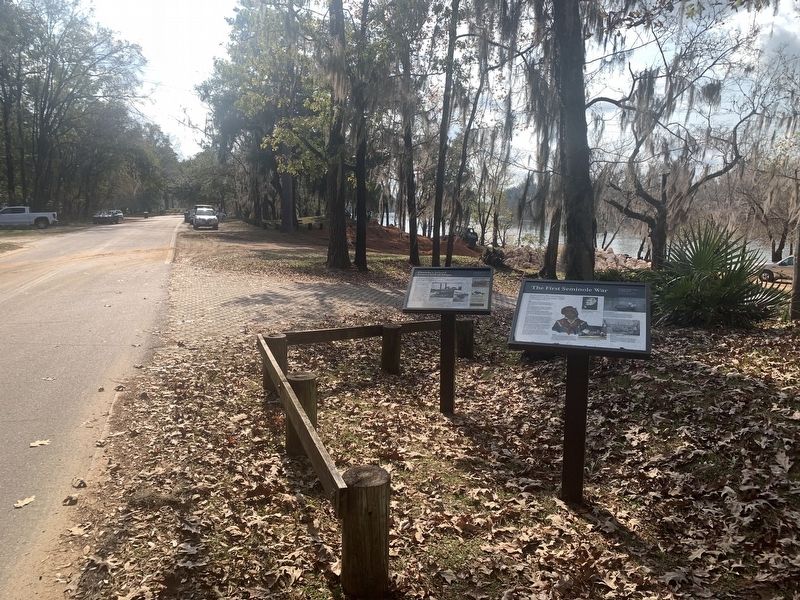
Photographed by Tim Fillmon, December 9, 2022
2. The First Seminole War Marker
Topics. This historical marker is listed in these topic lists: Indigenous Peoples and Communities • Wars, US Indian • Waterways & Vessels. A significant historical date for this entry is November 30, 1817.
Location. 30° 42.017′ N, 84° 51.401′ W. Marker is in Chattahoochee, Florida, in Gadsden County. It is on River Landing Road 0.4 miles south of U.S. 90, on the right when traveling south. Located near the end of River Landing Road in the Chattahoochee River Landing Park. Touch for map. Marker is in this post office area: Chattahoochee FL 32324, United States of America. Touch for directions.

Regionally, this marker is in Greater Tallahassee and on the Florida Panhandle. It is also in the American South and specifically in the Deep South. Globally, it is in the North Atlantic Region, North America, a Gulf of Mexico state, the Western Hemisphere, the Western World, and the Anglosphere. Historically, it finds itself in what was once New Spain, the territory of the Mississippian Culture, one of the Confederate States of America, and the Antebellum South.
Other nearby markers. At least 8 other markers are within walking distance of this marker: Chattahoochee Landing Mound Group (within shouting distance of this marker); Nicolls' Outpost (within shouting distance of this marker); The Scott Battle of 1817 (within shouting distance of this marker); a different marker also named Nicoll's Outpost (within shouting distance of this marker); The Scott Massacre (within shouting distance of this marker); a different marker also named The Chattahoochee Landing Mound Group (within shouting distance of this marker); The Apalachicola River - A Florida Blueway (within shouting distance of this marker); Ellicott's Camp and Observatory (about 300 feet away, measured in a direct line). Touch for a list and map of all markers in Chattahoochee.
Another marker is no longer nearby. Florida's Inland Graveyard of Ships (was here, next to this marker but has been confirmed missing).
Also see . . . The Seminole Wars. (Submitted on August 16, 2023, by Tim Fillmon of Webster, Florida.)
Credits. This page was last revised on August 16, 2023. It was originally submitted on August 16, 2023, by Tim Fillmon of Webster, Florida. This page has been viewed 426 times since then and 68 times this year. Photos: 1, 2. submitted on August 16, 2023, by Tim Fillmon of Webster, Florida.
