Sidney in Cheyenne County, Nebraska — The American Midwest (Upper Plains)
Sidney ~ Cheyenne County

Photographed by Cosmos Mariner, August 12, 2023
1. Sidney ~ Cheyenne County Marker
In 1867 an Army tent camp was established near here to provide protection for Union Pacific Railroad construction crews. Three years later it became Fort Sidney, the nucleus for the town of Sidney, county seat of Cheyenne County. The rush to the Black Hills gold fields after 1875 confirmed Sidney’s importance as a freighting center. The 267-mile Sidney-Black Hills Trail carried the bulk of traffic from the railhead to the mining towns. As railroads extended into northwest Nebraska and Dakota Territory, commerce on the trail diminished and finally ended about 1885. In its frontier heyday Sidney boomed with a colorful admixture of settlers, freighters, cowboys, and soldiers. Throughout these years Cheyenne County was a center of the cattle industry on the high plains. With the decline of the trail and the abandonment of the forts, Sidney became dependent on ranching. Early in the 20th Century homesteaders successfully challenged the cattlemen. Today ranching and farming combine to make Sidney an important agricultural center. In 1949 the first successful oil well in western Nebraska was drilled north of Sidney and petroleum
this page online
Erected by Nebraska State Historical Society; and Department of Roads. (Marker Number 78.)
Topics and series. This historical marker is listed in these topic lists: Agriculture • Railroads & Streetcars • Roads & Vehicles • Settlements & Settlers. In addition, it is included in the Nebraska State Historical Society series list. A significant historical year for this entry is 1867.
Location. 41° 6.832′ N, 102° 55.484′ W. Marker is in Sidney, Nebraska, in Cheyenne County. It can be reached from Interstate 80 (at milepost 61), 1.3 miles east of Upland Parkway (Alternate Interstate 80), on the right when traveling west. Marker is located at the Interstate 80 rest stop just east of Sidney. Touch for map. Marker is in this post office area: Sidney NE 69162, United States of America. Touch for directions.

Regionally, this marker is in the Nebraska Panhandle. It is also in the American Midwest, in the Corn Belt, on the prairies, on the Great Plains, and specifically on the High Plains. Globally, it is in North America, the Western Hemisphere, the Western World, and
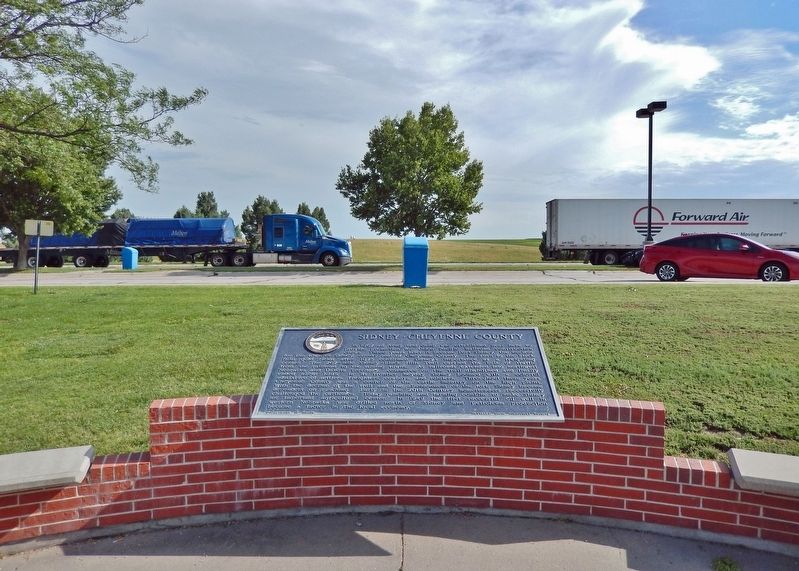
Photographed by Cosmos Mariner, August 12, 2023
2. Sidney ~ Cheyenne County Marker
Other nearby markers. At least 8 other markers are within 4 miles of this marker, measured as the crow flies: Purple Heart Trail (within shouting distance of this marker); Cheyenne County (about 300 feet away, measured in a direct line); 385 Gold Rush Byway (approx. 1½ miles away); National Pony Express Monument (approx. 1.6 miles away); Nebraska’s Earliest Documented Burial (approx. 2½ miles away); Pole Creek Original Station (approx. 2.7 miles away); Fort Sidney (approx. 3.2 miles away); Carnegie Library (approx. 3.4 miles away). Touch for a list and map of all markers in Sidney.
Also see . . .
1. Sidney, Nebraska (Wikipedia). Excerpt:
The city was named for Sidney Dillon, president of the Union Pacific Railroad. It was founded in 1867 by the Union Pacific and grew up around the military base of Fort Sidney (also known as Sidney Barracks), where soldiers were stationed to guard the transcontinental railroad against potential Native American attacks. The town became the southern terminus of the Sidney Black Hills Stage Road, allowing military and civilian traffic to reach Fort Robinson, Red Cloud Agency, Spotted Tail Agency, Custer, South Dakota, and Deadwood, South Dakota in the late 1870s and 1880s.(Submitted on August 18, 2023, by Cosmos Mariner of Cape Canaveral, Florida.)
2. Sidney, 1877. Excerpt:
Though prosperous as a frontier town, Sidney had a population of only about five hundred until the discovery of gold in the Black Hills. In the great rush to the new gold fields, hundreds of people passed through Sidney, which became a major outfitting point for the gold rush. The raucous atmosphere produced by travelers and soldiers from nearby Sidney Barracks was described briefly by a correspondent for The Daily State Journal of Lincoln on March 29, 1877...(Submitted on August 18, 2023, by Cosmos Mariner of Cape Canaveral, Florida.)
Credits. This page was last revised on August 18, 2023. It was originally submitted on August 18, 2023, by Cosmos Mariner of Cape Canaveral, Florida. This page has been viewed 328 times since then and 74 times this year. Photos: 1, 2. submitted on August 18, 2023, by Cosmos Mariner of Cape Canaveral, Florida.
