Fort Story in Virginia Beach, Virginia — The American South (Mid-Atlantic)
Battle of the Capes
U.S. Department of the Army
| — | Fort Story, Virginia | — |
Photographed by Richard E. Miller, September 27, 2009
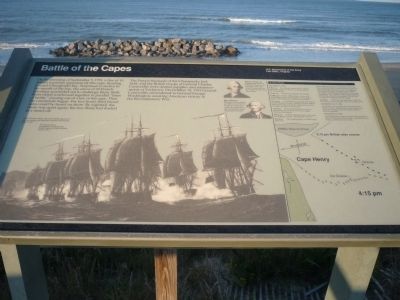
1. Battle of the Capes Marker
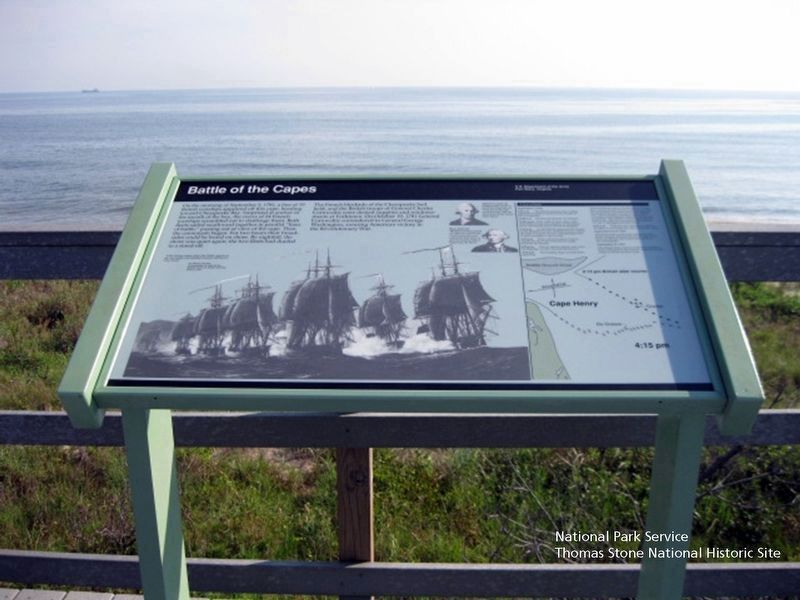
On the morning of September 5, 1781, a line of 19 British warships appeared off this cape, headed for Chesapeake Bay. Surprised at anchor in the mouth of the bay, the crews of 24 French warships scrambled out to challenge them. Both fleets sailed southward together in parallel “lines of battle,” passing out of view of the cape. Then the cannonade began. For two hours, their broadsides could be heard on shore. By nightfall, the shore was quiet again; the two fleets had dueled to a stand-off.
The French blockade of the Chesapeake had held, and the British troops of General Charles Cornwallis were denied supplies and reinforcements at Yorktown. On October 19, 1781, General Cornwallis surrendered to General George Washington, assuring America victory in the Revolutionary War.
“If the enemy remain only a few Weeks superior at sea, our insular and detached situation will become very critical,” Sir Henry Clinton, Commander in chief of British forces in North America, September, June 9, 1781.
[Timeline:]
“A Line of Battle:”
November 5, 1781
9:30 a.m. The British lookout ship Solebay sites the French at anchor at the mouth of the Chesapeake.
11:00 a.m. The French identify the British.
12:00 noon. With 1,900 sailors still unloading troops and supplies on the James River, the French put to sea short-handed.
2:00 p.m. As the British approach the shoals of the Middle Ground, Admiral Graves orders the fleet to turn in unison, maintaining a line of battle parallel to the British.
2:30 p.m. From mid-formation Graves signals for the front of his line to angle towards the French.
4:03 p.m. Graves signals attack, and veers his flagship London toward the French.
4:15 p.m. The leading ships of both fleets open fire.
4:15 to 6:30 p. m. Before the British can bring their cannon to bear, French seaman gunners fire diagonally into their masts and rigging. The French Diademe, fourth in line nearly succeeds in boarding the British Princess but is repelled. The captain of the French Reflechi, fifth in line, dies in a broadside. The British Terrible is damaged beyond repair.
6:30 p.m. With the rear squadrons still too far apart to exchange fire, the cannonade ends.
September 6-9, 1781
The fleets feint southward without further battle. French Admiral de Grasse slips from the British and heads back north to the Chesapeake.
September 13, 1781
The British fleet returns to the Chesapeake to find it blocked by the French. Admiral Graves orders a return to New York.
[Captions:]
Admiral Comte de Grasse sails north in aid of the Americans at Yorktown with cash, ground troops, and the entire fleet of the French West Indies.
Rear Admiral Charles Graves passed up chances to attack the French at anchor and waited for both fleets to get into position before beginning the battle.
Erected by U.S.
this page online
Topics and series. This historical marker is listed in these topic lists: Military • Notable Events • War, US Revolutionary • Waterways & Vessels. In addition, it is included in the Former U.S. Presidents: #01 George Washington, and the The Washington-Rochambeau Route series lists. A significant historical date for this entry is June 9, 1861.
Location. 36° 55.714′ N, 76° 0.542′ W. Marker is in Virginia Beach, Virginia. It is in Fort Story. It can be reached from Antic Avenue west of New Guinea Road, on the right when traveling west. Touch for map. Marker is at or near this postal address: 600 Atlantic Ave, Virginia Beach VA 23459, United States of America. Touch for directions.

Regionally, this marker is in Hampton Roads, specifically in Coastal Virginia, and in the Hampton Roads Metropolitan Area. It is also in the American South, specifically in the Upper South, in the Tidewater, and on the Eastern Seaboard. Globally, it is in the North Atlantic Region, North America, the Western Hemisphere, the Western World, and the Anglosphere. Historically, it finds itself in what
National Park Service, Thomas Stone National Historic Site, August 16, 2018
2. Battle of the Capes Marker
Viewing north towards the marker.
Other nearby markers. At least 8 other markers are within walking distance of this marker: French British Naval Engagement Off the Virginia Capes (within shouting distance of this marker); François Joseph Paul de Grasse (within shouting distance of this marker); Cape Henry Memorial (within shouting distance of this marker); Battle of the Capes 1781 (about 300 feet away, measured in a direct line); Gateway to the Chesapeake Bay (about 300 feet away); Cape Henry Memorial Cross (about 300 feet away); First Landing (approx. 0.2 miles away); Old Cape Henry Lighthouse (approx. 0.2 miles away). Touch for a list and map of all markers in Virginia Beach.
Also see . . .
1. Washington-Rochambeau National Historic Trail, National Park Service. (Submitted on August 19, 2019.)
2. Washington-Rochambeau Revolutionary Route Association, Inc. (Submitted on August 19, 2019.)
Additional keywords. Cape Henry Memorial; Marine Royal; La Marine militaire de la France; Ville de Paris;
Photographed by Richard E. Miller, September 27, 2009
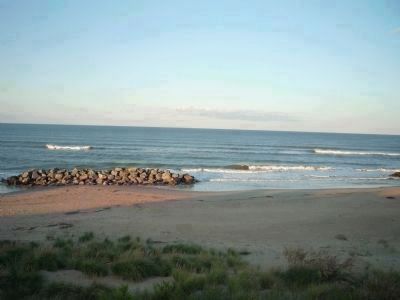
3. The beach at Cape Henry: view northward from the dunes near the marker, toward Cape Charles
Photographed by Richard E. Miller, September 27, 2009
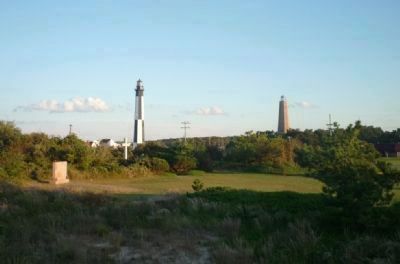
4. View from the beach pathway - toward the Cape Henry Memorial with its monuments
Credits. This page was last revised on June 21, 2025. It was originally submitted on October 9, 2009, by Richard E. Miller of Oxon Hill, Maryland. This page has been viewed 2,809 times since then and 124 times this year. Photos: 1. submitted on October 9, 2009, by Richard E. Miller of Oxon Hill, Maryland. 2. submitted on August 19, 2019. 3, 4. submitted on October 9, 2009, by Richard E. Miller of Oxon Hill, Maryland. • Kevin W. was the editor who published this page.
