Lomé in Golfe, Maritime, Togo — West Africa
The Wharf of Lomé

Photographed by J. Makali Bruton, July 22, 2023
1. The Wharf of Lomé Marker

Die Landungsbrücke von Lomé
Geschichte
Dort, wo sich heute am Bd. de la Marina (Bd. de la République in der französischen und Kaiser Staden in der deutschen Kolonialzeit) das Hotel Palm Beach" befindet, standen ursprünglich (rechtes Foto) das Große Beamtenwohnhaus (links) und das Kaiserliche Zollamt (rechts). Gegenüber liegen am Strand die Überreste der beiden Landungsbrückenvon Lomé.
Eine erste hölzerne Brücke war von Oktober 1899 bis Januar 1900 gebaut worden, die jedoch schon im April desselben Jahres von den Wellen zerstört wurde. Der Bau einer me tallenen Brücke von 304 m Länge durch deutsche Firmen begann am 1.11.1901 und kostete ca. 800.000 Mark Auch Togoer, darunter 350 Zwangsarbeiter, und 15 Schmiede, deDie Brücke wurde von 10 aus Ghana, wurden eingesetzt. Die Brücke wurde am 27.1.1904 (Geburtstag Kaiser Wilhelms II)eingeweiht. Von Februar 1908 bis 27.1.1909 wurde die Brücke um 50 m verlängert. Bei einem Sturm wurden am 17.5.1911 ca. 180 m. aus der Mitte des Stegs herausgerissen. Im Dezember des selben Jahres wurde neben den Resten der alten Brücke mit dem Bau einer neuen begonnen, die am 1.12.1912
this page online
Vor dem Bau der Brücke hatten in Ermangelung eines natur chen Hafens Waren und Personen in Ruderbooten durch die gefährliche Brandung an den Strand gebracht werden mus sen, wobei es auch zu vielen Todesfallen durch Ertrinken ge kommen war. Die Brücke erleichterte das Anlanden und den Abtransport von Menschen und Gütern daher erheblich. Sie wurde in der französischen Kolonialzeit erneuert (1928) und bis zum Bau des Tiefwasserhafens (1965-1968) genutzt. Da nach verfiel sie.
Le wharf de Lomé
Histoire
A rendroit où se trouve aujourd'hui << Hotel Palm Beach >> sur le boulevard de la Marina (ancien Bd de la République à l’époque française et Kaiser Staden au temps colonial allemande), étaient situés (image à droite) la grande residence des fonctionnaires (à gauche) et la douane impériale (à droite). En face de ces bâtiments se trouvent les ruines des deux wharfs de Lomé. Un premier wharf, long de 160 m, a été construit d'octobre 1899 à janvier 1900 en bois par des ingenieurs allemands a été détruit par les vagues en avril de la même année. La construction du wharf métallique de 304 m par
Photographed by J. Makali Bruton, July 22, 2023
2. The Wharf of Lomé Marker
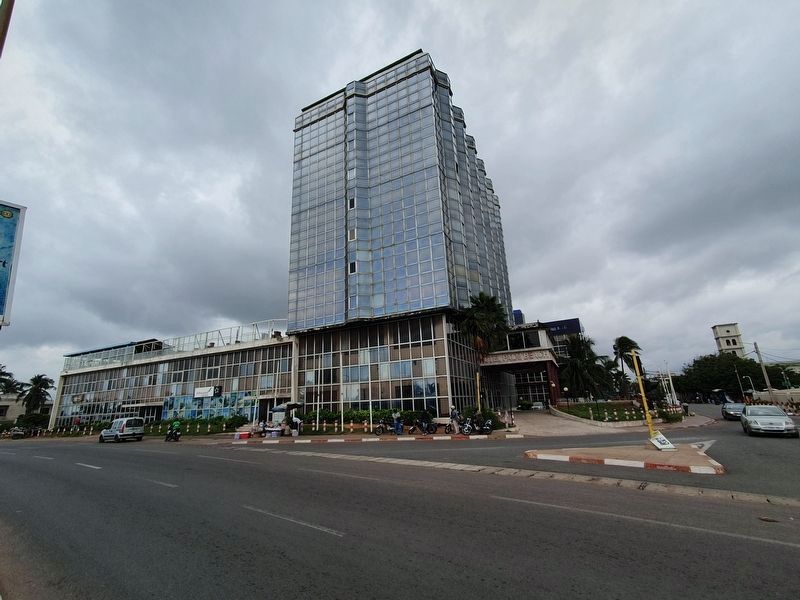
The marker is just south of the Palm Beach Hotel.

Photographed by J. Makali Bruton, July 22, 2023
3. The nearby Wharf of Lomé Remnants
Financé par Alexander Beckmann, Ambassadeur d’Allemagne au Togo 2008-2011
Klili le Lome
Dutinya
Nofe si “Palm Beach Medrzrodze fea” le egbea le Marina moga (blema Boulevard de la Republique le Frasi noli, Kaiser Stader le Dzama noli) dzi la, eyae dzi wofu dowolawodeze fe gaa (le miame) kple dzama gbamekafate fe (le dusime) la le. Xosiawoe kpa nko Lome fe klili eveawo.
Dzama yevuwo tu klili gbato kple ati wodidi meta 160 tso kole me fe 1899 lia va se de dzove me fe 1900 lia. Futsotsoewo gbae le afofie me le fe ma ke me.
Le 17-5-1911 gbe la, ahom sese ade ho klilia fe titina fu anyi ano abe meta 180 ene. Le fe ma fe dzome la, wodze gakpoklili Evelia gome le xoxoa fe axa dzi eye

Photographed by J. Makali Bruton, July 23, 2023
4. The Wharf of Lomé
This photo by Nicolas Robert was at the Palais de Lomé Museum.
The Wharf of Lomé
History
Where the Hotel Palm Beach is located today on the Boulevard de la Marina (former Boulevard de la République in French times and Kaiser Staden in German colonial times), were located (image on the right) the great residence of the officials (left) and the imperial customs (on the right). In front of these buildings are the ruins of the two wharfs of Lomé. A first wharf, 160 m long, was built from October 1899 to January 1900 in wood by German engineers and was destroyed by waves in April of the same year. The construction of the 304 m metal wharf by German firms began on January 11, 1901 and cost about 800,000 Marks. Togolese were involved, including 350 forced laborers, and 15 blacksmiths, including 10 from Ghana. The wharf was inaugurated on January 7, 1904, the birthday of German Emperor Wilhelm II. From February 1908 to January 27, 1909, this bridge was extended by 50 m. On May 17, 1911 about 150 m of the central part of the bridge was torn off by a violent storm. In December of the same year, next to the old bridge, the construction of a new one was started, which was put into service on December 1, 1912. Before the construction of the wharf, goods as well as people were transported from ships to beach in canoes in the middle of the aggressive waves which had caused significant losses and even deaths due to drowning. The wharf greatly facilitated the landing and re-embarkation of merchants and people and improved the colony's participation in international trade. It served until the French

Verlag der Kathol. Mission, Lome (courtesy University of Southern California Digital Library), circa 1930
5. The Wharf of Lomé
“Aerial view of Lome shoreline, including its wharf and various buildings. The front of the postcard contains a handwritten title: "Hamburger Street" and also "Wharf" is written to depict its location also.”
Funded by Alexander Beckmann, Ambassador of Germany to Togo 2008-2011
Erected 2008 by Alexander Beckmann, Ambassador of Germany to Togo 2008-2011.
Topics. This historical marker is listed in these topic lists: Colonial Era • Industry & Commerce • Waterways & Vessels. A significant historical month for this entry is January 1900.
Location. 6° 7.353′ N, 1° 13.362′ E. Marker is in Lomé, Maritime, in Golfe. It is at the intersection of Boulevard de la République and Rue de Kourome, on the right when traveling west on Boulevard de la République. Touch for map. Touch for directions.

Regionally, it is in Africa, Sub-Saharan Africa, and specifically West Africa. Historically, it finds itself in what was once a French colony and also a British Mandate.
Other nearby markers. At least 5 other markers are within walking distance of this marker: The Sacred Heart of Jesus of Lomé Cathedral (approx. half a kilometer away); The Lomé Advanced Training School (approx. 0.9 kilometers away); Former Central Railroad Station of Lomé (approx. 0.9 kilometers away); Independence of Togo (approx. 1.1 kilometers away); Paul Ahyi, Forces Vives, 1989 (approx. 1.4 kilometers away).
Additional commentary.
1. Ewe text transcription
Note that the Ewe text transcription is rough at best due to the lack of a good version of the Ewe keyboard at the moment. Improvements are welcome.
— Submitted August 25, 2023, by J. Makali Bruton of Washington, District of Columbia.
Credits. This page was last revised on April 6, 2025. It was originally submitted on August 25, 2023, by J. Makali Bruton of Washington, District of Columbia. This page has been viewed 570 times since then and 115 times this year. Photos: 1, 2, 3, 4. submitted on August 25, 2023, by J. Makali Bruton of Washington, District of Columbia. 5. submitted on August 25, 2023.
