William O'Brien State Park near Marine on St. Croix in Washington County, Minnesota — The American Midwest (Upper Plains)
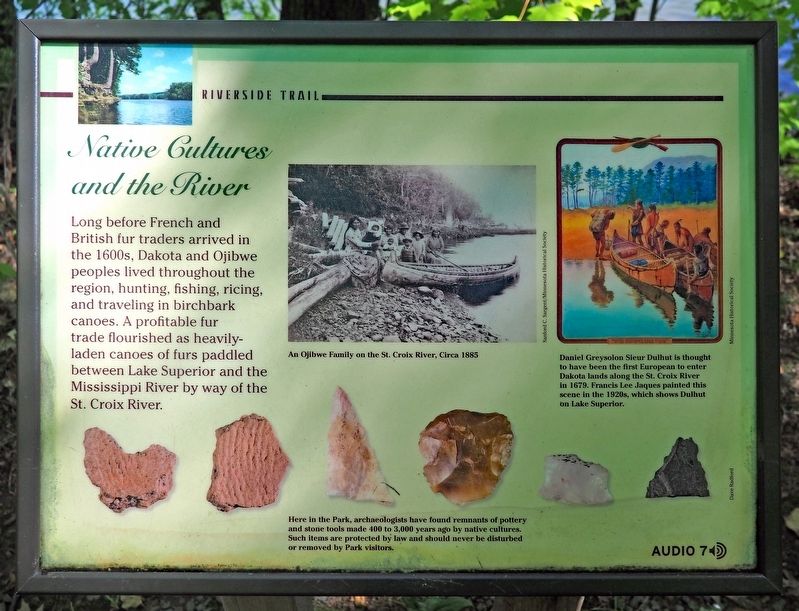
Native Cultures and the River
| — | Riverside Trail | — |
Photographed by McGhiever, September 15, 2021
1. Native Cultures and the River Marker
Long before French and British fur traders arrived in the 1600s, Dakota and Ojibwe peoples lived throughout the region, hunting, fishing, ricing, and traveling in birchbark canoes. A profitable fur trade flourished as heavily-laden canoes of furs paddled between Lake Superior and the Mississippi River by way of the St. Croix River.
An Ojibwe Family on the St. Croix River, Circa 1885
Here in the Park, archaeologists have found remnants of pottery and stone tools made 400 to 3,000 years ago by native cultures. Such items are protected by law and should never be disturbed or removed by Park visitors.
Daniel Greysolon Sieur Dulhut is thought to have been the first European to enter Dakota lands along the St. Croix River in 1679. Francis Lee Jacques painted this scene in the 1920s, which shows Dulhut on Lake Superior.
Erected by Minnesota Department of Natural Resources.
Topics. This historical marker is listed in these topic lists: Anthropology & Archaeology • Indigenous Peoples and Communities • Industry & Commerce • Waterways & Vessels. A significant historical year for this entry is 1679.
Location. 45° 13.542′ N,
this page online

Regionally, this marker is in the Twin Cities Metropolitan Area. It is also in the American Midwest, in the Corn Belt, and in the Great River Road Region. Globally, it is in North America, the Western Hemisphere, the Western World, and the Anglosphere. Historically, it finds itself in what was once Rupert’s Land, the territory of the Mississippian Culture, and the Northwest Territory.
Other nearby markers. At least 8 other markers are within 2 miles of this marker, measured as the crow flies: White Pines (approx. 0.2 miles away); Lake Alice (approx. 0.2 miles away); William O'Brien State Park (approx. 0.4 miles away); Wedge Hill (approx. 0.6 miles away); The Marine Township Hall (approx.
Photographed by McGhiever, September 15, 2021
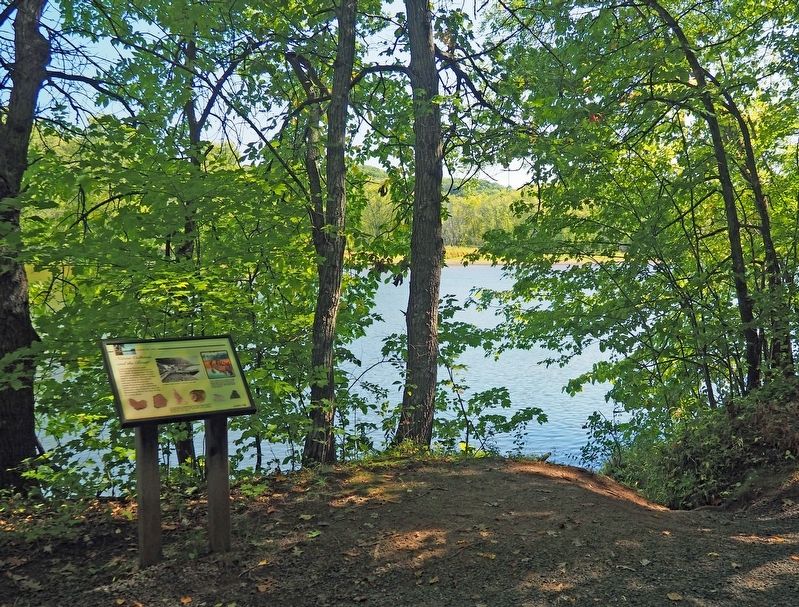
2. Native Cultures and the River Marker on the Riverside Trail along the St. Croix River
Another marker is no longer nearby. Technological Revolution (was approx. 2 miles away but has been replaced with another marker now near it).
Credits. This page was last revised on September 4, 2023. It was originally submitted on September 4, 2023, by McGhiever of Minneapolis, Minnesota. This page has been viewed 199 times since then and 21 times this year. Photos: 1, 2. submitted on September 4, 2023, by McGhiever of Minneapolis, Minnesota. • J. Makali Bruton was the editor who published this page.
