Pontevedra, Galicia, Spain — Southwestern Europe (Iberian Peninsula)
Ruins of Santo Domingo Church
Photographed by Andrew Ruppenstein, September 9, 2023
1. Ruins of Santa Domingo Church Marker

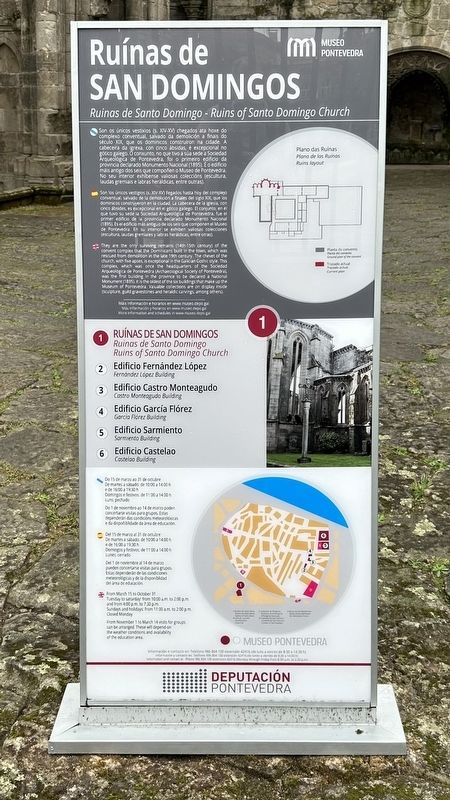
Son os únicos vestixios (s. XIV-XV) chegados ata hoxe do complexo conventual, salvado da demolición a finais do século XIX, que os dominicos construíron na cidade. A cabeceira da igrexa, con cinco ábsidas, é excepcional no gótico galego. O conxunto, no que tivo a súa sede a Sociedad Arqueológica de Pontevedra, foi o primeiro edificio da provincia declarado Monumento Nacional (1895). É o edificio máis antigo dos seis que compoñen o Museo de Pontevedra. No seu interior exhibense valiosas coleccións (escultura, laudas gremiais e labras heráldicas, entre outras).
Ruinas de Santo Domingo
Son los únicos vestigios (s. XIV-XV) llegados hasta hoy del complejo conventual, salvado de la demolición a finales del siglo XIX, que los dominicos construyeron en la ciudad. La cabecera de la iglesia, con cinco ábsides, es excepcional en el gótico gallego. El conjunto, en el que tuvo su sede la Sociedad Arqueológica de Pontevedra, fue el primer edificio de la provincia declarado Monumento Nacional (1895). Es el edificio más antiguo de los seis que componen el Museo de Pontevedra. En su interior se exhiben valiosas colecciones (escultura, laudas gremiales y labras heráldicas, entre otras).
They are the only surviving remains (14th-15th century) of the convent complex that the Dominicans built in the town, which was rescued from demolition in the late 19th century. The chevet of the church, with five apses, is exceptional in the Galician Gothic style. This complex, which was once the headquarters of the Sociedad Arqueológica de Pontevedra (Archaeological Society of Pontevedra), was the first building in the province to be declared a National Monument (1895). It is the oldest of the six buildings that make up the Museum of Pontevedra.
this page online
Máis información e horarios en www.museo.depo.gal
Más información y horarios en www.museo.depo.gal
More information and schedules in www.museo.depo.gal
Erected by Disputacion Pontevedra, Museo Pontevedra.
Topics. This historical marker is listed in these topic lists: Anthropology & Archaeology • Architecture • Religion & Religious Structures.
Location. 42° 25.88′ N, 8° 38.825′ W. Marker is in Pontevedra, Galicia. It is on Rúa Marqués de Riestra. Touch for map. Marker is in this post office area: Pontevedra, Galicia 36001, Spain. Touch for directions.

Regionally, it is in the North Atlantic Region, on the Atlantic Arc, in Europe, in the European Union, in Atlantic Europe, on the Iberian Peninsula, in the Schengen Area, in a coastal Mediterranean country, and in the Western World. Historically, it finds itself in what was once the Roman Empire.
Other nearby markers. At least 8 other markers are within walking distance of this marker: Arturo Souto

Photographed by Andrew Ruppenstein
2. Ruins of Santa Domingo Church and Marker
The marker is visible here just behind the fence, to the right of the open gate.
Also see . . . Ruins of Santo Domingo (Wikipedia).
Excerpt: The ruins of San Domingos (Spanish and Galician: Ruínas de San Domingos) was a convent located in Pontevedra, Galicia (Spain). It was declared Bien de Interés Cultural in 1895.(Submitted on September 14, 2023.)
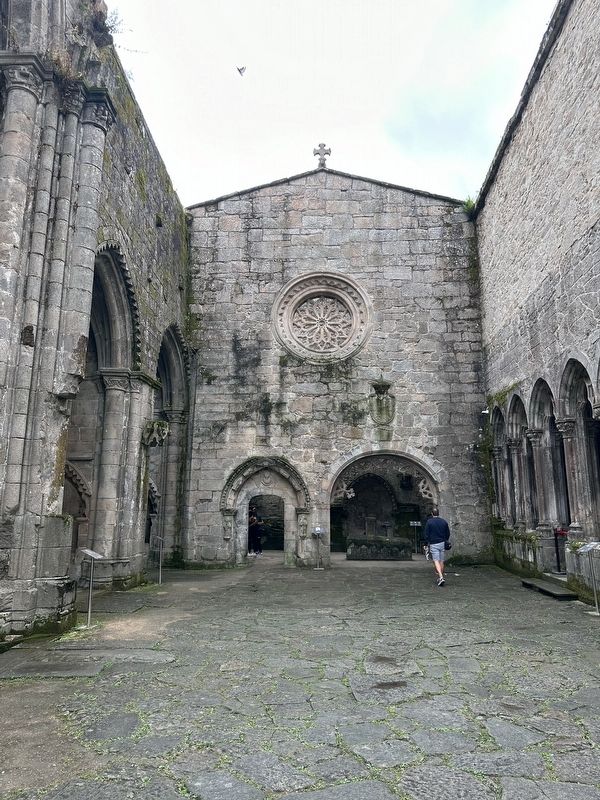
This is the oldest of all Pontevedra Museum’s buildings. The only sections of the original buildings that have been conserved are the main apse, formed by five apses, exceptional in Galician gothic architecture, and part of the south wall of the church and the entrance to the chapter of the Santo Domingo convent, founded in around 1282, although the workon the conserved temple did not begin until 1383, continuing through the 15th century.Photographed by Andrew Ruppenstein, September 9, 20233. Ruins of Santo Domingo Church Marker - interior
Photographed by Andrew Ruppenstein, September 9, 2023
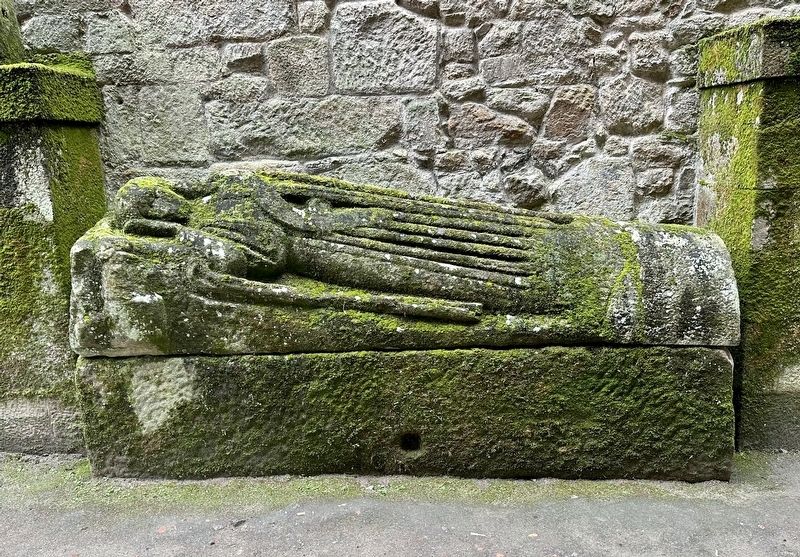
4. Ruins of Santo Domingo Church - sarcophagus in church interior
Photographed by Heliotypia de Kallmayer y Gautier, Madrid, circa 1910
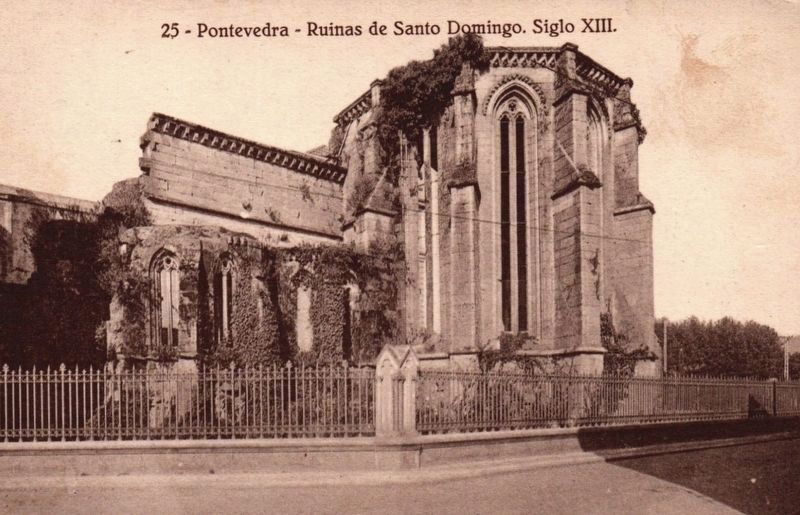
5. Ruínas de Santo Domingo, Siglo XIII
Credits. This page was last revised on December 20, 2023. It was originally submitted on September 10, 2023, by Andrew Ruppenstein of Lamorinda, California. This page has been viewed 170 times since then and 25 times this year. Photos: 1, 2. submitted on September 10, 2023, by Andrew Ruppenstein of Lamorinda, California. 3, 4. submitted on September 11, 2023, by Andrew Ruppenstein of Lamorinda, California. 5. submitted on September 14, 2023, by Andrew Ruppenstein of Lamorinda, California.
