Downtown Seattle in King County, Washington — The American West (Northwest)
Where did this bridge used to go?
⎯⎯⎯
Where does this bridge go now?
Bell Street Pier
Photographed by Adam Margolis, October 8, 2023
1. Where did this bridge used to go? / Where does this bridge go now? Marker
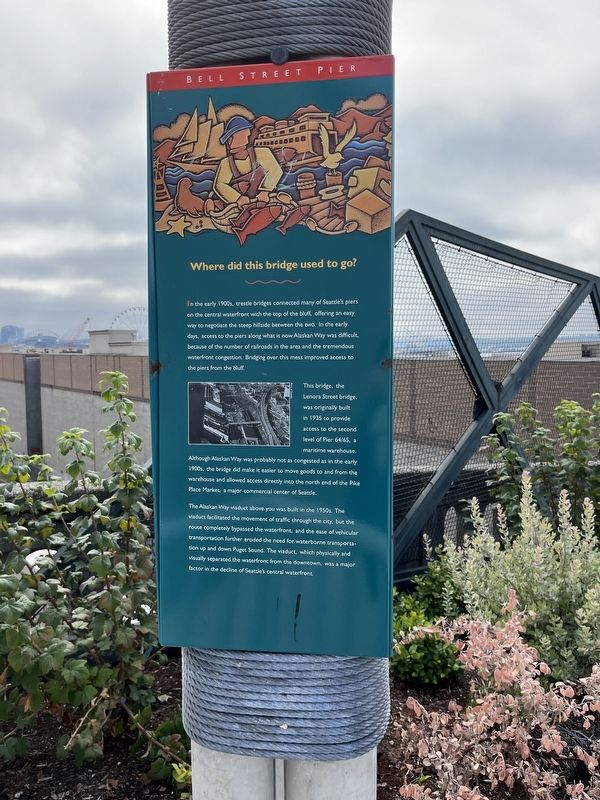
Where did this bridge used to go?
In the early 1900s, trestle bridges connected many of Seattle's piers on the central waterfront with the top of the bluff, offering an easy way to negotiate the steep hillside between the two. In the early days, access to the piers along what is now Alaskan Way was difficult, because of the number of railroads in the area and the tremendous waterfront congestion. Bridging over this mess improved access to the piers from the bluff.
This bridge, the Lenora Street bridge, was originally built in 1935 to provide access to the second level of Pier 64/65, a maritime warehouse. Although Alaskan Way was probably not as congested as in the early 1900s, the bridge did make it easier to move goods to and from the warehouse and allowed access directly into the north end of the Pike Place Market, a major commercial center of Seattle.
The Alaskan Way viaduct above you was built in the 1950s. The viaduct facilitated the movement of traffic through the city, but the route completely bypassed the waterfront, and the ease of vehicular transportation further eroded the need
this page online
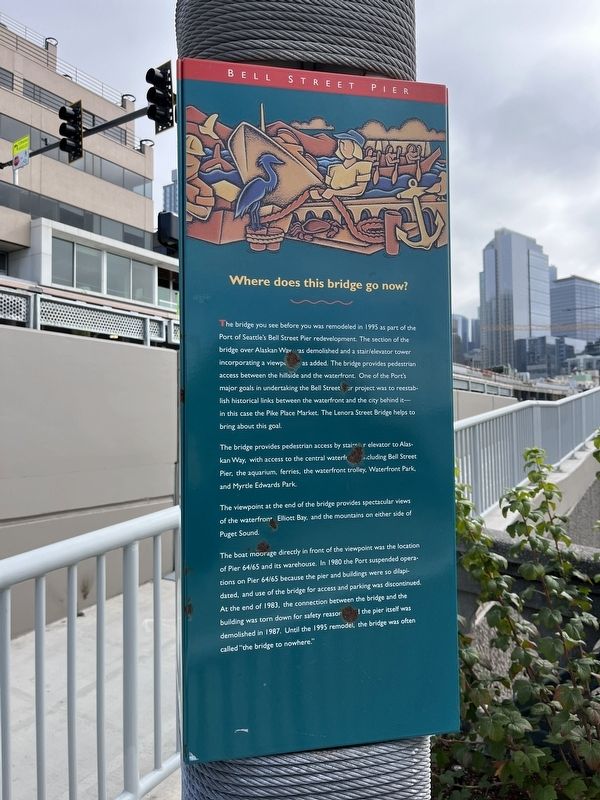
Where does this bridge go now?
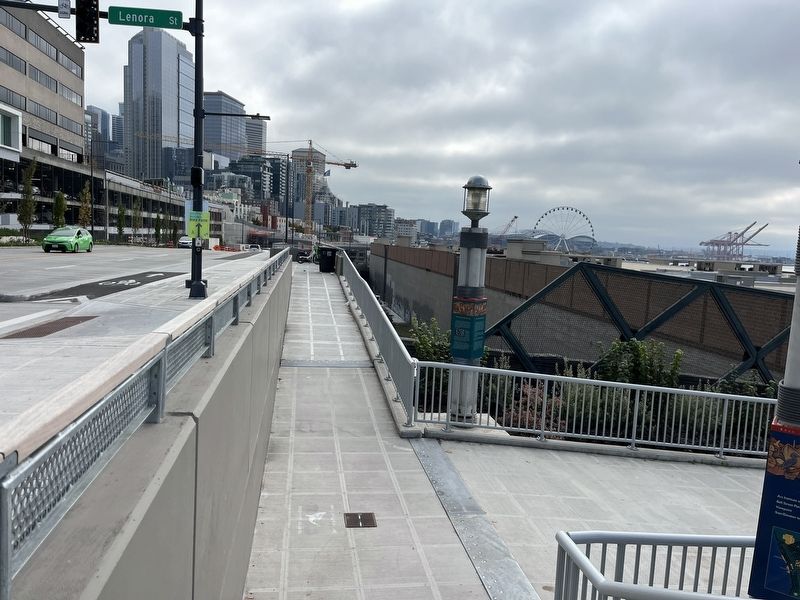
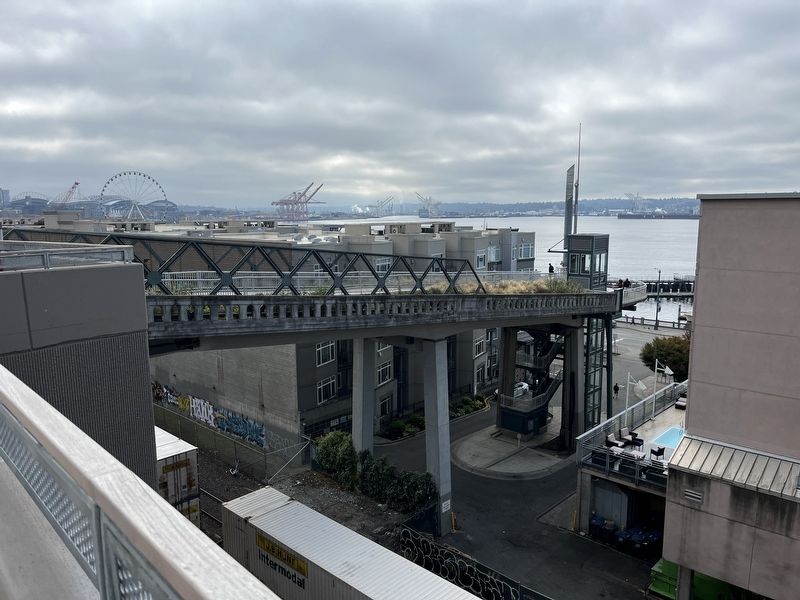
The bridge you see before you was remodeled in 1995 as part of the Port of Seattle's Bell Street Pier redevelopment. The section of the bridge over Alaskan Way as demolished and a stair/elevator tower incorporating a viewpoint was added. The bridge provides pedestrian access between the hillside and the waterfront. One of the Port's major goals in undertaking the Bell Street Pier project was to reestablish historical links between the waterfront and the city behind it-in this case the Pike Place Market. The Lenora Street Bridge helps to bring about this goal.
The bridge provides pedestrian access by stair or elevator to Alaskan Way, with access to the central waterfront including Bell Street Pier, the aquarium, ferries, the waterfront trolley, Waterfront Park, and Myrtle Edwards Park.
The viewpoint at the end of the bridge provides spectacular views of the waterfront, Elliott
Photographed by Adam Margolis, October 8, 2023
2. Where did this bridge used to go? / Where does this bridge go now? Marker
The boat moorage directly in front of the viewpoint was the location of Pier 64/65 and its warehouse. In 1980 the Port suspended operations on Pier 64/65 because the pier and buildings were so dilapidated, and use of the bridge for access and parking was discontinued. At the end of 1983, the connection between the bridge and the building was torn down for safety reasons and the pier itself was demolished in 1987. Until the 1995 remodel, the bridge was often called "the bridge to nowhere."
Topics. This historical marker is listed in these topic lists: Bridges & Viaducts • Industry & Commerce • Roads & Vehicles • Waterways & Vessels. A significant historical year for this entry is 1935.
Location. 47° 36.636′ N, 122° 20.73′ W. Marker is in Seattle, Washington, in King County. It is in Downtown Seattle. It is on Alaskan Way. Touch for map. Marker is at or near this postal address: 2112 Alaskan Wa, Seattle WA 98121, United States of America. Touch for directions.

Regionally, this marker is in the Puget Sound Region. It is also on the American Pacific Coast, in
Photographed by Adam Margolis, October 8, 2023
3. Where did this bridge used to go? / Where does this bridge go now? Marker
Other nearby markers. At least 8 other markers are within walking distance of this marker: “Great White Fleet” (about 400 feet away, measured in a direct line); Welcome to The Public Market (about 500 feet away); Guiry/Schillestad Buildings (about 600 feet away); Bell Street Terminal, Pier 66 (about 800 feet away); Seattle-Galway Stone (about 800 feet away); Bell Street Bridge (approx. 0.2 miles away); Crystal Pool (approx. 0.2 miles away); Seattle Union Record (1918-1928) (approx. 0.2 miles away). Touch for a list and map of all markers in Seattle.
Photographed by Adam Margolis, October 8, 2023
4. Where did this bridge used to go? / Where does this bridge go now? Marker
Credits. This page was last revised on October 31, 2023. It was originally submitted on October 25, 2023, by Adam Margolis of Mission Viejo, California. This page has been viewed 456 times since then and 75 times this year. Photos: 1, 2, 3, 4. submitted on October 25, 2023, by Adam Margolis of Mission Viejo, California. • Andrew Ruppenstein was the editor who published this page.
