Eijsden in Eijsden-Margraten, Limburg, Netherlands — Northwestern Europe
Vlucht naar de vrijheid
⎯⎯⎯
Flight to Freedom
Photographed by Andrew Ruppenstein, October 28, 2023
1. Vlucht naar de vrijheid / Flight to Freedom Marker

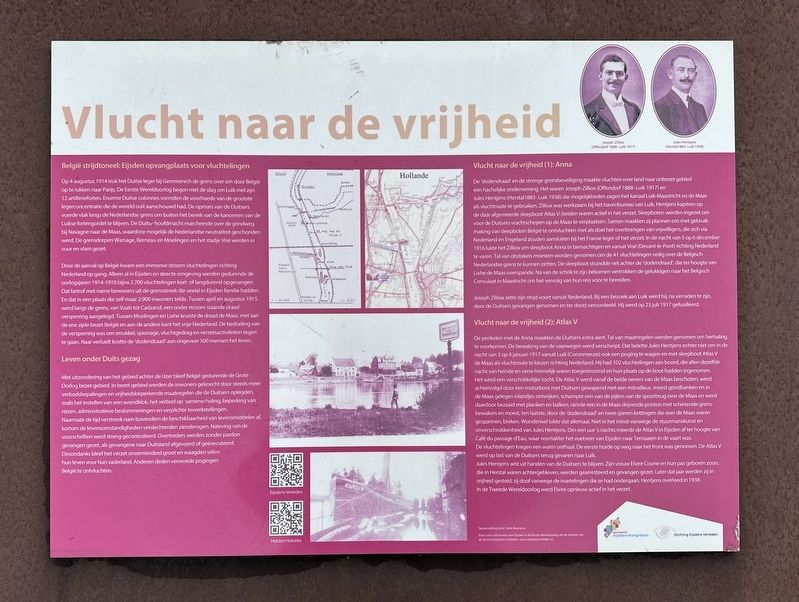
Op 4 augustus 1914 trok het Duitse leger bij Gemmenich de grens over om door België op te rukken naar Parijs. De Eerste Wereldoorlog begon met de slag om Luik met zijn 12 artillerieforten. Énorme Duitse colonnes vormden de voorhoede van de grootste legerconcentratie die de wereld ooit aanschouwd had. De opmars van de Duitsers voerde vlak langs de Nederlandse grens om buiten het bereik van de kanonnen van de Luikse fortengordel te blijven. De Duitse hoofdmacht marcheerde over de grindweg bij Navagne naar de Maas, waardoor mogelijk de Nederlandse neutraliteit geschonden werd. De grensdorpen Warsage, Berneau en Moelingen en het stadje Visé werden in vuur en vlam gezet.
Door de aanval op België kwam een immense stroom vluchtelingen richting Nederland op gang. Alleen al in Eijsden en directe omgeving werden gedurende de oorlogsjaren 1914-1918 bijna 2.700 vluchtelingen kort- of langdurend opgevangen. Dat betrof met name bewoners uit de grensstreek die veelal in Eijsden familie hadden. En dat in een plaats die zelf maar 2.900 inwoners telde. Tussen april
this page online
Leven onder Duits gezag
Met uitzondering van het gebied achter de Uzer bleef België gedurende de Grote Oorlog bezet gebied. In bezet gebied werden de inwoners geknecht door steeds meer verbodsbepalingen en vrijheidsbeperkende maatregelen die de Duitsers oplegden, zoals het instellen van een avondklok, het verbod op samenscholing, beperking van reizen, administratieve beslommeringen en verplichte tewerkstellingen. Naarmate de tijd verstreek nam bovendien de beschikbaarheid van levensmiddelen af, kortom de levensomstandigheden verslechterden zienderogen. Naleving van de voorschriften werd streng gecontroleerd. Overtreders werden zonder pardon gevangen gezet, als gevangene naar Duitsland afgevoerd of geëxecuteerd.
Photographed by Andrew Ruppenstein, October 28, 2023
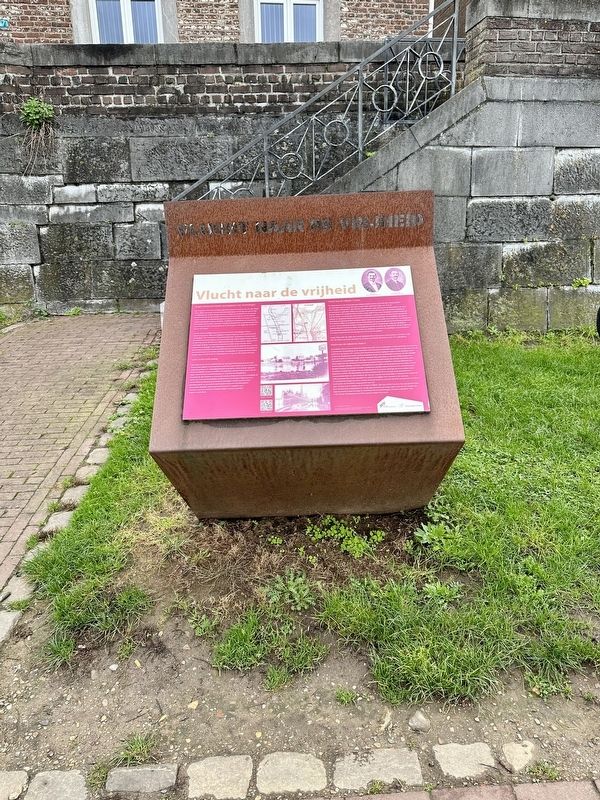
2. Vlucht naar de vrijheid / Flight to Freedom Marker
Vlucht naar de vrijheid (1): Anna
De 'dodendraad' en de strenge grensbeveiliging maakte vluchten over land naar onbezet gebied een hachelijke onderneming. Het waren Joseph Zilliox (Offendorf 1888-Luik 1917) en Jules Hentjens (Herstal 1883-Luik 1938) die mogelijkheden zagen het kanaal Luik-Maastricht en de Maas als vluchtroute te gebruiken. Zilliox was werkzaam bij het havenbureau van Luik, Hentjens kapitein op de daar afgemeerde sleepboot Atlas V; beiden waren actief in het verzet. Sleepboten werden ingezet om voor de Duitsers vrachtschepen op de Maas te verplaatsen. Samen maakten zij plannen om met gebruikmaking van sleepboten België te ontvluchten met als doel het overbrengen van vrijwilligers, die zich via Nederland en Engeland zouden aansluiten bij het Franse leger of het verzet. In de nacht van 5 op 6 december 1916 lukte het Zilliox om sleepboot Anna te bemachtigen en vanuit Visé (Devant-le-Pont) richting Nederland te varen. Tal van obstakels moesten worden genomen om de
Photographed by Andrew Ruppenstein, October 28, 2023
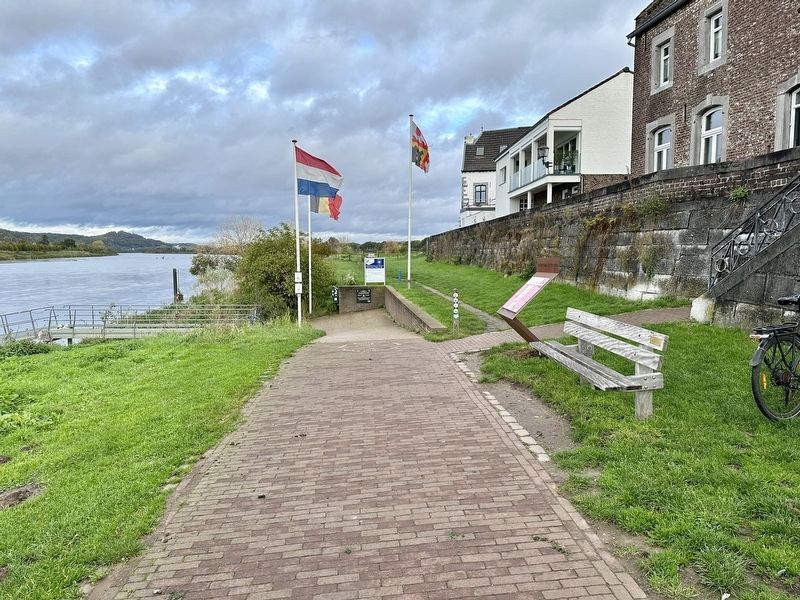
3. Marker site - looking north
Joseph Zilliox zette zijn strijd voort vanuit Nederland. Bij een bezoek aan Luik werd hij, na verraden te zijn, door de Duitsers gevangen genomen en ter dood veroordeeld. Hij werd op 23 juli 1917 gefusilleerd.
Vlucht naar de vrijheid (2): Atlas V
De perikelen met de Anna maakten de Duitsers extra alert. Tal van maatregelen werden genomen om herhaling te voorkomen. De bewaking van de vaarwegen werd verscherpt. Dat belette Jules Hentjens echter niet om in de nacht van 3 op 4 januari 1917 vanuit Luik (Coronmeuse) ook een poging te wagen en met sleepboot Atlas V de Maas als vluchtroute te kiezen richting Nederland. Hij had 102 vluchtelingen aan boord, die allen dezelfde nacht van heinde en verre heimelijk waren toegestroomd en hun plaats op de boot hadden ingenomen. Het werd een verschrikkelijke tocht. De Atlas V
Photographed by Andrew Ruppenstein, October 28, 2023
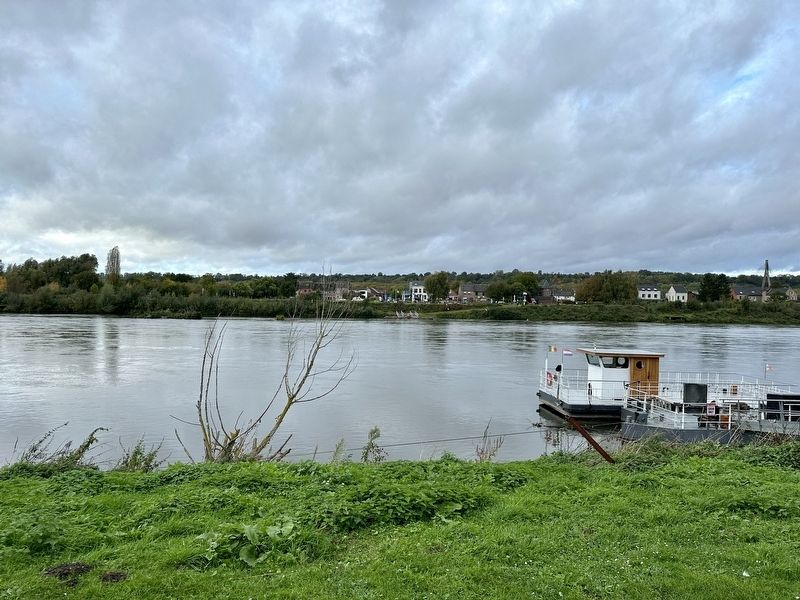
4. View from marker site
Looking due east across the Meuse/Maas River into Belgium.
Belgium battleground: Eijsden shelter for refugees
On August 4, 1914, the German army crossed the border at Gemmenich to advance through Belgium to Paris. The First World War started with the Battle of Liège with its 12 artillery forts. Huge German columns formed the vanguard of the largest army concentration the world had ever seen. The German advance led close to the Dutch border to stay out of the reach of the guns of the Liège fortress belt. The main German force marched over the gravel road near Navagne to the Meuse, possibly violating Dutch neutrality. The border villages of Warsage, Berneau and Moelingen and the town of Visé were set ablaze.
The attack on Belgium started an immense flow of refugees towards the Netherlands. In Eijsden and its immediate surroundings alone, almost 2,700 refugees were accommodated for short or long periods during the war years 1914-1918. This mainly concerned residents from the border region who often had family in Eijsden. And that in a place that itself had only 2,900 inhabitants. Between April and August 1915, an electric wire barrier was constructed along the border, from Vaals to Cadzand. Between Moelingen and Lixhe the wire crossed the Maas, with occupied Belgium on one side and the free Netherlands on the other. The intention of the barrier was to prevent smuggling, espionage, the flight of refugees, and resistance activities. The 'death wire' reportedly killed around 500 people.
Living under German authority
With the exception of the area behind the Uzer, Belgium remained occupied territory during the Great War. In occupied territory, the inhabitants were enslaved by more and more prohibitions and freedom-restricting measures imposed by the Germans, such as the imposition of a curfew, the ban on gatherings, restrictions on travel, administrative hassles and compulsory employment. As time passed, the availability of food decreased - and in short, living conditions deteriorated noticeably. Compliance with regulations was strictly controlled. Violators were unceremoniously imprisoned, taken to Germany as prisoners or executed. Nevertheless, the resistance remained strong and many risked their lives for their homeland. Others made frantic attempts to flee Belgium.
Flight to freedom (1): the Anna
The 'death wire' and strict border security made flights overland to unoccupied territory a perilous undertaking. It was Joseph Zilliox (Offendorf 1888-Liège 1917) and Jules Hentjens (Herstal 1883-Liège 1938) who saw opportunities to use the Liège-Maastricht canal and the Maas as an escape route. Zilliox worked at the port office of Liège, Hentjens was captain of the tugboat Atlas V moored there; both were active in the resistance. Tugboats were used to move cargo ships on the Maas for the Germans. Together they made plans to flee Belgium using tugboats with the aim of transferring volunteers who would join the French army or the resistance via the Netherlands and England. During the night of December 5 to 6, 1916, Zilliox managed to obtain the tugboat Anna and sail from Visé (Devant-le-Pont) towards the Netherlands. Numerous obstacles had to be overcome to get the 41 refugees safely across the Belgian-Dutch border. The tugboat beached just behind the 'death wire', which spanned the Maas near Lixhe. After recovering from the shock, the lucky ones left for the Belgian Consulate in Maastricht to prepare the remainder of their journey.
Joseph Zilliox continued his fight from the Netherlands. During a visit to Liège, after being betrayed, he was captured by the Germans and sentenced to death. He was shot on July 23, 1917.
Flight to freedom (2): the Atlas V
The troubles with the Anna made the Germans extra alert. Numerous measures were taken to prevent recurrence. Monitoring of the waterways was tightened. However, this did not prevent Jules Hentjens from making an attempt on the night of January 3 to 4, 1917 from Liège (Coronmeuse) and choosing the Maas as an escape route to the Netherlands with the tugboat Atlas V. He had 102 refugees on board, all of whom had secretly arrived from far and wide the same night and taken their place on the boat. It was a terrible journey. The Atlas V was shot at from both banks of the Maas, was chased by a motorboat with Germans armed with a machine gun, had to avoid gravel banks and islands in the Maas, grazed one of the pillars of the railway bridge over the Maas and as a result was littered with planks and beams, rammed a pontoon with shooting border guards floating in the Meuse, and finally had to break through the 'death wire' and two iron chains stretched across the Meuse. Miraculously, it all worked. Not least because of the helmsmanship and fearlessness of Jules Hentjens. At one o'clock at night the Atlas V moored in Eijsden about even with the Café du passage d'Eau (i.e., the marker site, roughly), where the foot ferry from Eijsden to Ternraai normally operated. The refugees received a warm welcome. The first hurdle on the way to the front had been overcome. The Atlas V was sailed back to Liège by order of the Germans. Jules Hentjens managed to stay out of the hands of the Germans. His wife Elvire Coune and their newly born son, who had remained behind in Herstal, were arrested and imprisoned. Later that year they were released; she was deaf because of the torture she had undergone. Hentjens died in 1938. During the Second World War, Elvire became active in the resistance again.
Erected 2018 by Gemeente Eijsden-Margraten, Stichting Eijsdens Verleden.
Topics. This historical marker is listed in these topic lists: Immigration • War, World I • Waterways & Vessels. A significant historical date for this entry is December 6, 1916.
Location. 50° 46.613′ N, 5° 41.974′ E. Marker is in Eijsden, Limburg, in Eijsden-Margraten. It can be reached from Bat. Touch for map. Marker is at or near this postal address: Bat 1, Eijsden, Limburg 6245 BN, Netherlands. Touch for directions.

Regionally, it is in Europe, the European Union, Atlantic Europe, the Benelux Low Countries, the Schengen Area, Western Europe, and the Western World. Historically, it finds itself in what was once the Roman Empire and specifically also the Holy Roman Empire.
Other nearby markers. At least 8 other markers are within walking distance of this marker: Sint Christinakerk / Saint Christina Church (about 150 meters away, measured in a direct line); Eijsden - Gronsveld Holocaust Memorial - De Breuk (“The Break”) (about 210 meters away); Verzetsmonument Eijsden / Resistance Memorial Eijsden (about 210 meters away); Petrus Wolfs (about 210 meters away); Von Dorpsstraat tot Diepstraat / From Dorpsstraat to Diepstraat (approx. 0.3 kilometers away); Aan de Laak / At the Border Water (approx. 0.3 kilometers away); Het Veldje / The Field (approx. 0.6 kilometers away); Opvang Belgische vluchtelingen / Asylum for Belgian Refugees (approx. 0.9 kilometers away). Touch for a list and map of all markers in Eijsden.
More about this marker. The marker is located by the pedestrian ferry, just off of Bat.
Credits. This page was last revised on December 31, 2023. It was originally submitted on November 5, 2023, by Andrew Ruppenstein of Lamorinda, California. This page has been viewed 198 times since then and 36 times this year. Photos: 1, 2. submitted on November 5, 2023, by Andrew Ruppenstein of Lamorinda, California. 3, 4. submitted on November 6, 2023, by Andrew Ruppenstein of Lamorinda, California.
